
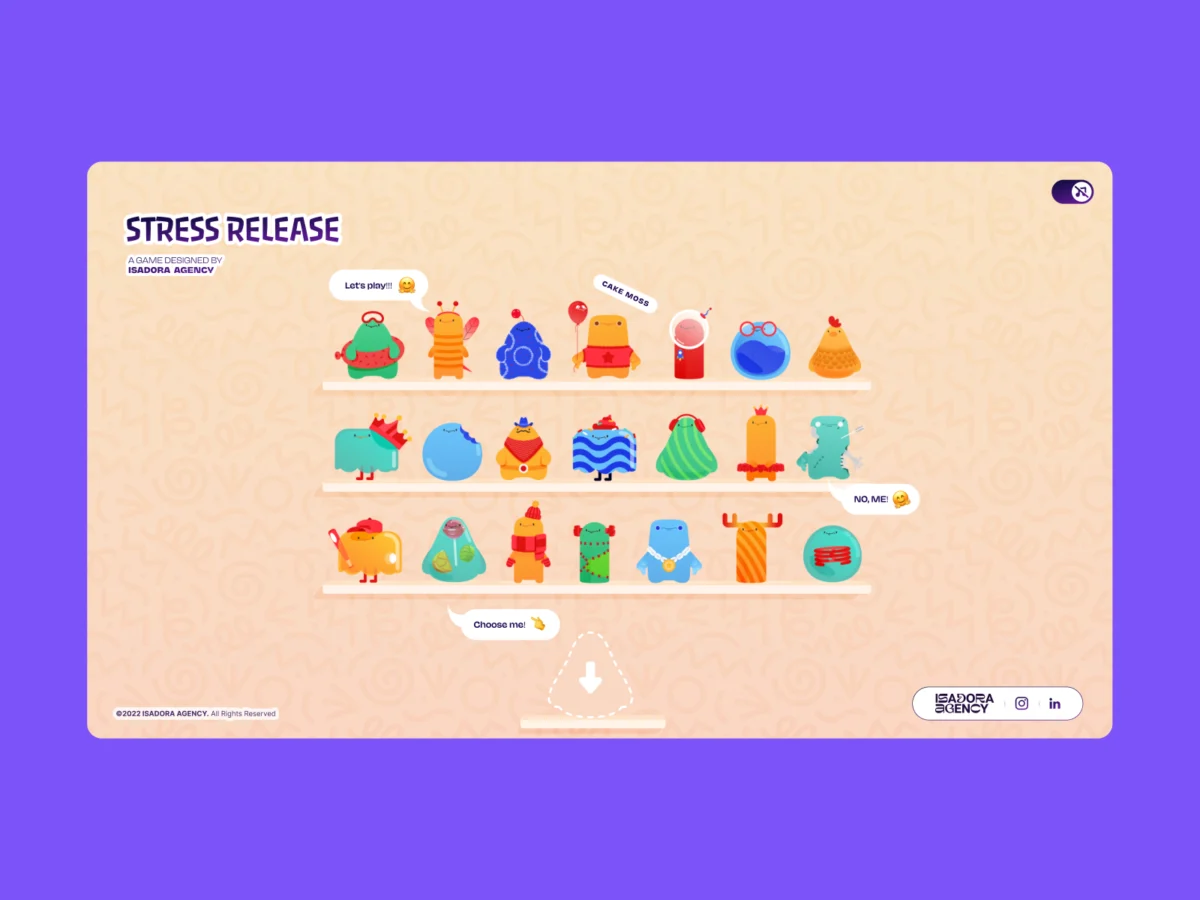
The digital landscape has long equated interactivity with physical simulation, often relying on complex physics engines to mimic reality; however, a recent architectural shift by the development team at Isadora Agency suggests that for high-fidelity art direction, programmatic control over vector animations may offer a superior alternative to traditional physics-based frameworks. When tasked with creating "Stress Release," a digital stress-relief experience, the agency’s engineers moved away from industry-standard solutions like Matter.js and Cannon.js in favor of an architecture built on Lottie animations, DOM events, and distance-based mathematics. This approach was designed to preserve the "intentional motion" crafted by animators, ensuring that user interactions would trigger specific, frame-accurate sequences rather than unpredictable, algorithmically generated movements.
The Shift from Plausible to Intentional Motion
In contemporary web development, the instinct when building bouncy or tactile interfaces is to implement a physics engine. These engines calculate the trajectories of objects based on mass, gravity, and friction, resulting in what developers call "plausible motion." While effective for games where emergent behavior is desired, plausible motion often conflicts with the precise vision of UI designers and animators. For the "Stress Release" project, the creative goal was to allow users to interact with a series of digital squeeze toys—characters designed to squash, stretch, and distort in highly specific ways.
Early prototyping revealed that physics engines, while realistic, could not replicate the "squishy" personality the design team had envisioned. "Physics engines produce motion that looks real, but our animators had produced motion that was intentional," noted Alexey Kopytin, a lead developer on the project. By scrapping the physics engine, the team regained absolute deterministic control, allowing every click to trigger a bespoke 181-frame build-up and release sequence that remained consistent across all browsers and devices.
Technical Chronology: From Concept to Optimization
The development of the Stress Release project followed a rigorous four-phase timeline that prioritized artistic integrity over automated simulation.
- Phase I: Conceptualization and Physics Prototyping (Weeks 1-4): The team initially explored Matter.js to handle collision detection and WebGL for rendering. While the performance was high, the "feel" of the interactions lacked the artisanal quality of the hand-keyed animations.
- Phase II: The Architectural Pivot (Weeks 5-8): The team transitioned to a Lottie-based architecture. Lottie, an open-source mobile library developed by Airbnb, renders Adobe After Effects animations in real-time. This allowed the engineers to treat the animation timeline as a programmable state machine.
- Phase III: Implementing Radial Input Mapping (Weeks 9-12): To create tactile feedback without a physics engine, the team implemented a "hit-zone" system based on the Pythagorean theorem. This allowed for concentric scoring rings around the character’s center, mapping the distance of a click to the intensity of the visual reaction.
- Phase IV: Performance Tuning and Mobile Optimization (Weeks 13-16): With 21 different character animations, the team had to address the overhead of loading multiple Lottie JSON files. They implemented a tiered quality system, reducing interpolation calculations on the "shelf" view to maintain 60 frames per second on mobile devices.
The Mechanics of Tactile Feedback: Math Over Simulation
The core of the "Stress Release" architecture lies in its use of DOM-managed SVG elements and coordinate-space mathematics. Unlike a physics engine that constantly monitors collisions in a global world-space, this system only performs calculations when an interaction occurs.

When a user clicks on a character, the application converts the page-level coordinates into the character’s local coordinate space. By determining the center point of the character and the exact coordinates of the click, the system uses Math.hypot(a, b) to find the straight-line distance. This single value then serves as the primary driver for three distinct systems:
- Scoring Logic: Closer clicks to the center yield higher points (e.g., a "bullseye" under 10 pixels provides 100 points).
- Visual Feedback: The coordinates are used to reposition a secondary "explosion" Lottie animation, ensuring the visual impact occurs exactly where the user touched the screen.
- State Triggering: The distance determines which animation segment to play, transitioning the character from an "idle" state to a "squeeze" state.
This method provides a "concentric zone system" that mimics the accuracy of a dartboard. Because the hitbox is a clean circle defined by math rather than a complex polygon, the hit detection is nearly instantaneous and requires negligible CPU resources compared to the continuous raycasting required by 3D or physics-based engines.
Data Analysis: The Performance Benefits of Lottie
Industry data suggests that Lottie animations offer significant advantages in file size and performance for web-based games and interactive UI. According to benchmarks provided by the LottieFiles community, Lottie JSON files are often 600% smaller than traditional GIFs and significantly more memory-efficient than video files.

In the "Stress Release" project, the team managed 21 simultaneous animations on the character selection shelf. To maintain performance, they utilized the lottie.setQuality() method. By setting the quality to 0.5 (50%) on the selection screen, they reduced the number of interpolation calculations per frame. However, once a single character was selected for the "play" screen, the quality was restored to 1.0, ensuring the focus remained on high-fidelity visual art.
| Metric | Physics Engine (Estimated) | Lottie + DOM Math |
|---|---|---|
| Initial Payload | 150KB – 500KB (Library) | 40KB (Lottie Library) |
| CPU Usage (Idle) | High (Physics loop) | Zero |
| Visual Fidelity | Variable (Procedural) | Absolute (Designer-led) |
| Responsive Scaling | Complex (Vector remapping) | Native (CSS/SVG) |
Responsive Design and CSS Integration
One of the primary challenges of web-based gaming is ensuring that hitboxes and animations scale correctly across various screen sizes. By using the DOM as the rendering layer, the Isadora Agency team was able to leverage native CSS behaviors.
They implemented a system of CSS custom properties (variables) that were recalculated on every window resize event. This ensured that the Lottie SVG containers maintained their aspect ratio and relative positioning without the need to update a physics world-space. The appHeight function recalculated --doc-height and --doc-width dynamically, allowing the layout to remain fluid and the "tactile" feel to persist regardless of whether the user was on a 27-inch desktop monitor or a 6-inch smartphone.

Industry Implications and Expert Perspectives
The decision to bypass physics engines in favor of programmatic animation control represents a broader trend in UX engineering known as "Deterministic Interaction Design." This philosophy argues that user satisfaction in digital products is derived more from the predictability and "juice" of an interaction than from its adherence to real-world physics.
"By mapping Lottie’s native timeline capabilities to the DOM, you can deliver incredibly rich, tactile user experiences while maintaining absolute control over the art direction," Kopytin explained. This approach empowers designers to act as directors, ensuring that every frame of an animation serves the brand’s identity, while developers focus on the logic that triggers those frames.
Furthermore, this architecture reduces the "QA tax" associated with physics engines. In a physics-simulated environment, unexpected "glitches"—such as objects clipping through walls or vibrating uncontrollably—are common. In a programmatic Lottie-based system, the animation is a fixed asset, meaning if it works once, it will work every time, provided the trigger logic is sound.

Conclusion: Technology Serving the Art
The success of the "Stress Release" game highlights a critical lesson for modern front-end developers: the architecture must serve the art direction, not the other way around. While physics engines remain a powerful tool for certain genres of web content, they are not a universal requirement for tactile or interactive experiences.
By utilizing the Pythagorean theorem for hit detection and Lottie for state-controlled animation, Isadora Agency demonstrated that simple math and well-structured vector assets can create a deeply satisfying, responsive, and "squishy" user experience. As web interfaces continue to evolve toward more immersive and gamified models, the ability to maintain deterministic control over "intentional motion" will likely become a hallmark of high-end digital craftsmanship. This methodology ensures that the final product is not just a simulation of reality, but a carefully curated piece of interactive art.

