
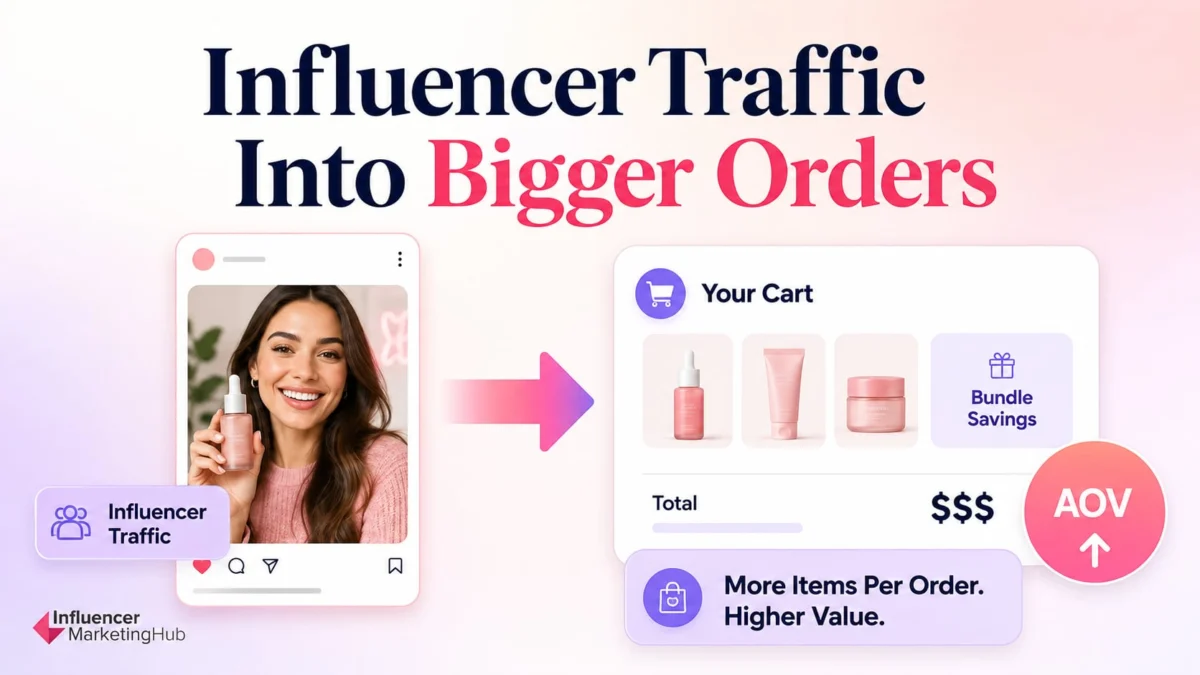
Influencer campaigns are frequently assessed by readily available metrics such as reach, engagement rates, click-throughs, and direct conversions. For e-commerce brands, however, these traditional indicators often present only a partial view of a campaign’s true commercial efficacy. A creator might successfully drive thousands of qualified visits and even a substantial number of purchases, yet the overall campaign could still fall short of its commercial potential if the majority of customers primarily acquire a single, low-priced product. This fundamental disconnect underscores the critical importance of evaluating Average Order Value (AOV) when measuring the revenue generated by influencer marketing efforts. The true opportunity within influencer marketing for e-commerce extends far beyond merely generating traffic; it lies in meticulously designing the post-click experience to ensure that the inherent trust cultivated by an influencer translates directly into higher-value transactions.
Achieving this requires a strategic shift, moving beyond mere creator selection to a holistic examination of the entire customer journey. This encompasses everything from the influencer’s initial content and the subsequent landing page experience, to intelligent product recommendations, strategic bundling, performance-based commission structures, and sophisticated retargeting initiatives. Industry projections highlight the burgeoning scale of influencer marketing, with global spending estimated to reach tens of billions of dollars annually, emphasizing the urgent need for more refined measurement and optimization strategies. As e-commerce continues its rapid expansion, particularly post-pandemic, the battle for customer acquisition and retention intensifies, making the maximization of each transaction, particularly AOV, a pivotal factor in sustained profitability.
The Unique Dynamics of Influencer-Driven Traffic
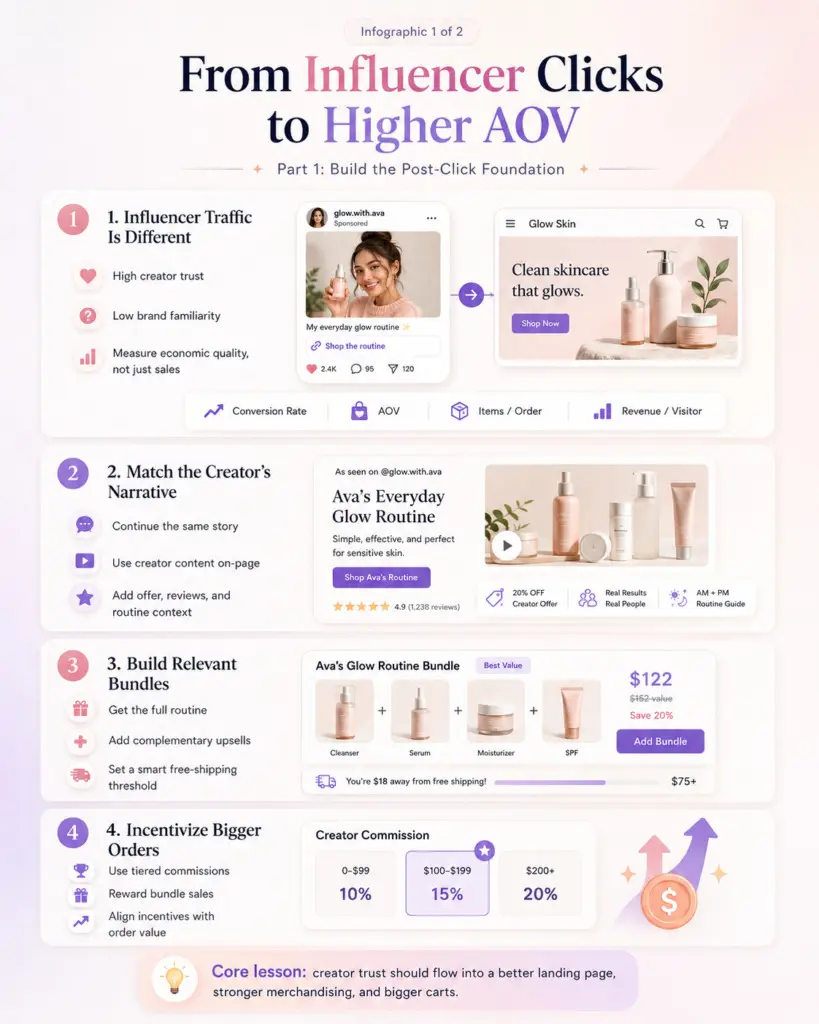
Not all acquisition channels are created equal, nor do they funnel visitors with identical levels of brand awareness or purchase intent. A customer arriving via a retargeting campaign, for instance, might already possess a degree of familiarity with the brand, having previously browsed products, added items to a cart, or even initiated a purchase. Conversely, visitors referred by an influencer exhibit a distinct behavioral pattern. They often arrive with high trust in the specific recommendation made by the creator, yet possess relatively little familiarity with the broader brand identity or its extensive product catalog. An influencer typically showcases or advocates for a particular product, and that specific item becomes the primary impetus for the click.
This unique dynamic presents both a significant advantage and a subtle limitation for e-commerce marketers. The influencer has already provided a powerful form of social proof, effectively mitigating some of the initial uncertainty associated with discovering an unfamiliar brand. This established trust is invaluable. However, the onus then falls on the retailer to skillfully introduce the customer to related products and compellingly articulate why purchasing more than just the featured item makes strategic sense. Many e-commerce platforms, by default, direct influencer-referred traffic to conventional product pages that are not inherently designed to accomplish this upselling or cross-selling objective. Brands that treat influencer referrals identically to every other traffic source risk squandering prime opportunities to significantly increase cart value precisely when purchase intent is at its peak.
To truly understand this distinct behavior, brands must leverage their analytics by segmenting traffic using creator-specific UTM parameters. This allows for granular insights into how influencer-referred visitors navigate the site, what products they view, and their ultimate purchase patterns. Useful metrics to compare for influencer-driven traffic versus other channels include conversion rates, bounce rates, pages per session, time on site, and critically, Average Order Value (AOV) and Items per Order. The objective transcends merely confirming whether an influencer generates sales; it is to meticulously understand the economic quality and long-term value of those sales.
Bridging the Narrative Gap: Matching Creator Content to Product Experience
One of the most significant sources of friction, and consequently, lost opportunity, in many influencer campaigns manifests between the creator’s compelling content and the brand’s subsequent landing page experience. Consider a beauty influencer who dedicates several minutes to meticulously explaining how a particular serum integrates seamlessly into their personalized six-week skincare routine. A captivated viewer, inspired by the demonstration and the influencer’s endorsement, clicks the provided link. They are then directed to a generic product page featuring a standard description, conventional product photography, and a complete absence of any reference to the specific routine or contextual usage they just observed.
This scenario exemplifies a pronounced narrative gap. The customer transitions abruptly from a highly contextualized, trustworthy recommendation to a relatively context-free, transactional shopping experience. This abrupt shift can disrupt purchasing momentum and diminish the perceived value of the initial recommendation. To counteract this, a highly effective approach involves creating dedicated landing experiences tailored specifically for pivotal creator campaigns. With appropriate usage rights, brands can seamlessly incorporate snippets of the creator’s content, directly explain the routine or use case demonstrated by the influencer, proactively address common questions that might arise from the content, and strategically present other complementary products involved in the influencer’s narrative.
Such a dedicated landing page transforms from a mere product showcase into a direct extension of the influencer’s campaign, fostering continuity rather than acting as an unrelated destination. For example, a creator-specific page could feature embedded video testimonials from the influencer, a detailed breakdown of the "influencer’s routine" with shoppable links for each step, a curated FAQ section addressing common queries related to the influencer’s specific usage, and even exclusive bundle offers directly tied to the creator’s recommendation. This strategic alignment creates a more coherent and engaging conversion funnel from initial content discovery all the way through the checkout process, significantly improving the chances of higher-value transactions. Furthermore, it provides marketers with a cleaner, more controlled environment for accurately measuring the commercial performance of individual partnerships.
Strategizing with Bundles: Capitalizing on Creator Recommendations
Product bundling emerges as an exceptionally relevant strategy for influencer campaigns, largely because creators inherently demonstrate products within a broader context—be it a comprehensive routine, a curated collection, a complete outfit, a specific recipe, or a practical use case. The paramount principle here is relevance.
Imagine a skincare influencer showcasing a cleanser, serum, and moisturizer as an essential three-step morning routine. Instead of directing viewers solely to the serum’s product page and passively hoping they independently discover the other complementary products, the brand could proactively offer the complete routine as a specially curated bundle. This directly aligns the purchase opportunity with the specific content that initially generated the customer’s interest and trust. A generic "starter kit" containing products the creator never discussed would likely be less persuasive, as influencer-referred customers are typically responding to a specific recommendation, not necessarily arriving with the intention of broadly browsing the entire catalog. Industry data suggests that intelligently designed bundles can increase AOV by 15-30%, a significant uplift for e-commerce profitability.
Brands can strategically experiment with several bundling approaches. This could include: a "Complete the Look" bundle for fashion influencers, a "Routine Builder" bundle for beauty or wellness, a "Project Pack" for DIY or craft creators, or a "Thematic Collection" aligned with seasonal or trend-driven content. Sophisticated e-commerce tools, such as Bundly, can automate the creation and management of these product groupings, eliminating the need for manual page building for every single partnership. The overarching principle is to skillfully capitalize on the trust transfer that occurs between the creator and the brand, while simultaneously simplifying and enhancing the next purchase decision for the customer, encouraging them to buy more valuable sets of products.
Aligning Incentives: Commission Structures for Bigger Orders
Influencer compensation models play a significant, albeit often overlooked, role in shaping the commercial outcomes of a campaign. Many prevalent affiliate-style influencer programs typically employ a percentage of sales, a fixed commission per sale, a cost-per-acquisition (CPA) payment, or a hybrid compensation model. Brands with a strategic focus on increasing Average Order Value should critically evaluate whether their current incentive structure genuinely encourages the desired customer behavior. If a creator receives the identical fixed commission regardless of whether the referred customer purchases a single entry-level item or a more extensive, higher-value product set, there is little inherent economic motivation for the creator to invest time and effort into explaining product bundles, premium options, or complementary items.
Tiered incentive structures offer a compelling alternative. For instance, a program could establish a baseline commission level for standard orders, with a significantly higher rate or bonus triggered once referred order values surpass a predetermined threshold. This directly rewards influencers for driving higher-value transactions. Brands could also implement bonuses based on metrics such as: total revenue generated, the average order value achieved within their referral pool, the number of bundled products sold, or even the conversion rate of specific high-margin products.
The optimal compensation structure will inevitably be influenced by factors such as product margins, the specific product category, the estimated customer lifetime value (CLTV), and the brand’s overarching influencer strategy. Crucially, the compensation structure must accurately reflect the specific outcomes the company genuinely desires its creators to generate. If the quality of revenue—meaning larger, more profitable orders—is prioritized over sheer transaction volume, the incentive model must be meticulously designed to account for and reward that priority. This transparent alignment between brand objectives and influencer incentives fosters more engaged and commercially effective partnerships.
Sustaining Engagement: Retargeting the Influencer Audience
An influencer campaign’s impact should not necessarily conclude the moment the original social media post ceases to generate clicks. A substantial segment of customers may initially discover a product through an influencer without immediately proceeding to purchase. These visitors have already demonstrated a clear interest and arrived via a trusted recommendation from someone they follow, rendering them a potentially invaluable audience for subsequent marketing efforts. Industry analysis consistently shows that retargeting can significantly boost conversion rates, often by 2-3 times compared to initial visits.
Creator-specific UTM parameters are indispensable for brands to effectively build and analyze these segmented audiences. Instead of lumping all non-converting visitors into a single, generic retargeting campaign, marketers can precisely segment influencer-referred visitors. This allows for the creation of highly personalized retargeting campaigns that maintain continuity with the original message and trust signal that initially captured their interest. Where advertising permissions and platform policies permit, retargeting creative should ideally reinforce the original campaign, the featured product, any specific offers, or the unique creator partnership, rather than abruptly switching to generic product advertising. This consistent messaging preserves the invaluable trust signal throughout a more extended portion of the customer journey.
Email and SMS capture mechanisms serve a similar, highly effective function. A creator-specific landing page could strategically encourage visitors to subscribe to email or SMS updates in exchange for an exclusive offer, a behind-the-scenes look, or useful content directly connected to the campaign’s theme. A follow-up sequence might then: provide additional context or usage tips related to the influencer’s recommendation, showcase complementary products that build on the initial interest, offer exclusive discounts or early access to new launches, or share testimonials from other customers who followed the influencer’s advice. Brands should rigorously test these customized sequences against their standard welcome flows, rather than assuming one approach will automatically outperform the other for influencer-sourced leads. Such comparative analysis can definitively reveal whether influencer-referred visitors necessitate a distinct lifecycle marketing strategy for optimal engagement and conversion.
Comprehensive Measurement: Beyond Basic Conversions
Solely relying on conversion rate as the primary metric for influencer performance provides an inherently incomplete and potentially misleading picture. Consider a scenario where two creators each generate 100 orders. If Creator A achieves an average order value of $45, while Creator B generates an average order value of $80, their commercial contributions are starkly different. Even before factoring in profit margins, potential repeat purchases, and customer acquisition costs, it is evident that these partnerships possess vastly different economic values for the brand.
E-commerce brands must therefore expand their influencer reporting to include a more comprehensive suite of metrics that truly reflect commercial impact:
| Metric | What It Helps Measure |
|---|---|
| Conversion Rate | How effectively traffic translates into customers. |
| Average Order Value | The total revenue generated per transaction. |
| Revenue Per Visitor | An indicator of overall traffic quality and profitability. |
| Items Per Order | Effectiveness of cross-sell and bundling strategies. |
| Customer Acquisition Cost | Efficiency of acquiring new customers through the channel. |
| New-Customer Percentage | Incremental customer growth attributable to the influencer. |
| Repeat Purchase Rate | The likelihood of customers returning for future purchases. |
| Customer Lifetime Value | The potential long-term revenue generated by acquired customers. |
This expanded framework fundamentally shifts influencer measurement away from superficial engagement metrics alone and towards a direct quantification of their contribution to e-commerce revenue and long-term customer value. This nuanced approach can significantly alter which creators are ultimately perceived as the strongest performers. A creator who generates fewer initial clicks but consistently attracts higher-value customers with greater lifetime potential may prove to be far more valuable to the brand than one who produces significantly more traffic with smaller, less profitable transactions. This holistic perspective aligns influencer marketing with broader business objectives of profitability and sustainable growth.
Scaling Without Compromising Authenticity
Once a brand successfully identifies an effective influencer campaign structure that yields strong AOV and other key metrics, the logical next step is to scale these efforts. However, achieving operational consistency should never necessitate that every creator produce identical content. The essence of an influencer’s appeal lies in their unique voice, distinctive format, and the authentic relationship they cultivate with their followers. Overly prescriptive campaign briefs can inadvertently stifle this creativity and undermine the very characteristics that make an influencer effective.
A more effective and scalable approach involves establishing creative freedom for influencers within clearly defined commercial guardrails. These guardrails might encompass essential elements such as permissible product claims, mandatory disclosure requirements, standardized campaign links, unique discount codes, key product information that must be conveyed, and critical brand-safety guidelines. Within these parameters, the creator can retain substantial control over how the product is organically integrated into their content, ensuring authenticity.
The same principle of thoughtful evaluation applies when selecting creators of various sizes. Micro-influencers, with their typically smaller yet highly engaged audiences, often appeal to e-commerce brands due to their potential for more focused communities and stronger creator-follower relationships, often translating into higher trust. However, follower count alone should never be the sole determinant of creator selection. Brands should compare creators based on a more comprehensive set of metrics: engagement rate, audience demographics and psychographics, historical AOV for referred traffic, conversion rate for similar campaigns, and crucially, revenue per dollar spent. Ultimately, the revenue generated for every dollar invested in an influencer partnership is a far more commercially meaningful metric than audience size in isolation, guiding scalable and profitable influencer strategies.
The Holistic Future of Influencer Commerce
Influencer marketing performance extends far beyond the initial selection of a creator, the reach of their posts, or even the conversion rate of their referred traffic. For e-commerce brands, the meticulously designed post-click experience is the pivotal determinant of how much genuine commercial value each creator partnership ultimately yields.
Dedicated landing pages are instrumental in maintaining a seamless continuity between the influencer’s compelling content and the brand’s online store, reducing friction and enhancing trust. Strategically relevant bundles can transform a single-product recommendation into a significantly larger, more profitable purchase. Thoughtfully aligned commission structures can proactively incentivize creators to communicate and drive higher-value offers, benefiting both the influencer and the brand. Intelligent retargeting and personalized lifecycle marketing strategies are crucial for capturing demand that doesn’t immediately convert during the initial visit, nurturing those leads into future sales. And finally, a robust, comprehensive measurement framework is essential to accurately identify which creators are truly producing valuable, high-AOV customers, rather than simply generating fleeting attention.
None of these tactics should operate in isolation. When combined strategically, they coalesce to form a powerful influencer commerce strategy where the creator initially generates invaluable trust, the landing experience meticulously preserves and builds upon it, merchandising innovatively expands the purchase opportunity, and sophisticated measurement rigorously tracks the resulting, high-quality revenue. For forward-thinking e-commerce marketers, this represents the transformative shift that truly matters: treating influencer marketing not merely as a source of traffic, but as a fully optimized acquisition channel capable of being refined and maximized at every stage, from the initial creator content to the final order value. This holistic approach is the cornerstone of sustainable growth and profitability in the dynamic landscape of modern e-commerce.

