
Most B2B outreach efforts currently fail before they can even begin to convert, not due to inherent product flaws or weak pitches, but because the underlying processes are fundamentally broken. Sales professionals frequently expend valuable time and resources on identifying contact information, only to dispatch emails to outdated addresses, follow up at inopportune moments, or lack a systematic approach to nurture leads once a response is finally received. This systemic inefficiency is reflected in alarming industry figures. According to Salesforce’s State of Sales report, a mere 28% of salespeople anticipate achieving their quota this year. This statistic points not to a crisis of motivation, but rather a profound workflow problem that hinders productivity and revenue generation across the B2B landscape.
The modern B2B sales environment is characterized by an unprecedented level of digital noise and buyer sophistication. Prospects are inundated with information and sales messages daily, making it increasingly difficult for outreach to cut through the clutter. Without a clearly defined, structured outreach workflow, the process can devolve into speculative guesswork, leading to inconsistent results and wasted effort. A robust workflow, however, provides sales development representatives (SDRs) and sales teams with a precise roadmap: identifying exactly who to contact, where to reliably source their information, and what compelling message to deliver to significantly elevate the probability of securing a response and advancing the sales cycle. This comprehensive playbook outlines the critical steps from initial target audience identification to converting cold interactions into signed contracts, offering actionable strategies for sales professionals at every scale.
The Workflow Imperative: Why Process Trumps Ad Hoc Approaches
The digital transformation has reshaped buyer behavior, placing a premium on value, relevance, and trust. In this climate, an ad hoc approach to outreach is a recipe for diminishing returns. A structured workflow, conversely, provides several strategic advantages:
- Predictability: Each step is clearly defined, allowing for consistent execution and predictable outcomes.
- Efficiency: Automation and clear guidelines reduce manual effort and free up sales teams to focus on high-value interactions.
- Scalability: A repeatable process can be scaled up or down as business needs dictate, without compromising quality.
- Optimisation: Defined metrics at each stage allow for continuous analysis and refinement, driving incremental improvements over time.
This systematic approach is no longer a luxury but a necessity for sales organizations aiming to navigate competitive markets and consistently meet their targets.
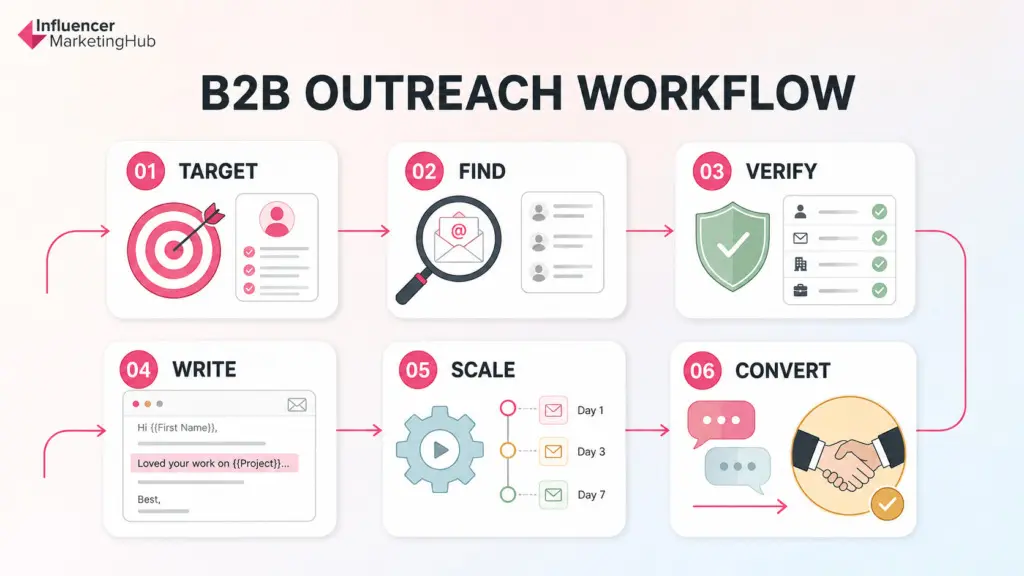
Step 1: Precision Targeting – Defining Your Ideal B2B Customer Profile
The cornerstone of any successful B2B outreach campaign is an unwavering clarity regarding the target audience. The most prevalent cause of outreach failure stems from vague or overly broad targeting, leading to irrelevant messages and low engagement rates. Before initiating any contact, sales teams must meticulously define their Ideal Customer Profile (ICP) and subsequently, their buyer personas.
An Ideal Customer Profile (ICP) delineates the characteristics of the companies most likely to derive significant value from your product or service, experience the highest success, and offer the greatest long-term value to your business. This is distinct from a buyer persona, which focuses on individuals. Key elements of an ICP include:
- Industry: Specific sectors (e.g., SaaS, manufacturing, healthcare, finance).
- Company Size: Revenue, employee count (e.g., mid-market, enterprise, SMB).
- Geographic Location: Country, region, specific markets.
- Growth Stage: Startup, established, rapidly expanding, mature.
- Technology Stack: Specific software or platforms they use (e.g., CRM, marketing automation, cloud providers).
- Pain Points/Challenges: Common problems they face that your solution addresses.
- Budgetary Capacity: Their ability and willingness to invest in solutions like yours.
Once the ICP is firmly established, the next layer involves identifying Buyer Personas – the specific individuals within those ICP companies who are decision-makers, influencers, or end-users. This involves detailing:
- Job Title/Role: VP of Marketing, Director of Operations, CIO, Founder.
- Responsibilities: Key duties and objectives.
- Reporting Structure: Who they report to and who reports to them.
- Challenges and Goals: Specific professional hurdles and aspirations.
- Preferred Communication Channels: Email, LinkedIn, phone.
For instance, if selling an employee scheduling tool, a suitable ICP might be US-based restaurant chains with 50 to 200 employees, experiencing high staff turnover and operational inefficiencies. The corresponding buyer persona would be the Operations Manager or General Manager, directly responsible for daily shift scheduling and cost management. The more granular and specific this targeting, the higher the relevance and, consequently, the response rate. Narrow targeting, though seemingly counterintuitive, consistently outperforms broad "spray-and-pray" approaches.
To effectively develop an ICP, sales teams should leverage their existing CRM data, analyzing the top 10-20 most successful current customers. Identifying commonalities across these accounts – industry, size, challenges solved – provides a robust foundation for building a data-driven ICP. Tools like LinkedIn Sales Navigator can then be instrumental in identifying companies that fit this profile, enabling a highly focused approach.
Step 2: Intelligent Lead Generation and Verified Contact Acquisition
With a meticulously defined target audience, the subsequent critical step is efficiently and accurately identifying the correct contact information for decision-makers within those organizations. While manual prospecting can suffice for very low volumes, it quickly becomes unsustainable and inefficient at scale. Relying on LinkedIn searches, guessing email formats, and hoping for the best is not a repeatable or reliable process.
Modern sales teams require robust tools designed for scalable contact acquisition. Specialized bulk email finders, such as Snov.io or similar platforms, significantly streamline this process. By uploading a list of names and company domains, these tools can generate verified email addresses in minutes, circumventing the time-consuming manual lookup process. This efficiency can save sales teams countless hours weekly, allowing them to redirect their focus towards selling. It is prudent to begin with a small batch of prospects to verify the accuracy of the results before processing an entire prospect list.
Key factors to consider when compiling your prospect list and finding emails include:
- Accuracy: Prioritize tools with high verification rates to minimize bounce rates.
- Efficiency: The ability to process large lists quickly is essential for scale.
- Integration: Compatibility with CRM systems and other sales tools.
- Data Enrichment: Tools that provide additional data points (e.g., job title, company size) can further refine targeting.
A practical workflow involves exporting a CSV file containing filtered prospects from LinkedIn Sales Navigator – including first name, last name, and company domain. Feeding this data into an email finder tool will yield a pristine, actionable list of contacts ready for outreach.
Compliance Considerations: It is imperative to adhere to data privacy regulations such as CAN-SPAM for contacts in the United States and GDPR for European contacts. This includes ensuring all outreach emails contain a clear unsubscribe link and that unsubscribe requests are honored promptly. Ethical outreach is not merely a legal requirement; it builds trust and maintains sender reputation.
Step 3: Data Hygiene – Verifying and Cleaning Prospect Data
Raw contact lists are inherently prone to inaccuracies and decay. Job titles change, individuals move to new companies, and domains expire. Poor data quality directly translates to a damaged sender reputation, compromised deliverability, and wasted outreach efforts. The Radicati Group reports that B2B data decays at an alarming rate of approximately 22.5% per year, meaning nearly a quarter of contacts on a one-year-old list may be outdated.
Email verification tools are indispensable for confirming the existence and validity of an email address without actually sending an email, thereby preventing bounces and protecting your domain’s reputation. Beyond email verification, a comprehensive data cleaning process should involve removing:
- Invalid Email Addresses: Hard bounces indicate non-existent addresses.
- Duplicate Entries: Redundant contacts waste effort and annoy prospects.
- Outdated Information: Incorrect job titles or company affiliations.
- Generic Email Addresses: info@, sales@, support@ are often less effective for personalized outreach.
- Non-Responsive Contacts: Prospects who have repeatedly shown no engagement over a defined period.
Furthermore, standardizing data across all fields (e.g., consistent formatting for first names, job titles, and company names) simplifies personalization and automation in subsequent stages. A healthy benchmark for email deliverability includes aiming for a bounce rate of 2% or less and a spam complaint rate of 0.1% or less. Exceeding these thresholds can lead to email service providers flagging or suspending accounts, severely impacting future outreach capabilities. Data cleanliness is not a mere technicality; it is a foundational step that underpins the entire outreach workflow, safeguarding reputation and maximizing efficiency.
Step 4: Crafting High-Converting Outreach Campaigns
Once a verified and clean prospect list is established, the next crucial step is to craft compelling email campaigns that resonate with recipients and elicit a response. This stage is where many outreach efforts falter. Research by the Radicati Group indicates that the average business user receives approximately 121 emails per day. To capture attention in such a crowded inbox, an email must stand out, starting with a powerful subject line.
Effective subject line principles include:
- Personalization: Including the recipient’s name or company name.
- Curiosity: Piquing interest without revealing everything.
- Urgency/Timeliness: Referencing recent news, events, or trends relevant to the prospect.
- Value Proposition: Hinting at a specific benefit or solution.
- Question-Based: Directly engaging the reader.
Examples that work effectively include: "Quick question about [Company]’s hiring plan," "Noticed you just expanded to Chicago," or "Idea for [Prospect’s Goal]." These subject lines feel like genuine, one-to-one communications rather than mass-sent messages.
For the email body, a structured approach significantly enhances engagement:
- Personalized Opening (The Hook): Demonstrate genuine research and relevance. Reference a recent achievement, industry news, or a specific pain point observed on their website.
- Problem Statement: Briefly articulate a challenge that the prospect likely faces, establishing empathy and understanding.
- Value Proposition/Solution (Brief): Introduce how your solution directly addresses that problem, focusing on their benefit, not your features. Include a concise, quantifiable result if possible (e.g., "reduce costs by X%").
- Social Proof (Optional but powerful): A quick mention of a similar client’s success can build credibility.
- Clear, Low-Friction Call to Action (CTA): Propose a small, easy next step, like a brief discussion, not an immediate sale.
Consider the example for the scheduling software company:
- Subject: Shift scheduling at Riverfront Grill
- Hi Marcus,
- Saw that Riverfront recently added two new locations. Managing schedules across multiple sites usually gets chaotic fast.
- We help restaurant groups reduce scheduling time by around 60%. One of our clients in a similar situation managed to reduce their manager’s overtime by 30% within the first month.
- Would it be worth a brief 20-minute discussion to explore if a similar impact is achievable for your team?
Notice the absence of superfluous pleasantries like "I hope this email finds you well," lengthy company histories, or aggressive sales language. This email is concise, directly relevant to the prospect’s world, and focused on potential benefits, making it significantly more likely to elicit a response. The objective is to open a dialogue, not to close a deal in the first email.
Step 5: Automating and Scaling Outreach Through Strategic Sequences
While crafting compelling emails is crucial, sending them consistently at scale while managing follow-up timing and replies presents another significant challenge. This is where strategic automation becomes invaluable. Research by Yesware indicates that 70% of email threads conclude after the initial email, yet the majority of positive responses often emerge from subsequent follow-ups. Relying solely on a single email means forfeiting a substantial portion of potential engagement.
A well-designed outreach sequence is typically multi-touch and spans several days or weeks:
- Day 1: Initial Email: The primary message, as outlined in Step 4.
- Day 3-4: First Follow-up: Reiterate the value proposition from a new angle or introduce additional relevant information, such as a helpful resource, a relevant blog post, or a brief case study.
- Day 7-8: Second Follow-up: A concise, direct message, often posing a simple yes/no question to lower the barrier to response.
- Day 14-16: Breakup Email: A final, often lighthearted or value-driven email indicating that you will cease contact, which can sometimes prompt a response from prospects who were on the fence.
Each follow-up must add new value or perspective; merely resending the initial email with a "following up on this" subject line is ineffective. Referencing a relevant article, sharing a brief case study, or inquiring about a specific challenge observed on their company website are far more engaging.
When implementing outreach automation, critical guardrails must be observed:
- Hyper-Personalization at Scale: Automation should enable, not replace, personalization. Use dynamic fields effectively.
- Frequency Caps: Avoid overwhelming prospects with too many emails in a short period.
- A/B Testing: Continuously test subject lines, email body content, CTAs, and follow-up timing to optimize performance.
- Monitoring Engagement: Track open rates, click-through rates, and reply rates to identify areas for improvement.
Furthermore, consider incorporating multi-channel outreach strategies. While email is potent, combining touchpoints on platforms like LinkedIn (connection requests, personalized InMail, engaging with their content) can significantly amplify response rates. When a prospect receives a thoughtful email after seeing a personalized connection request, the cumulative effect builds recognition and trust, increasing the likelihood of engagement. Automation serves to enhance human interaction, not to replace it. Computer-generated junk remains junk; therefore, automation must be applied judiciously to well-researched and personalized messaging.
Step 6: Converting Conversations into Qualified Sales Opportunities
Receiving a response marks not the conclusion of the outreach process but the commencement of the sales journey. The manner in which the initial response is handled is often the decisive factor in whether a lead progresses or disengages. Speed is paramount in B2B sales. According to a Harvard Business Review study, leads contacted within 5 minutes of engaging are 100 times more likely to convert than those contacted after 30 minutes. Sales teams should strive to reply within the hour whenever feasible.
Upon receiving a positive reply, the immediate goal is rapid qualification. This involves quickly assessing whether the prospect represents a genuine opportunity aligned with your ICP. Key areas to address include:
- Understanding Their Pain: Delve deeper into the specific challenges they are facing.
- Budget Alignment: Ascertain if they have the financial capacity or allocated budget for a solution.
- Decision-Making Authority: Identify if they are the ultimate decision-maker or an influencer.
- Timeline: Determine their urgency and timeframe for implementing a solution.
For more intricate enterprise deals, employing a lightweight qualification framework such as BANT (Budget, Authority, Need, Timing), MEDDPICC (Metrics, Economic Buyer, Decision Criteria, Decision Process, Paper Process, Implicate the Pain, Champion, Competition), or GPCTBA/C&I (Goals, Plans, Challenges, Timeline, Budget, Authority / Consequences & Implications) can provide structure. The objective is not to interrogate the prospect but to efficiently determine if there is a genuine fit and a viable path forward before investing significant time in extensive demos and proposals.
Preparation is paramount for any discovery call:
- Thorough Research: Review their company website, LinkedIn profiles, recent news, and industry trends.
- Craft a Call Agenda: Outline key discussion points and desired outcomes.
- Anticipate Objections: Prepare responses to common concerns.
- Define Your Goal: Know what information you need to gather and what next step you want to propose.
Following every call, a recap email should be sent within 24 hours. This email should summarize key discussion points, confirm mutual understanding, and clearly outline the agreed-upon next steps. This practice maintains momentum, reinforces your professionalism, and reduces potential misunderstandings. Every interaction, insight, and lead status change must be meticulously tracked in the CRM system. This data not only provides pipeline visibility but also offers invaluable insights into conversion trends, enabling continuous improvement of future outreach campaigns.
Common B2B Outreach Mistakes to Avoid
Even with a well-structured workflow, certain patterns can subtly undermine outreach effectiveness. Recognizing and proactively avoiding these pitfalls is crucial for sustained success.
- Product-Centric, Not Prospect-Centric Messaging: A pervasive error is focusing on product features rather than the prospect’s problems and desired outcomes. People care about solutions to their challenges, not merely what your product does. A simple test: count the occurrences of "I" or "we" versus "you" in your emails. A higher "you" ratio indicates better prospect focus.
- Lack of Genuine Personalization: In an age of sophisticated automation, generic, templated outreach is easily identifiable and routinely ignored. True personalization goes beyond merging a name. It involves demonstrating specific knowledge of the prospect’s company, industry, recent achievements, or stated challenges. Even five minutes of targeted research per prospect can yield unique insights that transform a generic message into a highly relevant one.
- Insufficient Follow-Up: As previously highlighted, a significant percentage of positive responses materialize after the third or fourth touch. Sales representatives who abandon an outreach sequence after just one or two attempts are leaving substantial pipeline opportunities on the table. Persistence, when coupled with value and relevance, is a hallmark of effective sales, not spam.
- Vague or Non-Existent Calls to Action: Phrases like "Let me know if you’re interested" place the onus entirely on the prospect, leading to inertia. An effective call to action is specific, low-friction, and proposes a clear next step. Examples include: "Are you free Tuesday or Wednesday at 2 PM for a quick 20-minute chat?" or "Would you be open to a brief demo next week?"
- Ignoring Sender Reputation and Email Warm-up: Launching a full-scale outreach campaign from a new domain or an unwarmed email account is a direct route to the spam folder. Email service providers monitor sending patterns closely. New domains require a "warm-up" period, typically 2-4 weeks, involving sending a gradual increase of emails and engaging with replies to establish a positive sending history and reputation. Overlooking this step can severely hamper deliverability.
- Failure to A/B Test and Iterate: The B2B landscape is dynamic. What yielded results last quarter may not work today. Subject line open rates, reply rates, and conversion rates are constantly shifting. Successful sales teams embrace continuous improvement through rigorous A/B testing of various elements – subject lines, email length, value propositions, and calls to action. Data, not gut instinct, should drive the iterative refinement of outreach strategies.
Conclusion
Effective B2B outreach in the contemporary market is fundamentally about precision, timing, and unwavering consistency, rather than sheer volume. The sales professionals and teams that consistently close deals are not necessarily the most inherently talented communicators, but rather those who meticulously adhere to a well-defined, optimized system.
The initial step towards streamlining any outreach operation is a thorough audit of current processes. Where are the bottlenecks? Is targeting too broad? Is contact data compromised? Are follow-up sequences prematurely abandoned? Identifying and addressing the weakest link first will yield the most immediate and significant improvements.
Following this, sales organizations can incrementally implement the steps outlined in this workflow. By focusing on one stage per week – from refining ICPs to optimizing follow-up sequences – a repeatable process that consistently generates results can be established within a month. Within a quarter, sufficient data will accumulate to enable sophisticated optimization of every stage, transforming outreach from an unpredictable endeavor into a predictable revenue engine.
The optimal time to rectify a broken outreach workflow was undoubtedly six months ago. The second-best time, and perhaps the most critical, is unequivocally right now. Proactive investment in process and strategy is the definitive pathway to achieving and exceeding sales quotas in an increasingly competitive B2B landscape.

