
The burgeoning landscape of e-commerce is undergoing a significant transformation with the announcement of a strategic collaboration between Shopify, the e-commerce platform giant, and Vercel, a leading provider of frontend development platforms. This partnership aims to redefine online retail by developing e-commerce storefronts that are not only intuitive for human consumers but also accessible and functional for artificial intelligence agents. The groundbreaking initiative was unveiled on October 15th at Vercel’s Ship 26 conference in San Francisco, where Shopify CEO Tobi Lütke and Vercel CEO Guillermo Rauch shared their vision for the future of "agentic e-commerce."
At the heart of this collaboration lie two key technological advancements: the release of Shopify’s comprehensively rebuilt Hydrogen software development kit (SDK) and Vercel’s innovative AI-enabled open-source storefront template, aptly named Vercel Shop. This synergy promises to empower developers with advanced tools to construct sophisticated and adaptable online retail experiences.
The Genesis of Agentic E-commerce: Hydrogen and Vercel Shop
The rebuilt Hydrogen SDK represents a significant evolution for Shopify’s developer ecosystem. It provides developers with a suite of reusable tools and components designed to streamline the creation of Shopify storefronts across a diverse range of JavaScript frameworks. This means developers can leverage Shopify’s robust backend infrastructure and e-commerce functionalities while retaining the flexibility to build highly customized and performant frontend experiences. The SDK is engineered to abstract away much of the complexity associated with integrating with Shopify’s core services, allowing developers to focus on crafting the user journey and visual design of the storefront.
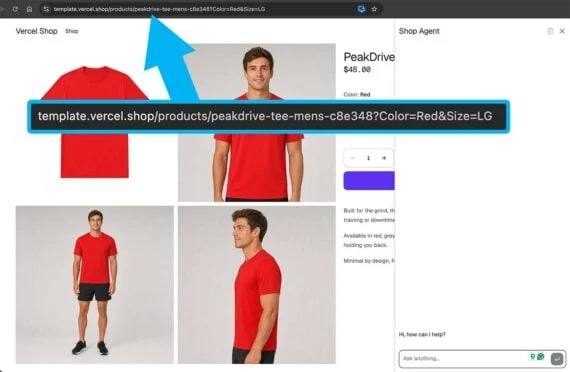
Complementing Hydrogen, Vercel Shop introduces a novel approach to storefront architecture. It’s an open-source template that not only serves as a functional e-commerce store for human shoppers but is also meticulously structured to be "agent-readable." This crucial feature enables AI agents to interact with product information, understand purchasing options, and even manage shopping carts programmatically, without the need for complex visual parsing or simulated human interaction.
A Deeper Dive into the Technologies
Hydrogen’s strength lies in its ability to organize common e-commerce functions into shared, reusable tools. This modular approach allows developers to pick and choose the components they need, accelerating development cycles and ensuring consistency across different projects. By abstracting core functionalities like product catalog management, inventory checks, and cart operations, Hydrogen empowers developers to concentrate on building unique shopper experiences that differentiate their brands.
Vercel Shop takes this a step further by embedding agent-readability directly into the product data structure. This means that product descriptions, attributes, pricing, and availability are presented in a format that AI agents can easily parse and interpret. This structured data is vital for enabling AI-driven shopping, where agents can act on behalf of consumers to find, compare, and purchase products with unprecedented efficiency.
The October Unveiling: A Milestone Event
The joint presentation at Vercel’s Ship 26 conference marked a significant milestone in the ongoing partnership between Shopify and Vercel. This event built upon the momentum generated by the June 30th announcement of the Hydrogen rebuild, a project that signaled a deeper commitment to collaborative development between the two companies. The Ship 26 conference, a highly anticipated event in the web development community, provided the ideal platform to showcase the tangible results of this collaboration and to articulate a compelling vision for the future of online retail.
The Ship 26 conference itself is known for its focus on cutting-edge web technologies and developer productivity. Attracting thousands of developers, designers, and product leaders, the event serves as a critical venue for announcing new products, sharing best practices, and fostering innovation within the web development ecosystem. The presence of both Lütke and Rauch on stage underscored the strategic importance of this partnership for both organizations.
Enabling Sophisticated Custom Storefronts
Building custom e-commerce storefronts has traditionally been a complex undertaking, requiring extensive integration with various backend systems that facilitate purchases. Developers have had to painstakingly connect the frontend shopping experience to product catalogs, real-time inventory management, dynamic pricing, and secure checkout processes. Each of these components demands precise data synchronization and robust error handling.
The rebuilt Hydrogen SDK and the Vercel Shop template directly address these challenges by providing a unified and developer-friendly approach. They offer a foundation that significantly reduces the integration burden, allowing developers to focus on the user-facing aspects of the shopping experience.
Tobi Lütke, in his remarks at the conference, articulated the philosophy behind Shopify’s approach to checkout. He stated, "Checkouts are ridiculously hard to get right. It’s one of those pieces of software that actually does need 20 years of tinkering with. And Shopify has always been very open, and so we invite people to remix pieces from our checkout just as much as you want. Basically taking all the infrastructure that Shopify built, and you can build whatever you want with it." This sentiment highlights Shopify’s commitment to providing a robust and secure checkout infrastructure while encouraging innovation and customization at the storefront level.

This means that Shopify’s underlying software provides developers with the foundational commerce tools, enabling them to concentrate on how shoppers discover products and interact with the store. They can then extend these capabilities as needed, building unique and engaging experiences that resonate with their target audience. The architecture also supports a multiplicity of shopping interactions. Customers can engage with a traditional visual storefront or opt for a more interactive experience by leveraging an AI assistant. Simultaneously, compatible external AI agents can seamlessly access product information and shopping tools directly from the merchant’s domain.
The Rise of External AI Shopping Agents
The implications of agentic e-commerce extend to the burgeoning field of AI agents capable of shopping on behalf of consumers. For an AI agent to effectively act as a personal shopper, it needs to be able to autonomously find products, evaluate options, and assemble a shopping cart. Vercel Shop is designed to support these tasks directly, eliminating the need for agents to navigate the visual interface of a traditional website.
This is achieved through the structured, machine-readable product data that Vercel Shop provides. An AI agent looking for a specific item, such as a black jacket in a particular size, doesn’t need to parse complex HTML code or rely on image recognition to extract this information. Instead, the product details are presented in a format that the AI can directly process, enabling swift and accurate product selection. This programmatic access to product information is a fundamental shift in how AI can interact with online retail environments.
The ability for external agents to access product information and shopping tools on a merchant’s domain means that brands can potentially integrate their offerings with a wider range of AI-powered services and platforms. This could lead to new avenues for product discovery and sales, driven by AI assistants that are deeply integrated into consumers’ digital lives.
The Integrated Store Assistant: Enhancing the Human Shopping Experience
Beyond enabling external AI agents, Vercel Shop also features an integrated, optional AI-powered shopping assistant. This assistant is designed to enhance the experience for human shoppers by providing conversational support throughout their browsing and purchasing journey. Functionally, it can be compared to virtual assistants like Walmart’s Sparky or Amazon’s Alexa for Shopping, offering a more personalized and interactive way to shop.
This in-store assistant helps shoppers locate products, navigate through various product options and configurations, answer questions about store policies, and manage their shopping cart through a natural language chat interface. Crucially, the assistant operates using the same Shopify cart as the visual storefront. This ensures a seamless experience, where actions taken by the shopper on the website are reflected in the assistant’s view, and vice versa. For instance, a shopper might add a jacket to their cart while browsing, then use the assistant to request a different size or to find a matching accessory, such as a hat. All these changes are synchronized in real-time.
Shopify’s robust backend systems continue to manage critical aspects of the transaction, including price verification, availability checks, and the enforcement of permitted cart modifications. However, the assistant is designed to work in conjunction with a familiar checkout flow. It does not handle order placement or payment processing, thereby maintaining a secure and established purchasing process.
The AI assistant is intentionally disabled by default, providing merchants with control over its implementation. Developers must explicitly enable the assistant and configure access to Vercel’s AI Gateway, which powers its conversational capabilities. This allows for extensive customization, enabling merchants to tailor the guidance the assistant provides and the way it presents product information to align with their brand identity and marketing strategies.
A practical demonstration of the Vercel Shop template and its integrated shopping assistant can be found on Vercel’s own merchandise store, providing a live example of these capabilities in action. This allows potential users to experience firsthand how the technology can be applied to create engaging and efficient online retail environments.
Broader Implications and Future Outlook
The collaboration between Shopify and Vercel signals a significant step towards a more intelligent and interconnected e-commerce future. By building platforms that cater to both human and AI interaction, they are laying the groundwork for new business models and enhanced consumer experiences.
For businesses, this partnership offers the potential to:
- Increase Efficiency: Automate aspects of customer service and sales processes through AI agents.
- Enhance Personalization: Offer highly tailored shopping experiences driven by AI-driven recommendations and assistance.
- Expand Reach: Integrate with a growing ecosystem of AI-powered shopping platforms and services.
- Reduce Development Costs: Leverage reusable components and streamlined integration processes provided by Hydrogen and Vercel Shop.
From a consumer perspective, this could lead to:
- More Convenient Shopping: AI agents can handle repetitive tasks, freeing up consumers’ time.
- Improved Product Discovery: AI assistants can help users find exactly what they’re looking for, even with vague or complex requests.
- Personalized Recommendations: AI can analyze preferences and past behavior to suggest relevant products.
The concept of agentic e-commerce is still in its nascent stages, but the foundation being laid by Shopify and Vercel is poised to accelerate its adoption. As AI technology continues to advance, the ability for AI agents to seamlessly interact with online stores will become increasingly crucial. This partnership positions both companies at the forefront of this evolution, promising a future where online shopping is more intelligent, efficient, and personalized than ever before. The ability to create storefronts that speak the language of both humans and machines is a testament to the rapid pace of innovation in the digital economy.

