
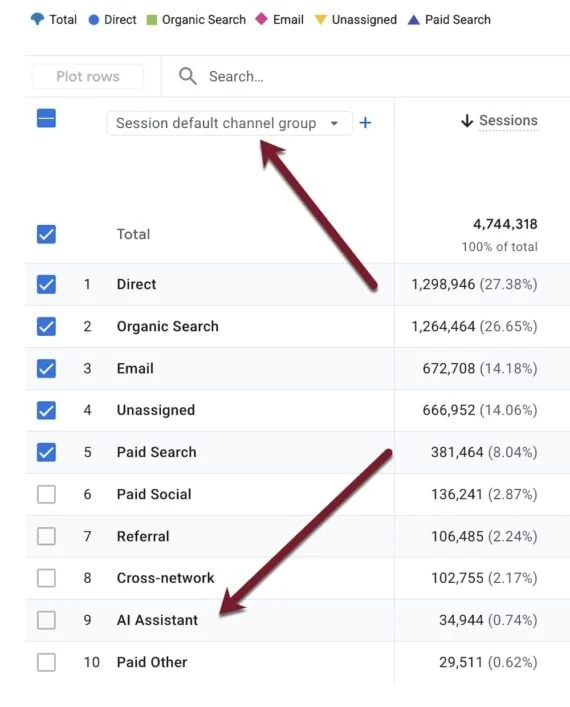
Google Analytics 4 (GA4) has officially launched a new "AI Assistant" channel, a significant development for digital marketers and website owners seeking to understand the impact of generative AI on their web traffic. Rolled out in May, this dedicated channel aims to measure and analyze traffic originating from prominent generative AI platforms, offering unprecedented insight into this rapidly evolving segment of online engagement. Previously, traffic from these sources was often categorized under broader, less specific channels, making it challenging to isolate and assess their performance.
The "AI Assistant" channel is designed to capture user interactions stemming from conversational AI interfaces. According to Google’s official "Analytics Help" portal, this new dimension explicitly includes traffic from chatbots such as OpenAI’s ChatGPT, Google’s own Gemini, and Anthropic’s Claude. This direct attribution provides a clearer picture of how users are discovering and interacting with content through these AI-powered tools.
It is crucial to note, however, that Google has clarified the scope of this new channel. Specifically, traffic generated through Google’s AI Overviews and its "AI Mode" in search results will not be categorized under the "AI Assistant" channel. Instead, clicks from these particular AI-driven search features will continue to be reported under the "Organic Search" dimension. This distinction is important for analysts, as it separates direct chatbot interactions from AI-enhanced search experiences.
Navigating the AI Assistant Channel in GA4
For users looking to access and analyze this new data, the process is integrated within the existing GA4 reporting interface. To find AI-assisted traffic, users should navigate to the "Reports" section, then select "Acquisition," followed by "Traffic acquisition." Within this report, the "Session Channel Group" dimension can be explored, where the new "AI Assistant" channel will be clearly listed alongside established channels like Direct, Organic Search, and Paid Search.
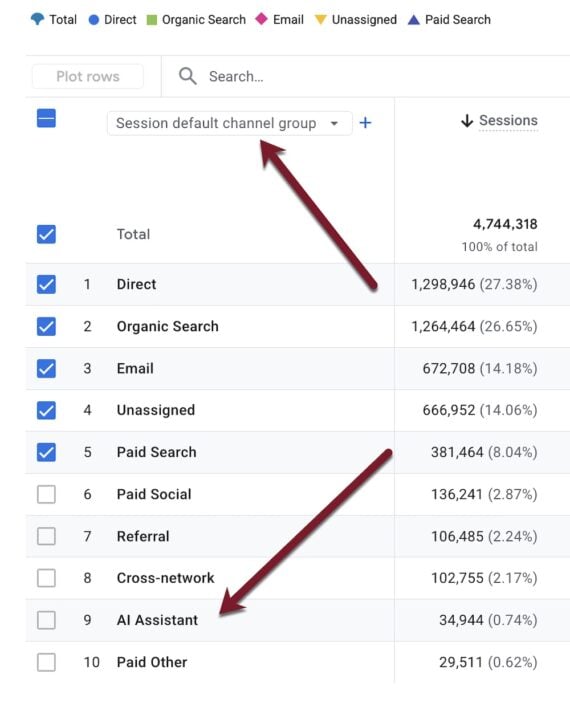
The "AI Assistant" channel report provides a suite of performance metrics that mirror those available for other traffic sources. This includes key indicators such as engagement rates, events per session, average session duration, and other relevant engagement metrics. This comprehensive data allows marketers to evaluate the quality of traffic from AI platforms, understand user behavior, and assess the effectiveness of their content in this new discovery pathway.
Identifying Landing Pages Driven by AI
Beyond simply tracking traffic volume, the "AI Assistant" channel offers valuable insights into which specific pages on a website are being cited and driving clicks from AI platforms. This capability is particularly important for content optimization and SEO strategies in the age of AI.
To identify these AI-driven landing pages, users can navigate to the "Reports" section, then select "Engagement," followed by "Pages and screens." This report typically displays the highest-traffic pages on a website. At the top of the graph displaying page performance, users can click "Add filter." Within the filter options, they can then select the "Session default channel group" dimension. For the condition, they should choose "exactly matches" and then select "AI Assistant" from the dropdown menu. Applying this filter will reveal the pages that have received the most clicks originating from AI platforms.
Comparing AI-Assisted Traffic with Other Sources
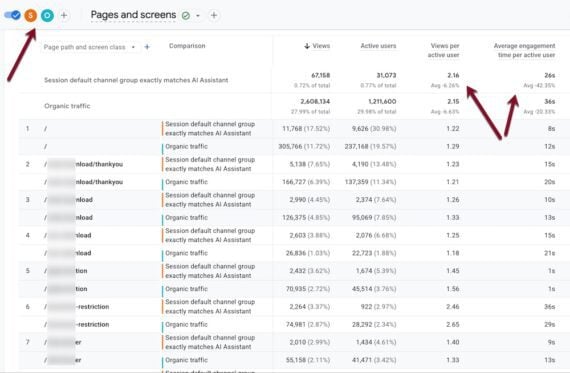
A critical aspect of understanding the impact of the "AI Assistant" channel is its comparison with other established traffic sources. GA4 facilitates this by allowing users to overlay and compare different traffic segments within the "Pages and screens" report.
To initiate a comparison, users should remain in the "Pages and screens" section. Above the performance graph, they will find an "Add comparison" button. Clicking this button will prompt them to "Create new." Following a similar process to filtering, they will select the "Session default channel group" dimension. For this comparison, they can choose "All users" to represent the overall website traffic, or they can select specific channels like "Organic Search" or "Paid Search" to create a direct, side-by-side analysis.
Once the comparison is set up, the report will display engagement metrics for each page, broken down by the AI-assisted traffic and the chosen comparison traffic source. This allows for a granular analysis of how AI-driven visitors interact with content compared to, for instance, users who arrive via organic search. This comparative data can inform content strategy, highlighting whether AI traffic exhibits different engagement patterns, content consumption habits, or conversion behaviors.
Initial observations from testing this feature suggest that traffic from top organic search pages and AI-assisted pages may not always overlap. This divergence underscores the unique nature of AI-driven discovery. To further investigate the prompts and search queries that lead to AI citations, it is recommended to utilize tools like Semrush or similar SEO platforms, which can provide deeper insights into the specific queries driving AI referrals.
Leveraging Regex for Granular AI Traffic Tracking
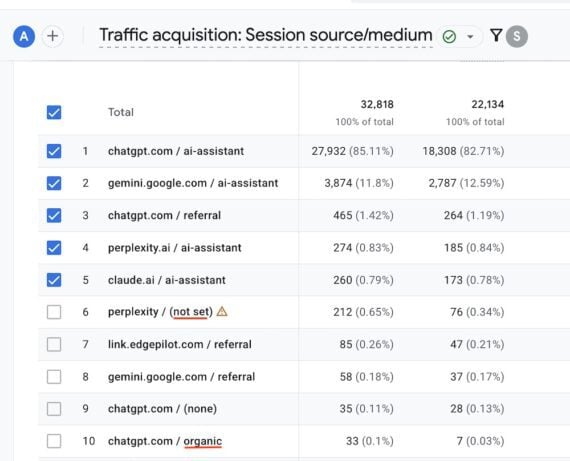
While the "AI Assistant" default channel simplifies tracking AI traffic, it does not inherently break down which specific generative AI platforms are contributing to this volume. For marketers who need a more detailed view of individual AI sources, leveraging regular expressions (regex) within GA4’s "Source/Medium" report offers a powerful alternative or supplementary method.
To implement this, users can navigate to "Reports," then "Acquisition," and select "Traffic acquisition." Within this report, they can change the primary dimension to "Session source / medium." Then, click "Add filter." A new filter should be created using the "Session source / medium" dimension. For the condition, select "contains" or "matches regex."
The following regular expression can be pasted into the "Value" field to capture traffic from a range of popular AI platforms:
.*chatgpt.com.*|.*perplexity.*|.*edgepilot.*|.*copilot.microsoft.com.*|.*openai.com.*|.*gemini.google.com.*|.*claude.ai.*|.*grok.x.ai.*
This regex is designed to identify traffic originating from domains associated with ChatGPT, Perplexity AI, Microsoft Copilot (often accessed via Edgepilot), OpenAI’s broader domain, Google Gemini, Anthropic’s Claude, and X’s Grok. By applying this filter, users can generate a detailed breakdown of traffic sources attributed to these specific generative AI tools.
It is worth noting that in such regex-based analyses, there might be minor data inconsistencies. For example, some traffic that might intuitively be considered AI-assisted could appear under "Organic" or "(not set)" dimensions, indicating that the regex capture might not be exhaustive or that GA4’s default channel grouping has its own categorization logic. Nevertheless, the regex approach provides a valuable layer of detail for understanding the specific AI platforms driving engagement.
Implications and Future Outlook
The introduction of the "AI Assistant" channel in Google Analytics 4 marks a pivotal moment in the measurement of digital marketing effectiveness. As generative AI continues to permeate how users search for information and discover content, having dedicated tools to track and analyze this traffic is no longer a luxury but a necessity.
Background Context: The proliferation of advanced AI models like ChatGPT in late 2022 and the subsequent integration of AI into search engines and other platforms have fundamentally altered the digital landscape. Businesses have grappled with how to understand the impact of these new discovery mechanisms on their websites. Traditional analytics platforms, while robust, were not initially equipped to distinguish traffic from these novel AI interfaces.
Chronology of Development: The emergence of generative AI as a significant traffic driver has been a rapid phenomenon. While GA4 has been evolving with AI capabilities, the explicit "AI Assistant" channel represents a targeted response to this specific trend. Its rollout in May signifies Google’s commitment to providing marketers with actionable data in this dynamic environment. The inclusion of specific platforms like ChatGPT, Gemini, and Claude highlights the recognized importance of these major players in the AI ecosystem.
Supporting Data and Analysis: The ability to see engagement metrics, identify top-performing landing pages, and compare AI traffic against established channels provides a rich dataset for strategic decision-making. For instance, if AI-assisted traffic demonstrates higher engagement times or lower bounce rates on certain content, it suggests that this content is resonating well with users interacting through AI. Conversely, if AI traffic exhibits poor engagement, it may indicate a need to optimize content for AI summarization or ensure that it directly answers queries that AI models are likely to surface.
Broader Impact and Implications:
- Content Strategy Optimization: Marketers can now tailor content not just for human readers and search engine algorithms but also for AI models that might be summarizing or referencing it. Understanding which prompts lead to website citations is crucial.
- SEO Evolution: The distinction between "Organic Search" and "AI Assistant" traffic suggests that SEO strategies may need to adapt. While traditional SEO remains vital, optimizing for AI inclusion and understanding how AI "reads" and "presents" content will become increasingly important.
- Emerging Traffic Channels: The "AI Assistant" channel represents a new frontier in digital acquisition. Businesses that proactively analyze and leverage this data will likely gain a competitive advantage.
- Data Granularity: The ability to use regex for more granular tracking of specific AI platforms addresses the potential limitations of default channel groupings and empowers advanced users to gain deeper insights.
- Future of Measurement: This move by Google Analytics underscores a broader trend towards more intelligent and context-aware web analytics, anticipating and responding to shifts in user behavior and technology adoption.
As generative AI continues its rapid evolution, the "AI Assistant" channel in GA4 is poised to become an indispensable tool for understanding and navigating this transformative phase of the internet. Its successful implementation will depend on ongoing adaptation and a clear understanding of how AI is reshaping the digital journey of users.

