
The landscape of e-commerce marketing is undergoing a profound transformation, driven by the rapid advancement and integration of generative artificial intelligence (AI) into search and shopping behaviors. For decades, marketers have operated under the foundational principle that understanding shopper "intent"—the underlying need or desire driving a search query—is paramount. This has traditionally manifested in categorizations like "purchase intent" and "informational intent," each aiming to target prospects based on their perceived requirements. However, the advent of sophisticated AI models like Claude, Gemini, and ChatGPT is not merely enhancing these existing paradigms; it is fundamentally reshaping how intent is expressed and, consequently, how marketers can effectively respond.
The core of this evolution lies in the qualitative shift in user interaction with AI-powered search and conversational agents. While traditional search engines typically process queries averaging around four words, AI chatbots, according to a 2026 Semrush analysis, generate significantly longer and more complex prompts, often reaching an average of 23 words. This stark difference in query length and detail opens up unprecedented opportunities for marketers to gain deeper insights into consumer needs.
Consider the example of a shopper seeking a coffee grinder. In a traditional search engine, their query might be as simple as "small simple coffee grinder." This provides a basic understanding of their need for a compact and uncomplicated device. However, when interacting with an AI chatbot, the same shopper might articulate their requirements with far greater nuance and context. They might ask, "I’m looking for a quiet coffee grinder for my small apartment that works well for pour-over brewing and is easy to clean without making a mess." This detailed, scenario-driven query reveals not just a need for a grinder, but specific constraints and desired functionalities—quiet operation for an apartment setting, compatibility with a specific brewing method, and ease of maintenance. While both queries might ultimately lead to the recommendation of a conical burr grinder, the latter query, fueled by AI’s conversational capabilities, exposes a much richer vein of actionable information for marketers.
The Rise of Product Intent Clusters in the AI Era
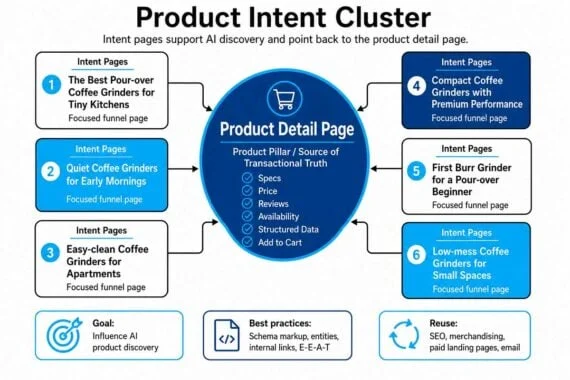
This heightened granularity in user intent is paving the way for a new strategic framework: "product intent clusters." These clusters represent a sophisticated evolution of traditional SEO topic clusters, designed specifically to influence AI-driven product discovery. Instead of broad topical coverage, product intent clusters are meticulously crafted around specific shopper scenarios, use cases, and information-seeking behaviors that collectively point towards a particular product. At the heart of each cluster lies the product detail page (PDP), serving as the definitive source of truth for purchase decisions, encompassing specifications, pricing, reviews, availability, and structured data.
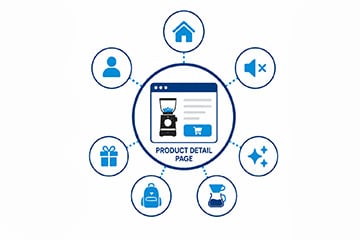
The concept is analogous to a hub-and-spoke model. The central hub is the PDP, rich with transactional and descriptive information. Radiating outwards are numerous "spoke" pages, each designed to address a specific facet of a shopper’s journey or a particular problem they are trying to solve with a product. These supporting pages delve into the informational needs that precede a purchase, providing context, comparisons, and solutions tailored to nuanced user queries.
For instance, in the coffee grinder example, a simple PDP might list the features of a conical burr grinder. However, within a product intent cluster, supporting pages could be dedicated to specific scenarios. One page might be titled "The Best Quiet Coffee Grinders for Early Morning Brews," directly addressing the shopper’s concern about noise. Another could be "Compact Pour-Over Coffee Grinders for Small Kitchens," catering to spatial limitations and brewing preferences. A third might focus on "Mess-Free Coffee Grinding Solutions for Apartment Dwellers," highlighting ease of cleaning and minimal disruption.
Structuring for AI Comprehension and Human Readability
The effectiveness of these product intent clusters hinges on their ability to be understood by both AI algorithms and human consumers. Each supporting page within a cluster must not only be rich in relevant content but also meticulously optimized for AI comprehension. This involves employing best practices such as schema.org structured data markup, the strategic use of entities, and robust internal linking that guides both users and search bots through the information architecture.
While the PDP remains the conversion nexus, it should not be transformed into an unwieldy buying guide. Instead, it can strategically link to these supporting intent pages, effectively organizing related questions, clarifying product use cases, and providing a seamless pathway to deeper information. The supporting pages, in turn, are designed to be funnel-focused, guiding the shopper towards a purchase decision by directly addressing their specific needs and concerns.
The distinction between a generic informational query and a specific intent-driven one is critical. A search for "best pour-over coffee grinders" is broad. However, an AI-powered query like "best pour-over coffee grinders for tiny kitchens that are quiet and easy to clean" is highly specific and reveals a complex set of user requirements. The supporting intent page should therefore go beyond mere product listings and actively guide the shopper by answering these nuanced questions. This includes detailing how the product addresses specific pain points, providing comparative analyses within the context of the scenario, and demonstrating the product’s value proposition for that particular use case.
Furthermore, these pages must be optimized for search engines in the traditional sense, ensuring they are discoverable through organic search. This means adhering to established SEO principles, including keyword optimization, content quality, and user experience. However, their primary purpose in the current landscape is to serve as valuable, context-rich resources that AI models can readily extract and leverage when responding to complex user prompts. The goal is to create a comprehensive ecosystem of content that anticipates and addresses every conceivable user need related to a product, thereby positioning that product as the optimal solution.
The AI-Enabled Acceleration of Content Creation
The development and maintenance of such a granular content strategy were historically prohibitive for many e-commerce marketers. The sheer volume of research, outlining, writing, optimizing, and ongoing maintenance required for dozens, if not hundreds, of highly specific intent pages per product was a significant barrier. The cost-benefit analysis often favored broader content strategies with less specialized targeting.
Generative AI has fundamentally altered this equation. The ability of AI to automate and expedite content creation processes means that the once-daunting task of producing numerous high-quality, precisely engineered intent pages is now feasible. Marketers can leverage AI to not only generate content but also to identify the very topics that should populate these intent pages. By feeding structured customer feedback—such as support tickets, product reviews, forum discussions, and social media comments—into generative AI platforms, businesses can gain data-driven insights into the specific problems, questions, and desires their customers have. This data can then be used to prompt AI to generate content that directly addresses these identified needs.
This data-driven approach ensures that the intent pages are not speculative but are grounded in real customer feedback and behavior. The AI can analyze patterns in customer inquiries to identify emerging use cases, common pain points, and frequently asked questions that might not be immediately apparent through traditional keyword research. This allows for a proactive content strategy that anticipates and addresses shopper needs before they are even explicitly articulated in a search query.
The implications are far-reaching. Businesses that embrace this AI-driven approach to building product intent clusters can achieve a level of precision in their marketing that was previously unattainable. They can ensure that when a shopper, especially one who is still exploring options and may not know exactly what they want, turns to an AI assistant, their product is presented as the most relevant and suitable solution. This is because the AI, having been fed comprehensive and well-structured information through these intent pages, can confidently connect the shopper’s nuanced need with the product’s specific capabilities and benefits.
Evolving the E-commerce Marketing Playbook
The strategic shift towards product intent clusters, powered by generative AI, represents a paradigm shift in e-commerce marketing. It moves beyond simple keyword targeting to a more sophisticated understanding of the entire shopper journey, from initial exploration and problem identification to detailed evaluation and purchase. This approach acknowledges that many purchasing decisions are not made in a vacuum but are the result of a complex information-gathering process, often facilitated by increasingly intelligent AI tools.
For e-commerce businesses, the immediate takeaway is the need to re-evaluate their content strategy and invest in building out these detailed intent-focused resources. This doesn’t necessarily mean abandoning existing SEO efforts but rather augmenting them with a more specialized, AI-centric approach. The creation of these intent pages requires a deep understanding of the target audience, their pain points, and their preferred methods of information consumption. While AI can significantly accelerate the creation process, human oversight and strategic direction remain crucial to ensure accuracy, brand consistency, and genuine value for the consumer.
The long-term implications suggest a future where AI acts as a powerful co-pilot in both consumer decision-making and marketer strategy. As AI models become more sophisticated, their ability to interpret and respond to complex, context-rich queries will only improve. E-commerce marketers who proactively adapt to this evolving landscape by building robust product intent clusters will be best positioned to capture the attention of these AI-influenced shoppers, driving both engagement and conversions in an increasingly competitive digital marketplace. The "intent" in marketing vocabulary is no longer just a concept; it is a dynamic, data-rich, and AI-interpretable driver of commerce, and understanding its new manifestations is key to future success.

