
The evolving landscape of digital advertising, particularly within Google Ads, is increasingly shaped by artificial intelligence (AI). While AI’s capabilities in audience targeting and conversion optimization are well-documented, a critical, yet often less emphasized, aspect of effective AI utilization lies in meticulously defining what to exclude. This nuanced approach, moving beyond traditional keyword exclusions to sophisticated intent-based controls, is becoming paramount for advertisers aiming to maximize their return on investment in an AI-driven ecosystem. The ability to precisely instruct AI on who not to target is proving as vital as identifying the ideal customer.
Historically, advertisers relied heavily on negative keywords and placement exclusions to prevent their ads from appearing in irrelevant contexts. For instance, adding "cheap" as a negative keyword would theoretically prevent ads from displaying for search queries containing that specific term. This method, while functional, operated on a surface level, directly matching or excluding explicit keywords. However, the sophistication of modern search behavior, driven by user intent, has rendered this approach insufficient. A user seeking an affordable laptop case might not explicitly use the word "cheap," instead opting for broader terms like "laptop cases." Without a deeper understanding of the underlying intent, advertisers could inadvertently reach users whose primary goal is budget-friendliness, a segment that may not align with brands focused on premium or higher-priced offerings.
The imperative for advertisers now is to train AI to understand and avoid specific audience segments based on their underlying intent, rather than solely on explicit search terms. This shift necessitates a move towards more advanced control mechanisms that allow for granular instruction.

Harnessing Text Guidelines and Asset Optimization for Precision Targeting
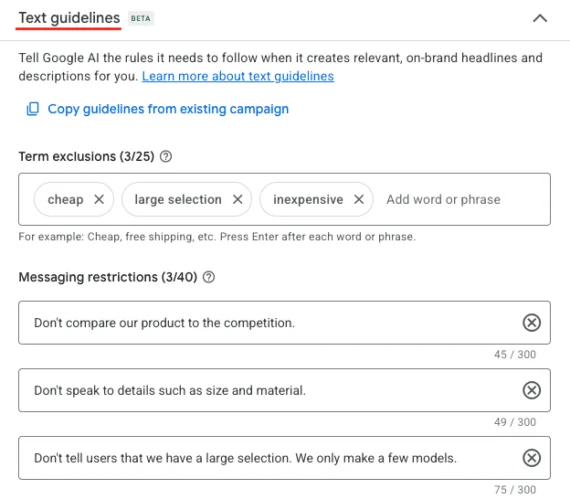
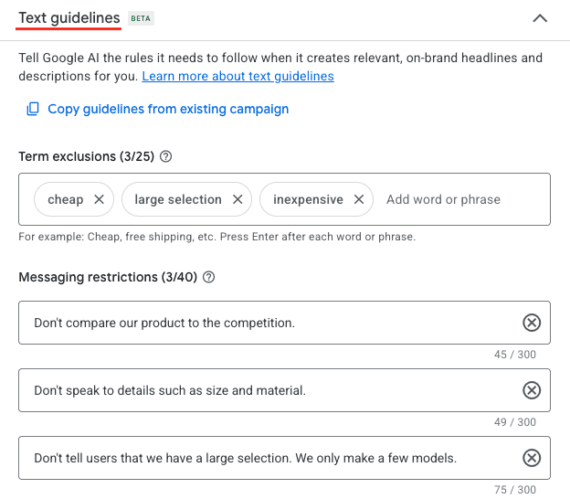
Google Ads has introduced sophisticated tools to address this evolving need, primarily through text guidelines and asset optimizations, available within Performance Max and AI Max Search campaigns. These features act as crucial guardrails for Google’s AI, which dynamically generates ad copy and determines landing page placements. By providing clear directives, advertisers can guide the AI to target the right prospects and, equally important, to actively avoid those whose intent does not align with the brand’s value proposition.
Consider an advertiser specializing in high-quality, premium laptop cases. Their objective is to attract customers willing to invest in superior craftsmanship and durability, rather than those seeking the lowest price point. Traditional negative keywords might struggle to capture the intent behind searches for "laptop cases" from a price-conscious consumer. However, by leveraging text guidelines, this advertiser can explicitly inform the AI that their offerings are not inexpensive. This might involve including terms like "premium," "high-quality," or "durable" in their approved messaging, while simultaneously instructing the AI to exclude searches that imply a focus on affordability. For example, if the AI is trained to understand that terms like "cheap," "budget," or "discount" signal a price-sensitive intent, it can then steer ad delivery away from such queries, even if the explicit keywords are not present. This allows the AI to prioritize prospects who are more likely to resonate with the brand’s premium positioning and ultimately convert.
Similarly, asset optimization offers advertisers granular control over how their creative assets are utilized. In Performance Max campaigns, advertisers can disable automated image and video enhancements, allowing for greater control over brand aesthetics and messaging consistency. Furthermore, asset optimization facilitates text and URL exclusions in both Performance Max and AI Max campaigns. URL exclusions, for instance, are critical for preventing ads from directing users to pages that might contradict the campaign’s objective. For a premium product, directing users to a clearance or sale page could dilute the brand’s premium perception and attract the wrong audience. By excluding such URLs, advertisers ensure that their AI-driven campaigns consistently reinforce their desired brand image and target relevant customer segments.
Unpacking Automated Assets and Their Strategic Management
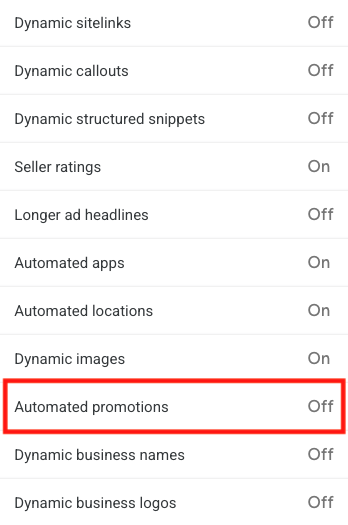
Within the Google Ads interface, a feature known as "Account-level automated assets" holds significant, albeit sometimes overlooked, potential. This functionality allows Google to dynamically populate various components of an ad, including sitelinks, callouts, images, and even promotional elements. Recently, the introduction of automated promotions has become particularly noteworthy, enabling Google to automatically pull discounted items from an advertiser’s website to feature in ads. While this can be a powerful tool for driving sales of promotional items, it requires careful management to ensure brand integrity and alignment with overall campaign objectives.
To access and manage these automated assets, advertisers can navigate through the "Advanced settings" within their Google Ads account. This section provides an overview of the status of various account-level automated assets, including automated promotions. For instance, an advertiser might choose to disable automated promotions if they are currently running a high-end product campaign where discounts are not a primary focus, or if they prefer to curate promotional content manually.
The implications of automated assets extend to brand identity. Google can automate the use of an advertiser’s name and logos, which, if not carefully monitored, could lead to inaccurate or inconsistent branding. Advertisers can view which assets have been added by Google AI by navigating to the "Assets" section in the left-hand navigation and filtering by "Added by: Google AI." This transparency is crucial for maintaining brand control and ensuring that AI-generated assets align with established brand guidelines. By proactively managing these automated assets, advertisers can harness their power without compromising their brand’s integrity or diluting their marketing efforts.
The Strategic Deployment of Optimized Targeting and Audience Expansion
Beyond the direct control over ad content and landing pages, Google Ads offers broader targeting functionalities such as "optimized targeting" and "audience expansion." Search campaigns, by default, may target Google Search Partners and the Display Network unless advertisers opt out. Similarly, campaigns utilizing Demand Gen and Video formats often employ optimized targeting and audience expansion features automatically. While these options are designed to broaden reach and potentially discover new customer segments, they warrant a strategic approach to implementation.
The potential benefit of these features is undeniable; they are designed to identify and engage users who are likely to convert, even if they fall outside the advertiser’s initially defined audience. For example, optimized targeting in display campaigns can leverage AI to show ads to users who have demonstrated intent for similar products or services, even if they haven’t directly searched for the advertiser’s offerings. Audience expansion can broaden the reach of a campaign to similar audiences, potentially uncovering new valuable customer pools.
However, these features can also inadvertently draw budget away from established, high-performing audience segments if not managed with care. A common recommendation is to allow campaigns to run for a sufficient period, gathering robust conversion data, before enabling these broader targeting options. This initial phase allows the AI to learn from the advertiser’s existing, well-defined customer base. Once adequate conversion data is collected, the AI has a stronger foundation upon which to build and expand, making the insights gained from optimized targeting and audience expansion more accurate and beneficial. In essence, the principle of "train the AI first" applies here, ensuring that the subsequent expansion and optimization efforts are built upon a solid understanding of what constitutes a valuable customer for the specific advertiser.
Broader Implications and Future Outlook
The increasing reliance on AI in Google Ads signifies a profound shift in digital advertising strategies. As AI becomes more sophisticated, the ability to provide precise instructions, particularly through exclusion mechanisms, will become a key differentiator for successful campaigns. This moves advertising beyond a purely keyword-driven model to one that deeply understands user intent and brand positioning.
The trend towards AI-driven automation in advertising is not unique to Google. Major platforms are investing heavily in AI to enhance campaign performance, streamline ad creation, and improve targeting accuracy. For advertisers, this means a continuous need to adapt and evolve their strategies. The tools and techniques discussed – text guidelines, asset optimization, careful management of automated assets, and strategic deployment of audience expansion – are not static; they are likely to be further refined and expanded upon by platforms like Google.
The implications of this evolution are far-reaching. For businesses, it promises greater efficiency and potentially higher returns on ad spend, provided they can effectively leverage these advanced AI capabilities. However, it also necessitates a deeper understanding of AI’s inner workings and a proactive approach to data management and campaign setup. The ability to articulate clear exclusion criteria, to define brand guardrails, and to provide the AI with rich, first-party data will become indispensable skills for digital marketers. As AI continues to permeate the advertising ecosystem, the focus on precise control and intelligent exclusion will undoubtedly remain a critical factor in achieving sustained success.

