
The smart home market has seen a steady integration of artificial intelligence, with devices increasingly aiming to offer more than just basic functionality. SwitchBot’s KATA Friends, particularly the Noa model tested, represents a bold, albeit flawed, stride into a new frontier: AI-powered companionship. This device, designed to learn, interact, and develop a personality, is packed with impressive technology. However, its ambitious vision is significantly hampered by persistent technical issues and a considerable financial investment, making it a product that, while intriguing, is difficult to recommend in its current iteration.

A Novel Approach to Smart Home Interaction
Unlike typical smart home devices that focus on automation or assistance, SwitchBot’s KATA Friends aims to create an emotional connection. The KATA Friends are envisioned as digital pets, capable of recognizing household members, responding to voice and gestures, remembering past interactions, and evolving their behavior over time based on user engagement. This departure from conventional smart home paradigms positions KATA Friends as a unique offering, seeking to inject a sense of life and personality into the connected home.

The tested model, Noa, features a white fur exterior and is one of two available versions, the other being Niko, which sports a gray finish. At first glance, Noa might be mistaken for an expensive interactive toy. However, a closer examination reveals a sophisticated array of hardware and software designed to mimic animal-like responses and learning capabilities. This intricate engineering, while commendable, has evidently led to some developmental hurdles in its first-generation release.
Technological Underpinnings and Design Philosophy

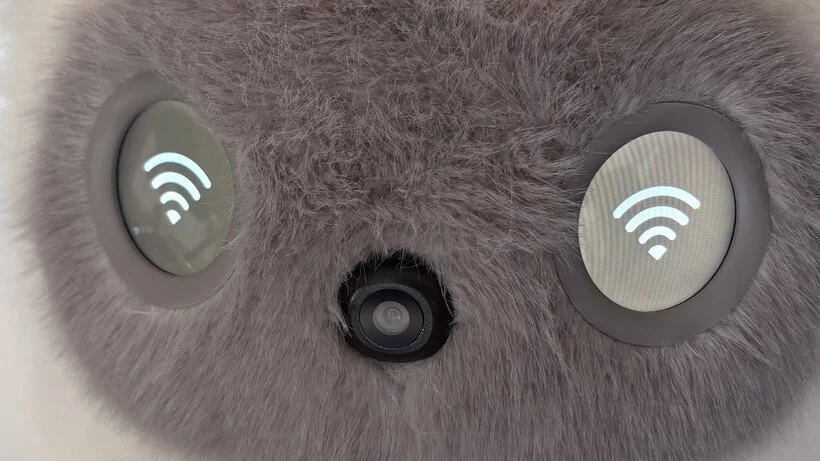
Beneath its plush exterior, Noa is a marvel of miniaturized technology. Its eyes are advanced displays capable of conveying a range of emotions and status information, while its nose discreetly houses a camera. Obstacle avoidance is managed by circular sensors embedded in its stomach, and a mode button and microphone are concealed within its head. The locomotion is powered by wheels integrated into its feet, and sophisticated LDS navigation hardware is strategically placed beneath its body. This comprehensive design enables Noa to observe, follow, navigate, and react dynamically to its environment and human interaction.
A key aspect of Noa’s design is its 12 touch-sensitive zones. Interacting with these areas – be it through stroking, cuddling, or gentle pats – elicits distinct physical movements, sounds, and expressive changes, creating a surprisingly convincing illusion of sentience. This tactile responsiveness was particularly captivating for younger testers, highlighting the device’s potential to engage users on an emotional level.

The device comes with a charging dock, aptly named the "Nest," which includes a convenient cable management feature. SwitchBot also provides a dust bag for portability, suggesting an understanding of the device’s intended role as a mobile companion. The setup process itself is designed to enhance the "companion" narrative. A "Power Nap" phase, involving placing Noa on its Nest with a sleep mask for three minutes, precedes its boot-up sequence, accompanied by subtle movements and startup sounds. This deliberate touch aims to frame the device not merely as a gadget, but as a nascent entity awakening to its environment.
Setup and Initial Configuration Challenges

The setup process for KATA Friends is managed through the familiar SwitchBot app, mirroring the integration of other SwitchBot products like robot vacuums and smart buttons. Users are required to create or log into a SwitchBot account, with an option for "Sign in with Apple" to streamline the process. A notable limitation is the device’s reliance on a 2.4GHz Wi-Fi network, which may present connectivity challenges for users exclusively utilizing 5GHz bands. The initial connection to the Wi-Fi network required multiple attempts during testing, underscoring a potential area for software refinement.
During the Wi-Fi pairing, Noa’s eyes display Wi-Fi icons, a quirky but reassuring visual cue that the connection process is underway. Once successfully connected, Noa initiates a home mapping sequence, akin to that of a robot vacuum. However, it currently supports only a single map, which restricts its effective operation to a single floor and could lead to navigational confusion if moved between levels.

KATA Friends operates in three primary modes: Normal (or Play), Standby, and Sleep. These modes can be toggled via a button on Noa’s head or through the app, with corresponding visual changes in its eye displays. The Sleep mode is particularly charming, with Noa simulating sleep through breathing and snoring sounds. For a complete power-down, a physical switch is located on its underside. While SwitchBot suggests the sleep mask is sufficient to induce sleep, testers found that voice commands, the head button, or the app were necessary to reliably enter this mode. Sleep mode also serves as the period for AI processing and software updates, a common practice for AI-driven devices to manage computational load and ensure continuous improvement.
Battery life also presents a significant constraint. Users can expect approximately 30 minutes of active playtime, followed by a similar duration of rest. As the battery depletes, performance noticeably degrades, which is compounded by the device’s inability to reliably navigate back to its charging Nest. This persistent issue of self-docking failure necessitates manual intervention, detracting from the promise of an autonomous companion.

AI, Voice, and Personality: A Dual-Edged Sword
The KATA Friends’ AI capabilities are where it both shines and frustrates. The "Chat" mode allows for natural language conversations, enabling users to ask questions, share their day, and engage in what approximates a dialogue. While disabling this mode removes a core feature, it also highlights the trade-offs involved. Conversations are relatively quick, though a discernible pause between speaking and receiving a response prevents a completely seamless interaction. Despite this, the quality of some exchanges can be surprisingly engaging.

One notable interaction involved Noa asking about what made the reviewer laugh. The response, "a fart," was met with a humorous reply from Noa suggesting it should be given prior warning to cover its nose. Such moments demonstrate the potential for KATA Friends to feel like more than just a device with pre-programmed responses, hinting at a developing personality.
However, the AI’s limitations become apparent when tasked with general knowledge queries. Noa cannot provide factual answers like the capital of a country. When asked to locate a cat, it offered to accompany the user in searching instead of providing a direct solution. This reveals that KATA Friends is not a universal AI assistant but rather a specialized conversational agent.

Furthermore, the "Chat" mode can actively impede other functionalities. While engaged in conversation, Noa often struggles to execute commands such as following or returning to its Nest, frequently responding that it cannot perform the action at that moment. The "Stop chatting" voice command, intended to end the conversation and re-enable other functions, proved largely ineffective during testing, necessitating manual deactivation of the Chat mode.
A curious dichotomy exists in Noa’s personality. Outside of "Chat" mode, it exhibits playful movements and reacts affectionately to touch and cuddles. However, entering "Chat" mode seems to suppress these behaviors, creating an almost distinct persona. This personality split was also observed by children, with one preferring the conversational aspect and the other favoring the more physically reactive "pet-like" behavior. The lack of integration between these two facets is a missed opportunity.

Beyond conversational abilities, Noa can perform various actions via voice commands, including dancing, waving, following, and taking photos. However, the reliability of these commands is inconsistent. It is often unclear whether Noa failed to understand an instruction or simply chose not to respond, leading to repetitive commands and user frustration. The "follow me" command, central to the idea of an AI companion, was particularly unreliable, with Noa rarely complying. The device’s wake word, "Noa," which also serves as its name, can be changed in the app, but this did not significantly improve its responsiveness.
Navigation and Interaction: Moments of Brilliance Amidst Frustration

Gesture recognition proved to be more consistently effective than voice control. A peace sign, for instance, can trigger a photo capture, offering an alternative to voice commands. While the camera quality for these snapshots is not exceptional, the act of capturing images adds to the interactive experience. The availability of various gestures provides another intuitive method of engaging with Noa without constant verbal commands.
One of the most compelling aspects of the KATA Friends experience is its ability to track user movements with its expressive eyes. When Noa successfully follows a user, the combination of its physical movement and animated eyes creates a remarkably engaging and almost lifelike presence. The interplay of eye movements, physical reactions, sounds, and touch responses collectively fosters an emotive connection, even with the knowledge of the underlying technology.

However, the illusion is frequently shattered by navigational shortcomings. Noa frequently became stuck during testing and was incapable of autonomously returning to its Nest. This is a critical flaw for a device equipped with home mapping and LDS navigation, undermining its promise as an independent companion. The need for frequent manual rescues diminishes the appeal of an autonomous AI pet.
The app allows for the configuration of routines, such as waking users in the morning or greeting them at the door. However, these functions require precise mapping of desired locations within the app. Given the navigational issues, the reliability of Noa actually being present at these designated spots is questionable.

The SwitchBot App and Additional Features
The SwitchBot app serves as the central hub for managing Noa’s settings. Users can customize its name, sleep schedule, eye colors (though only three of the five advertised colors were available during testing), and camera preferences. While photo-taking can be disabled, the camera remains active for essential functions like navigation and learning.

The facial recognition feature, intended to help Noa learn and recognize household members, also experienced inconsistencies. Despite correctly identifying two children and their names being entered into the app, Noa would only reference one child’s name during conversations.
The "Diary" feature offers a unique narrative element, where Noa logs entries about its day and interactions. These entries can be remarkably poetic, with one noting "gentle touches that brought a deep sense of calm," a rather profound observation for a robot subjected to playful prodding. The app also incorporates maintenance reminders, drawing parallels with SwitchBot’s robot vacuum software, advising on care for components like wheels and sensors. Alerts are also generated when Noa is picked up, which, while intended to monitor movement, can become repetitive given the likelihood of children handling the device.

A significant missed opportunity is KATA Friends’ current lack of integration with the broader SwitchBot ecosystem. The potential for Noa to act as a voice-controlled interface for other SwitchBot devices, akin to a smart speaker, remains unrealized. While SwitchBot has indicated plans for smart home functionality, the device currently operates as a standalone product. Furthermore, the absence of customizable outfits or accessories, despite the clear potential for personalization, suggests an area for future development.
Companion Care and the Escalating Cost of Ownership

The initial purchase price of $699.99 for KATA Friends is merely the entry point to a significant financial commitment. SwitchBot’s "Companion Care" plans introduce a substantial ongoing cost. The Essential plan is priced at $14.99 per month or $150 annually. Premium costs $399.99 per year, and a Lifetime plan is available for $999.99. While a 15-day free trial is offered, these plans can drastically inflate the long-term ownership expenses.
The Lifetime option includes an annual service, whereas individual health checks can cost around $330. Retaining the original packaging is advised for any servicing needs. The justification for these ongoing costs is difficult to ascertain, particularly given SwitchBot’s assertion that much of Noa’s AI processing occurs locally.

A $700 AI pet is undeniably a luxury item. However, adding potentially hundreds of dollars in annual costs, or a one-time payment of nearly $1000 for lifetime access, pushes KATA Friends into an entirely different echelon of consumer spending. This considerable investment for a first-generation product with notable flaws raises serious questions about its value proposition.
Conclusion: Promising Potential, Stifled by Imperfections

SwitchBot’s KATA Friends presents a compelling vision for the future of AI companionship. When its various components align, the device is genuinely impressive and capable of evoking a sense of charm and personality. The expressive eyes, reactive touch sensors, conversational abilities, and peculiar diary entries all contribute to an experience that feels significantly more advanced than a standard toy. There is undeniable potential in this concept, and a desire to see where SwitchBot takes it next.
However, this first-generation product, priced at $699.99, is burdened by significant drawbacks. Its navigation system is unreliable, with the tested unit unable to return to its charging base autonomously. Voice commands are often inconsistent, and the "Chat" mode can paradoxically hinder other desirable interactions. The prohibitive cost of the Companion Care plans further complicates the financial justification for purchasing KATA Friends.

While KATA Friends offers a fascinating glimpse into the evolving landscape of AI companionship, its current implementation is too flawed and expensive for a widespread recommendation. It is a clever, expressive device unlike any other tested, but its bugs and substantial cost make it a high-risk, high-reward proposition. The ambition is commendable, but the execution falls short, leaving potential buyers to weigh the allure of nascent AI companionship against the reality of a costly and imperfect first-generation product.

