
The digital marketplace is undergoing a profound transformation, driven by the rapid evolution of artificial intelligence, particularly in the realm of search and shopping. For e-commerce marketers, this shift presents an unprecedented opportunity to connect with consumers by understanding and catering to their nascent desires, even when those desires are not yet fully articulated. The traditional marketing concept of "intent"—whether purchase intent or informational intent—is being redefined and amplified by AI, paving the way for more precise and effective consumer engagement strategies. This new paradigm, centered around "product intent clusters," promises to revolutionize how businesses influence AI-driven product discovery and ultimately drive sales.
The foundation of modern marketing has long rested on identifying a consumer’s need or desire. Terms like "purchase intent," signaling a clear readiness to buy, and "informational intent," indicating a desire to learn more before making a decision, have been cornerstones of targeting strategies. These concepts have guided marketers in segmenting audiences and tailoring their messages to meet prospects at various stages of the buyer’s journey. However, the advent of sophisticated AI, particularly generative AI chatbots like Claude, Gemini, and ChatGPT, is fundamentally altering the nature of consumer queries and, consequently, the opportunities for marketers.
The shift is most evident in the stark contrast between traditional keyword searches and conversational AI interactions. A conventional search engine query is typically concise, averaging around four words. For instance, a shopper looking for a coffee grinder might simply type "small simple coffee grinder." This brevity, while efficient for human operators, offers limited insight into the nuances of the user’s needs. In contrast, AI-powered conversational search allows for much more detailed and context-rich inquiries. A user engaging with an AI assistant might ask, "I live in a small apartment and need a quiet coffee grinder that’s easy to clean and works well for making pour-over coffee, without making a mess." This more elaborate query, often exceeding 20 words—with some analyses by Semrush pointing to an average of 23 words for ChatGPT queries in 2026—provides a wealth of information about the user’s specific circumstances and preferences.
This expansion in query complexity is where the true AI opportunity lies. While both the simple and complex queries might ultimately lead to a similar product recommendation, such as a conical burr grinder, the latter query unveils a deeper understanding of the shopper’s context. It highlights not just the need for a coffee grinder, but also specific constraints and desired functionalities: a need for quiet operation, suitability for small living spaces, ease of use for pour-over brewing, and a desire for a mess-free experience. This detailed articulation of needs, facilitated by AI’s conversational capabilities, presents a golden opportunity for marketers to showcase products that precisely match these nuanced requirements.
The Architecture of Product Intent Clusters
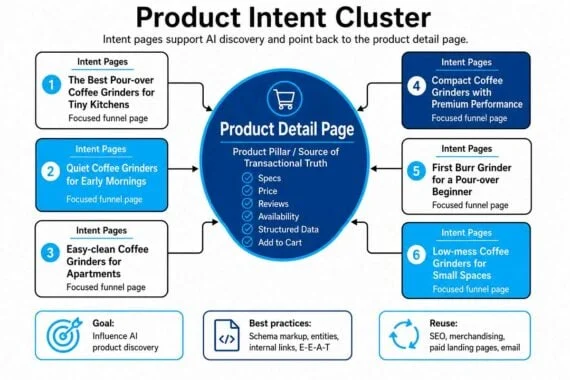
To effectively capitalize on these increasingly detailed AI-driven queries, e-commerce marketers are being encouraged to adopt a new content strategy: the creation of "product intent clusters." These clusters are conceptualized as a familiar hub-and-spoke model, with the product detail page (PDP) serving as the central "hub." Radiating outwards are numerous "spokes," each representing a specific shopper scenario or intent, meticulously crafted to address particular use cases and informational needs.
These product intent clusters bear a resemblance to traditional topic clusters or content silos, which have long been employed in SEO to organize content around broad themes. However, product intent clusters are distinct in their granular focus on specific user needs, practical applications, and individual customer scenarios. Their primary objective is to comprehensively inform and influence AI product discovery algorithms, guiding them to surface relevant products when a user articulates a particular set of needs.
At the core of this strategy is the product detail page. This page remains the ultimate arbiter of a purchase decision, housing critical information such as product specifications, pricing, customer reviews, availability, and structured data that facilitates AI understanding. It is the page designed for conversion, and its structured nature makes it inherently rankable, extractable, and interpretable by AI systems as a distinct entity.
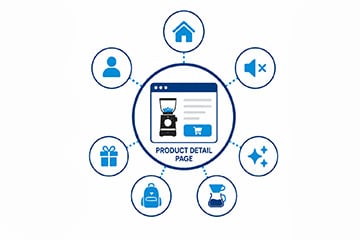
The supporting pages within a product intent cluster are designed to complement the PDP by addressing a specific facet of shopper intent. These pages can encompass a wide range of content types and informational angles, collectively guiding the AI and the user towards the central product. Examples of content within these clusters, as illustrated by diagrams of product intent cluster structures, can include:
- "The Best Pour-over Coffee Grinders for Tiny Kitchens": This targets a specific use case and a common lifestyle constraint, directly addressing the detailed query example.
- "Quiet Coffee Grinders for Early Mornings": This focuses on a functional requirement that enhances user experience and addresses a specific time-based need.
- "Easy-to-Clean Coffee Grinders for Mess-Free Brewing": This highlights a practical benefit and addresses a common pain point for coffee enthusiasts.
- "Compact Coffee Grinders for Small Apartments": This directly addresses the space limitations mentioned in the AI query.
- "Coffee Grinders Optimized for Single-Serve Brewers": This targets a specific brewing method, catering to a segment of coffee drinkers.
- "Durable Coffee Grinders for Frequent Use": This speaks to the longevity and reliability of the product, appealing to a value-conscious consumer.
These intent pages are not merely descriptive; they are engineered to influence AI responses. By combining rich content, strategic merchandising, and direct links to the product detail page, marketers can effectively shape how AI systems interpret and respond to complex user queries. This approach mirrors the evolution of organic search optimization, where long-tail content played a crucial role in capturing specific search queries and driving targeted traffic.
Crafting Intent Pages for AI and Humans
The supporting pages within a product intent cluster are deliberately funnel-focused, designed to guide a shopper through a specific decision-making process. A general query like "best coffee grinders for pour-over" is deemed too broad. Instead, an effective intent page delves into the shopper’s actual situation. For instance, "best pour-over coffee grinders for tiny kitchens" acknowledges not only the desired brewing method but also the practical constraints of limited counter space, potential noise concerns, and the need for straightforward cleaning.
Each intent page should aim to seamlessly guide the shopper towards a purchase by providing relevant, actionable information. This includes:
- Detailed Use Case Analysis: Explaining how the product excels in the specific scenario outlined in the intent page title.
- Comparative Information: Highlighting how the product stacks up against alternatives within that specific use case.
- Problem/Solution Framing: Clearly articulating the shopper’s problem and positioning the product as the ideal solution.
- Feature Highlighting: Emphasizing the product features that directly address the needs described in the intent.
- User Testimonials/Reviews: Incorporating snippets or links to reviews that validate the product’s performance in the described scenario.
- Direct Calls to Action: Providing clear pathways to view the product details, compare options, or add to cart.
Crucially, these intent pages must adhere to traditional search engine optimization best practices. This includes implementing Schema.org structured data markup to help AI understand the content’s context and purpose, and strategically using entities to represent key concepts and relationships. While the primary audience for these pages is increasingly AI bots, they must also remain highly useful and readable for human consumers. The ultimate goal is to provide a rich, informative experience that builds confidence and facilitates a purchase decision, while simultaneously ensuring that AI systems can accurately parse and utilize the information. Marketers are encouraged to develop dozens, if not hundreds, of these intent pages per product to cover the full spectrum of potential user needs and AI queries.
The AI-Driven Unlocking of Niche Markets
The rise of generative AI presents a significant shift in the economic viability of creating such detailed and specialized content. Prior to the widespread adoption of generative AI, e-commerce marketing teams often found it challenging to justify the substantial investment in researching, outlining, writing, optimizing, and maintaining a dedicated page for a niche use case like "the best pour-over coffee grinders for tiny kitchens." The perceived ROI was often too low, the labor costs too high, and the potential benefit too uncertain. The market for such specific information was deemed too narrow to warrant the resources.
However, the landscape has changed dramatically. Automation and generative AI technologies are now capable of producing and maintaining a vast number of high-quality intent pages with remarkable efficiency and precision. This capability is further enhanced by the ability of AI to analyze structured customer feedback, such as support tickets, product reviews, and forum discussions. By feeding this data into generative AI platforms, marketers can not only automate content creation but also identify the most relevant and valuable topics for their intent pages, ensuring that the content directly addresses real-world customer pain points and desires.
In essence, generative AI is empowering marketers to cater to the "unknown unknowns" of consumer intent. When shoppers are unsure of precisely what they want, or when their needs are complex and multifaceted, they are increasingly turning to AI assistants for guidance. Product intent pages provide these AI systems with the necessary information and context to connect a shopper’s articulated need with a specific product offering, thereby driving conversion. This symbiotic relationship between AI-driven search and strategically crafted content is poised to unlock new avenues for product discovery and sales, allowing businesses to reach and resonate with consumers on a more personalized and precise level than ever before. The implications for market segmentation, content strategy, and overall customer engagement are profound, marking a new era in e-commerce marketing.

