
A sweeping new European Union regulation, Regulation (EU) 2024/1689, colloquially known as the "E.U. AI Act," aims to usher in an era of transparency regarding artificial intelligence-generated content. However, the mechanism designed to identify "synthetic" content is sparking significant concern among marketing professionals, who fear it could inadvertently create a powerful infrastructure for surveillance and censorship, potentially undermining the cost-effectiveness and accessibility of AI-driven content creation.
At its core, the AI Act mandates that content produced by AI systems must be machine-detectable. While proponents champion this as a vital step towards combating misinformation and ensuring accountability, critics argue that the underlying technology could be leveraged by governments and platforms to scrutinize, segregate, and even suppress text based on its origin rather than its inherent merit or accuracy. This shift in regulatory focus has prompted immediate responses from leading AI developers, with Anthropic already announcing that all future iterations of its Claude models will incorporate identifiable, text-based "watermarks." It is widely anticipated that other major AI companies will follow suit to comply with the new regulations and maintain market access within the EU.
The Genesis of the AI Act and the Drive for Identification
The journey towards the E.U. AI Act has been a multi-year process, reflecting the accelerating integration of AI into various facets of society and the growing apprehension surrounding its potential societal impacts. Discussions and drafting phases began in earnest following the widespread public introduction of advanced generative AI models in late 2022 and early 2023, which demonstrated a remarkable ability to produce human-like text, images, and code. Policymakers across the globe grappled with how to harness the benefits of AI while mitigating risks such as deepfakes, automated disinformation campaigns, and the erosion of trust in digital content.
The E.U.’s approach, culminating in the AI Act, prioritizes a risk-based framework, categorizing AI applications according to their potential harm. Generative AI, particularly its ability to create synthetic content, falls under scrutiny due to its capacity for widespread dissemination and potential for misuse. The requirement for machine-detectability is a direct response to the challenge of discerning AI-generated material from human-created content, a distinction that has become increasingly blurred.
Early attempts to identify AI-generated text often relied on stylistic cues – the perceived use of em dashes or colons, for instance. However, these methods are inherently unreliable. Punctuation marks and stylistic choices are fundamental elements of language that predate modern AI and are employed by writers of all backgrounds. Furthermore, AI models are continually evolving, becoming more adept at mimicking human writing styles. This rapid evolution renders static detection methods quickly obsolete. As AI-generated text becomes more sophisticated and indistinguishable from human writing based on superficial characteristics, a more robust and embedded method of identification became necessary to satisfy regulatory demands. The E.U.’s mandate thus pushed developers towards more sophisticated, embedded detection technologies.
Anthropic’s Watermarking Solution: SynthID-Text
In anticipation of and in direct response to the AI Act’s requirements, Anthropic has revealed its adoption of a text-based watermarking technique developed by Google, known as SynthID-Text. This innovative approach embeds a subtle, statistically significant pattern within the generated text itself, allowing for detection without the need to re-query the large language model (LLM) that created it, nor requiring extensive computational resources or reliance on external databases.
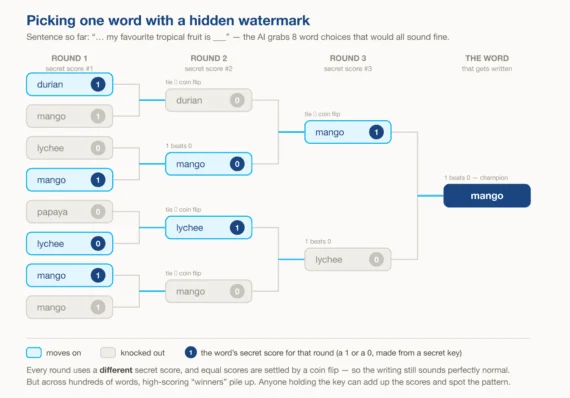
The fundamental principle behind SynthID-Text, and indeed many other watermarking technologies, lies in the probabilistic nature of LLMs. When an AI model is tasked with generating text – whether it be a blog post, a product description, or an email marketing campaign – it operates on a token-by-token basis. A "token" can be a word, part of a word, punctuation, or a number, representing a fundamental unit of data in natural language processing. The AI model begins with an initial token and then, using complex statistical algorithms and vast training data, predicts the most probable next token. For example, if prompted with "My favorite tropical fruit is…", the AI will consider a range of statistically plausible options such as "mango," "durian," "lychee," or "papaya."

The "Tournament" Mechanism: Weaving the Watermark
SynthID-Text leverages this probabilistic decision-making process to embed a watermark. Instead of simply selecting the single most probable token, the system introduces a subtle bias. This bias is akin to a hidden scoring system that influences the AI’s choices. The process can be conceptualized as a series of "tournaments" for each token selection.
Imagine the AI is deciding on the next word after "My favorite tropical fruit is." SynthID-Text might present a bracket of plausible candidate words. Through a series of internal, statistically weighted comparisons – the "tournament" – a particular word is "selected" as the next token. This selection is not purely random, nor is it always the absolute most statistically probable choice from the AI’s perspective. Instead, the watermark mechanism subtly nudges the probabilities, ensuring that the chosen token, when analyzed in aggregate, reveals a pattern indicative of AI generation.
The crucial aspect of this "tournament" is that it doesn’t make every single token choice overtly predictable. A word like "mango" might emerge as the winner in one sentence, while in a slightly different context or with a different internal "seed" for the random number generator, "durian" might be chosen. This variability is key to making the watermark difficult to detect by simple analysis and ensures that the generated text still reads naturally.
However, the power of SynthID-Text lies in the accumulation of these subtle nudges over many token selections. A single instance of a "watermarked" choice might be statistically insignificant. But when hundreds or thousands of tokens in a passage have been generated under the influence of this hidden scoring system, a discernible statistical pattern emerges. This aggregate pattern is the watermark. It signifies that the sequence of token choices deviates from what would be expected by pure chance or standard LLM prediction, indicating the presence of an embedded generative influence.
Detection: Unraveling the Statistical Thread
The process of detecting this watermark involves a specialized "detector" algorithm. This algorithm, armed with the secret key or parameters that govern the watermarking process, can deconstruct a given passage of text. It breaks the text down into its constituent tokens and, crucially, can reconstruct the "tournament scores" for each token selection. By comparing the actual sequence of token choices against the expected probabilities influenced by the watermark, the detector can calculate a score.
If the sequence of token choices in a passage correlates strongly enough with the watermark’s statistical signature to exceed a predefined detection threshold, the passage is flagged as AI-generated or, at the very least, AI-assisted. The effectiveness of detection increases with the length of the text. A short passage might contain only a few statistically influenced token choices, which could potentially occur by chance. However, a longer piece of writing, such as a comprehensive report or a lengthy marketing article, provides a larger sample size, making the aggregate statistical pattern more robust and the watermark more reliably detectable.
Conversely, the watermark’s detectability can be influenced by the nature of the content. Text that is heavily factual, relies on precise data, or is extensively edited and refined by human input might present fewer opportunities for the watermark to manifest distinctively. In such cases, the model may have fewer acceptable token choices available, or the human intervention might override the subtle statistical biases. Nevertheless, any text that surpasses the detection threshold is likely to be identified.
Implications for Marketers: Navigating the New Landscape
The advent of reliable AI content detection technology presents a significant paradigm shift for marketing professionals, particularly those in e-commerce. One of the primary advantages of generative AI for marketers has been its ability to dramatically lower the cost and increase the speed of content creation and repurposing. Small teams, or even individual marketers, can now produce a volume and variety of content – from website copy and social media posts to email newsletters and product descriptions – that was previously only achievable with much larger budgets and dedicated teams.

The ability to easily identify AI-generated text introduces the potential for content segregation and even censorship. Search engines, social media platforms, LLMs used for research, and email clients could develop mechanisms to identify and then act upon AI-generated content. This action could manifest in several ways:
- Search Engine De-prioritization: Search engines like Google, which have historically prioritized quality and originality, might begin to discount or downrank pages predominantly composed of AI-generated text. While Google has stated it does not penalize AI content per se, a consistent pattern of low-quality or unoriginal AI-generated content could impact rankings. The AI Act’s identification capabilities could provide a direct signal for such de-prioritization.
- LLM Source Avoidance: AI models that serve as research tools or content aggregators might be programmed to avoid citing or referencing AI-generated sources, fearing that they might perpetuate misinformation or lack original insight.
- Social Media Distribution Reduction: Platforms like Pinterest have already begun to experiment with reducing the visibility of AI-generated content. The AI Act’s mandated detectability could accelerate this trend across various social networks, limiting the reach and engagement of AI-assisted marketing campaigns.
- Email Filtering: Email clients could potentially route AI-generated marketing emails to spam folders or a dedicated "likely AI" category, significantly reducing open rates and conversion opportunities.
This potential for discrimination against AI-generated content poses a direct threat to the efficiency gains that marketers have come to rely on. If AI-generated content is systematically devalued, the cost-effectiveness of using these tools diminishes, potentially forcing businesses to revert to more labor-intensive and expensive content creation methods.
The Imperfect Nature of Detection and Future Considerations
It is crucial to acknowledge that AI detection systems, even those based on sophisticated statistical methods like SynthID-Text, are not infallible. Detection is inherently statistical, and like any statistical analysis, there is a risk of false positives and false negatives. If the detection threshold is set too low, a significant number of human-written or AI-assisted pieces might be incorrectly flagged as purely AI-generated. Conversely, if the threshold is too high, genuine AI-generated content might evade detection.
The ongoing evolution of AI technology also presents a continuous challenge. As AI models become more sophisticated, and watermarking techniques are developed, so too will methods to circumvent them. This creates an ongoing arms race between AI developers, regulators, and those seeking to identify or disguise AI-generated content.
For marketers, the immediate future demands a strategic re-evaluation of their content creation workflows. While the E.U. AI Act is specific to the European Union, its influence is likely to be global. Companies operating in or targeting the EU market will need to comply, and the technological solutions developed for this regulation may well become industry standards elsewhere.
Marketers should consider a hybrid approach, leveraging AI for efficiency in drafting, ideation, and content repurposing, but ensuring that human oversight, editing, and creative input remain paramount. This approach not only helps to maintain content quality and originality but also provides a buffer against potential misclassification by AI detection systems. Understanding the nuances of AI watermarking and detection will become an increasingly important skill set for digital marketing professionals navigating the evolving regulatory and technological landscape. The balance between AI-driven efficiency and the preservation of trust and authenticity in digital communication remains a critical challenge, and the E.U. AI Act has undeniably brought this challenge into sharper focus for the marketing industry.

