
The traditional lifecycle of a corporate website follows a predictable and often frustrating trajectory: a period of intense development, a brief moment of "launch day perfection," and a subsequent, slow descent into obsolescence. This phenomenon, often referred to as digital decay, occurs not because the underlying code fails, but because the pace of market shifts, design trends, and technological standards quickly outstrips the capacity of human teams to provide continuous updates. Pierre Burgy, co-founder of the autonomous website platform Fimo, argues that while the technology now exists to create "autonomous websites" that optimize themselves, the primary barrier to adoption is a fundamental human tension between the desire for efficiency and the need for creative control.
The Phenomenon of Digital Decay and Technical Debt
In the current digital economy, a website is the primary storefront for most enterprises. However, data suggests that the average lifespan of a website before a major redesign is only two to three years. According to industry benchmarks, nearly 90% of websites are considered "outdated" within 24 months of their initial launch. This is rarely due to a lack of initial investment; rather, it is the result of "drift." As messaging shifts, competitors launch new features, and design systems evolve, the static codebase of a traditional site becomes a "period piece"—a snapshot of the company as it existed on launch day.
The labor required to combat this drift is immense. Maintenance tasks—such as optimizing images for new device standards, ensuring accessibility compliance, and propagating design system updates—are often sidelined in favor of high-level strategic projects. Consequently, technical debt accumulates. A 2023 study on web accessibility found that 96.3% of the top one million homepages had detectable WCAG 2 failures, a statistic that highlights the inability of manual oversight to keep pace with evolving web standards.
The Rise of Autonomous Agents in Web Architecture
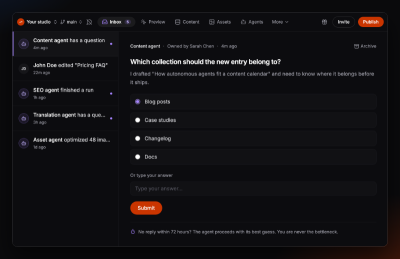
The proposed solution to this stagnation is the autonomous website: a platform where AI-driven agents continuously monitor, edit, and optimize the site post-launch. In theory, these agents function as a 24/7 maintenance crew. While a human team sleeps, an agent might identify that a recent design system change failed to update the pricing page and deploy a fix. Another might compress unoptimized assets shipped in a hurried release, while a third flags accessibility regressions introduced by new components.
However, as Burgy and the team at Fimo discovered during the development of their platform, the transition to full autonomy is met with significant resistance. The challenge is not a lack of trust in the AI’s technical capability, but rather the fact that a website has no single owner. Different departments—marketing, design, and engineering—each claim sovereignty over different aspects of the digital experience. This leads to a complex management problem: where does the "line" of autonomy sit, and who gets to draw it?
The Hierarchy of Web Autonomy: Chores vs. Judgment
To address the hesitation of stakeholders, the work of maintaining a website must be categorized into three distinct tiers. This framework allows organizations to delegate repetitive tasks while retaining control over brand identity and strategic decisions.
1. The Rule-Bound Chores (The "No-Brainers")
The vast majority of website maintenance—estimated at nearly 80% of the total workload—consists of repetitive, rule-based tasks. This includes SEO meta-tagging, link rot repair, image optimization, and basic accessibility compliance. Because these tasks are defined by objective rules rather than subjective taste, they are ideal candidates for full autonomy. Delegating these "chores" does not threaten the creative roles within a company; instead, it liberates designers and developers from the "joyless" aspects of their jobs.
2. The Untouchable Creative Core
At the opposite end of the spectrum is work that requires human judgment and "taste." An AI agent can confirm that a page meets contrast requirements or follows a style guide, but it cannot determine if a design "feels" right or if the emotional resonance of the copy aligns with a brand’s long-term vision. This tier remains the exclusive domain of human professionals. The resistance to autonomous websites often stems from the fear that AI will encroach upon this creative core, making it essential for platforms to offer granular "off-switches" for high-stakes brand elements.
3. The Ambiguous Middle: The Perspective Gap
The most significant friction occurs in the middle tier, where a task’s suitability for automation depends entirely on the observer’s role. For example, changing a website’s default theme to "dark mode" is a technical task that a developer might happily delegate to an agent. However, for a lead designer, that same change is a major brand statement that dictates how the company is perceived. This "perspective gap" necessitates a system where autonomy is not a binary toggle but a per-task, per-person setting.
Chronology of Development: From Full Autonomy to Managed Control
The development of autonomous web technology has moved through several distinct phases over the last decade:
- 2010–2018: The Era of Static CMS. Websites were updated manually via Content Management Systems. Automation was limited to basic plugins and scheduled posts.
- 2019–2022: The Integration of Narrow AI. Tools for automated SEO auditing and basic image compression became standard, but they remained reactive rather than proactive.
- 2023–Present: The Shift to Proactive Agents. Platforms like Fimo began experimenting with agents that not only identify problems but also propose and deploy solutions.
- The Future: The "Earned Trust" Model. The industry is moving toward a model where agents start with narrow permissions and gain more autonomy as they demonstrate reliability through a history of successful, audited changes.
Industry Reactions and Stakeholder Analysis
The response to the prospect of autonomous websites is split along departmental lines. Chief Technology Officers (CTOs) generally view the technology as a means to reduce "ops" overhead and ensure site performance remains high without increasing headcount. Conversely, Creative Directors express concern regarding "algorithmic beige-ness"—the risk that autonomous optimization will smooth over the unique, idiosyncratic design choices that make a brand stand out.
"The point of autonomy was never to remove the human from the website," Burgy noted in his analysis. "It was to remove the decay." This sentiment is echoed by many in the DevOps community who argue that the real risk is not an over-active AI, but a "frozen" site that slowly loses relevance.
Broader Implications for the Digital Workforce
The shift toward autonomous websites suggests a fundamental change in the roles of web professionals. Developers may transition from "builders" to "architects of agents," focusing on the logic and boundaries within which AI operates. Designers may spend less time on the minutiae of component states and more on high-level brand strategy and user experience flows.
Furthermore, the "Living Web" model could disrupt the traditional agency-client relationship. If a website can optimize itself, the need for expensive, recurring maintenance retainers may diminish, forcing agencies to pivot toward high-value strategic consulting and specialized creative services.
Conclusion: The Risk of the Frozen Site
While the technical hurdles of autonomous agents are being rapidly cleared, the psychological hurdle remains. Organizations must weigh the risk of an agent making a minor aesthetic error against the certain risk of a site that never changes. A static website is a decaying asset; it represents a company that no longer exists in a market that has already moved on.
The path forward lies in "managed autonomy"—a system where trust is earned incrementally. By starting with rule-bound chores and slowly widening the scope of delegation, teams can ensure their digital presence remains as sharp and effective as it was on launch day. The goal is a website that doesn’t just work, but one that actively improves while its creators focus on the next big challenge. In this new paradigm, the "best version" of a website is no longer the one that ships on day one, but the one that has evolved to meet the demands of day one thousand.

