
The efficacy of AI-generated marketing content is intrinsically linked to its ability to capture organic traffic from search engines, large language models (LLMs), and platforms like Google Discover. Content marketing, at its core, is designed to attract, engage, and retain customers. For e-commerce marketers, the initial attraction phase often holds paramount importance. Historically, this attraction was predominantly driven by search engine optimization (SEO). Content that ranked well on search engine results pages (SERPs) generated valuable website visits, effectively feeding the top of the sales funnel. While customer retention remains a crucial aspect of marketing strategy, the primary function of content marketing has consistently been prospect acquisition.
The advent of ubiquitous artificial intelligence presents a complex, dual-edged scenario for content marketers. On one hand, AI has dramatically reduced the perceived cost and effort associated with content production, particularly for generating content that serves a utilitarian purpose. However, this accessibility has also led to an internet inundated with a significant volume of relatively low-value content. Concurrently, AI has fundamentally altered consumer search behaviors and consumption patterns.
The Shifting Tides of Search and Discovery
A pivotal moment in this evolution was the Google algorithm update in February 2026, which placed a significant emphasis on Google Discover. According to analysis by DiscoverSnoop, a research firm specializing in Google Discover performance, this update resulted in substantial losses of Discover exposure for several prominent websites. This shift underscores a broader trend: search engines and content discovery platforms are increasingly prioritizing content that demonstrates genuine value, authority, and a user-centric approach, rather than sheer volume.
The implications of such algorithm updates, coupled with the rise of zero-click search results—where users find answers directly on the SERP without needing to click through to a website—and evolving consumer behaviors, have created a challenging feedback loop for AI-generated content. As organic traffic across traditional search, LLM queries, and content feeds begins to decline, the perceived cost of producing impactful content rises. In an effort to mitigate this rising cost, marketers are increasingly turning to AI for content generation. However, this proliferation of AI-generated content intensifies competition, paradoxically leading to diminished performance and further exacerbating the decline in visibility.
A significant challenge arises from the homogeneity that can characterize AI-generated content. When numerous articles are produced using similar AI models and identical prompts, they tend to exhibit a striking similarity in tone, structure, and substance. This phenomenon has been described as "AI slop" in the context of content marketing, where the ease of production overshadows the creation of truly unique and engaging material. The result is a digital landscape where differentiating oneself becomes increasingly difficult.
The Imperative of Quality in the Age of AI
A year ago, the primary advantage offered by AI in content marketing was speed and cost reduction. This competitive edge has largely eroded as the technology has become more widely adopted. The new differentiator is no longer the mere existence of AI-assisted content, but the quality of its execution. Modern content marketers must now focus on producing AI-assisted content that is meticulously structured, thoroughly validated, and expertly refined. In practical terms, this translates to a significant elevation in content quality.
A crucial first step for marketers is to overcome any inherent bias against AI-generated content. It is essential to recognize that AI, when guided by human expertise, can produce content that is at least on par with, and often superior to, human-generated text. This was subtly demonstrated in a March 2026 quiz published by The New York Times, which pitted human-written prose against an AI-generated rewrite. Astonishingly, approximately half of the quiz participants expressed a preference for the AI-generated versions, highlighting the increasing sophistication of AI writing capabilities.
Secondly, there needs to be a fundamental belief in the potential for AI-assisted content to be systematically optimized and refined. This requires a shift in mindset from viewing AI as a purely automated content factory to recognizing it as a powerful tool that, when integrated into a robust workflow, can enhance human creativity and strategic insight.
A 12-Step Framework for Elevating AI-Generated Content
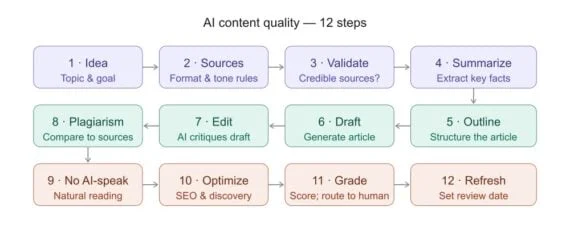
The path to improving AI-generated content lies not solely in refining prompts, but more importantly, in establishing superior processes. A practical and systematic approach involves treating content generation as a series of distinct steps. Each stage is designed to imbue the content with greater structure, mitigate potential risks, and ultimately enhance its overall quality. While human editors can and should be involved at any stage, these steps outline a general workflow where AI can play a significant role in content automation.
1. Idea Generation & Goal Definition: The process begins with clearly defining the core topic and the overarching goal of the content. This includes identifying the target audience and the desired outcome, whether it’s brand awareness, lead generation, or customer education.

2. Source Identification & Rule Setting: This stage involves identifying credible and relevant sources of information. Crucially, it also entails establishing clear rules for the AI regarding format, tone, and stylistic guidelines to ensure the content aligns with brand voice and objectives.
3. Validation of Sources: Before content is generated, the credibility and accuracy of the identified sources must be rigorously validated. This step is critical for preventing the spread of misinformation and ensuring the factual integrity of the final output.
4. Summarization of Key Facts: The AI is tasked with extracting and summarizing the most crucial facts and insights from the validated sources. This condensation process ensures that the core information is readily available for subsequent content creation.
5. Outline Creation: Based on the summarized facts and the defined goals, the AI constructs a logical and coherent outline for the article. This structured approach ensures that the content flows well and covers all essential points.
6. Drafting the Content: With the outline in place, the AI proceeds to generate the initial draft of the article. This is where the raw information is transformed into prose, adhering to the established tone and format rules.
7. AI-Assisted Editing & Critique: Once the draft is complete, the AI can be employed to perform an initial critique. This involves identifying grammatical errors, awkward phrasing, and areas where clarity or coherence could be improved.
8. Plagiarism and Source Comparison: A critical step involves comparing the generated content against the original sources to ensure originality and prevent unintentional plagiarism. This also helps in verifying that the AI has accurately represented the information from its inputs.
9. Natural Language Refinement (Eliminating "AI-Speak"): This stage focuses on refining the language to ensure it reads naturally and avoids the robotic or overly formal tone sometimes associated with AI-generated text. The goal is to create content that resonates with human readers.
10. Optimization for Search and Discovery: The content is then optimized for search engines and discovery platforms. This includes incorporating relevant keywords, ensuring appropriate meta descriptions, and structuring the content for maximum visibility on platforms like Google Discover.
11. Quality Grading and Human Review Routing: A scoring mechanism can be implemented to grade the quality of the AI-generated content based on predefined metrics. Content that falls below a certain threshold can be automatically routed for human review and further editing.
12. Scheduled Refresh and Maintenance: To maintain relevance and accuracy, a review date is set for the content. This ensures that articles are periodically refreshed to incorporate new information, adapt to changing trends, and maintain their search engine performance.
The Future of Content: Excellence Over Volume
Artificial intelligence has undeniably democratized content production, significantly lowering the barrier to entry and reducing the cost associated with creating written material. However, it has not lowered the standard required to achieve genuine market impact. In fact, the opposite is true: the bar for effective content has been raised. The digital landscape is saturated, and standing out requires more than just a presence; it demands excellence.
The marketers who will ultimately succeed in 2026 and beyond are those who can harness AI not as a substitute for human ingenuity, but as a powerful amplifier of it. These are the professionals who will prioritize generating the best content, characterized by its depth, accuracy, originality, and reader engagement, rather than simply the most content. The focus has irrevocably shifted from quantity to a sophisticated, AI-assisted pursuit of quality. This evolution necessitates a strategic integration of AI into content workflows, ensuring that technology serves as a tool to enhance human creativity, critical thinking, and strategic marketing objectives. The future of content marketing is not about being replaced by AI, but about intelligently collaborating with it to achieve unprecedented levels of excellence and impact.

