
In an increasingly crowded marketplace, a fundamental shift is redefining the relationship between consumers and brands. The era of simply selling products based on utility or price is rapidly ceding ground to a more profound strategy: the creation of immersive "worlds" that consumers aspire to inhabit. This paradigm represents a sophisticated evolution in marketing, recognizing that purchases today are less about what an item does and more about what it represents – a shortcut to a desired identity, a badge of belonging, or a signal of cultural fluency.
The Evolution of Consumer Engagement: From Utility to Identity
For decades, traditional advertising focused on highlighting product features, benefits, and competitive pricing. The emphasis was on solving a practical problem or fulfilling a basic need. However, as markets matured and products became increasingly commoditized, brands began to incorporate emotional appeals, striving to connect with consumers on a deeper level. This marked a transition from purely functional marketing to a blend of utility and emotional resonance.
The current marketing landscape, however, pushes beyond even emotional connection. It taps into the very core of human desire: the aspiration for self-improvement, social affirmation, and belonging. A Dairy Boy sweatshirt, a Dyson Airwrap, a Canon PowerShot G7 X camera, or a Loewe tank top are no longer just commodities. They are carefully curated "identity signals," artifacts that grant entry into a specific lifestyle, a community, or an aesthetic. Brands that grasp this distinction – and the strategic teams behind them – understand that they are not just moving inventory; they are curating experiences and shaping aspirations. This insight explains why a consumer might rationalize the purchase of an overpriced wellness smoothie; it’s not merely a beverage, but an emblem of a health-conscious, aspirational lifestyle they wish to embody.
Psychological Foundations of Aspirational Consumption
The shift towards identity-driven consumption is deeply rooted in established psychological theories that explain human motivation and social behavior.
-
The Extended Self (Russell Belk): Pioneered by psychologist Russell Belk in the 1980s, the concept of the "extended self" posits that our possessions are not merely external objects but become intrinsic extensions of our identity. Our cars, homes, clothing, and even digital assets contribute to how we define ourselves and how others perceive us. In this framework, buying a specific brand is akin to acquiring a piece of an identity, integrating it into our personal narrative. For instance, a runner’s cherished pair of running shoes might be seen as an extension of their athletic prowess and commitment.
-
Self-Congruity Theory (M. Joseph Sirgy): Expanding on Belk’s work, M. Joseph Sirgy’s self-congruity theory suggests that consumers are drawn to brands whose perceived image aligns with either their actual self-image (who they believe they are) or their ideal self-image (who they aspire to be). This explains the dual motivation behind a purchase like Nike sneakers: one individual buys them because they already identify as an athlete, while another buys them as a tangible step towards becoming one. Both motivations converge on the same aspirational outcome. A 2023 study by the Journal of Consumer Research found that consumers exhibiting high self-congruity with a brand reported up to a 30% higher likelihood of repeat purchases and brand advocacy.
-
Cultural Capital (Pierre Bourdieu): The sociologist Pierre Bourdieu introduced the concept of "cultural capital," which refers to the non-financial social assets that promote social mobility. In the context of consumption, cultural capital manifests as an understanding and appreciation of certain tastes, aesthetics, and brands that signal belonging to a particular social group or class. The "right" coffee order, the "right" designer accessory, or the "right" tech gadget communicates a subtle but powerful message: "I understand this world. I belong here." Brands effectively leverage cultural capital by associating themselves with specific subcultures, trends, or elite groups, thereby offering consumers a pathway to acquire or display their own cultural fluency. The rise of "quiet luxury" brands, for example, caters to those who wish to signal status through understated elegance rather than overt branding, a clear demonstration of cultural capital at play.
-
Self-Expansion Theory (Aron & Aron): Developed by psychologists Arthur and Elaine Aron, the self-expansion theory posits that humans have a fundamental motivation to expand their sense of self. This can be achieved by incorporating new identities, experiences, and resources into one’s self-concept. Aspirational purchases tap into this innate drive, offering consumers a perceived means to grow, evolve, and become a more complete version of themselves. The emotional power derived from these purchases stems from the feeling of progress and self-enhancement they provide. This theory helps explain the intense emotional attachment some consumers develop towards brands that facilitate their personal growth, whether it’s through fitness equipment, educational platforms, or travel experiences.
Collectively, these psychological frameworks provide a robust explanation for why a product, when skillfully embedded within the right "world," championed by the right individual, or aligned with a pivotal cultural moment, can become utterly irresistible. Brands that overlook these deeply ingrained human motivations risk reducing their offerings to mere commodities, competing solely on price in a race to the bottom.
The Indispensable Role of the Creator Economy
The shift from product-centric to identity-centric marketing has dramatically elevated the importance of the creator economy. In the past, traditional advertising relied on mass media and often idealized, unattainable personas. Today, the authenticity and relatability of content creators offer a more direct and potent pathway into consumers’ aspirational worlds.
Creators do not merely advertise products; they embody a lifestyle. They cultivate trust, build communities, and craft narratives that make their audience feel what it would be like to belong within that world. When a creator showcases a particular brand, it’s not just an endorsement; it’s an invitation. Their followers witness the product integrated seamlessly into a desired aesthetic, a relatable daily routine, or an aspirational journey. This authentic integration transforms a mere advertisement into a compelling lived experience.
Statistics underscore the growing influence of creators. The global creator economy, valued at an estimated $250 billion in 2023, is projected to reach $1.5 trillion by 2027, indicating a monumental shift in marketing investment. A 2024 report by Influencer Marketing Hub revealed that businesses are now dedicating an average of 15% of their marketing budgets to influencer campaigns, with many reporting an average ROI of $5.78 for every dollar spent. This data highlights the tangible impact creators have on driving engagement, conversions, and ultimately, shaping brand perception.
Building Enduring Brand Worlds: Key Characteristics
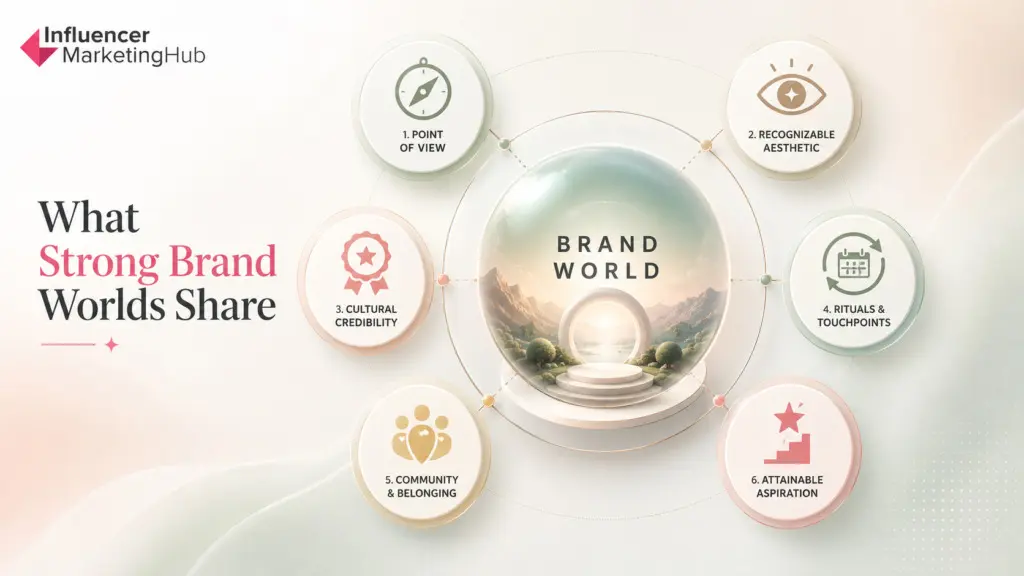
The most successful brands today are not simply selling goods or services; they are architecting comprehensive ecosystems that consumers actively desire to enter and inhabit. These potent brand worlds typically share several foundational characteristics:
- A Coherent Narrative and Vision: A strong brand world is built upon a clear, compelling story that transcends individual products. It articulates a distinct vision, a set of values, and a unique perspective on life. This narrative provides the emotional scaffolding for the entire brand experience. For example, Patagonia’s world is built around environmental activism and rugged outdoor adventure, while Apple’s revolves around innovation, seamless design, and creative empowerment.
- Distinct Aesthetic and Sensory Experience: Beyond visual identity, successful brand worlds cultivate a unique aesthetic that appeals to multiple senses. This includes specific visual styles, color palettes, typography, soundscapes, and even tactile qualities of packaging or retail spaces. This consistent sensory experience reinforces the brand’s identity and makes its world feel tangible and immersive. Think of the instantly recognizable clean lines of a Muji store or the vibrant, playful imagery of Glossier.
- Community and Belonging: At the heart of any compelling world is a sense of community. Brands foster this by creating spaces – both digital and physical – where like-minded individuals can connect, share experiences, and reinforce their shared identity. This can manifest through online forums, exclusive events, fan clubs, or even simply a shared understanding of brand codes and inside jokes. Lululemon, for instance, has successfully built a community around wellness, fitness, and a particular aspirational lifestyle.
- Rituals and Practices: Brand worlds often embed themselves into consumers’ daily lives through rituals. These are repetitive, meaningful actions associated with the brand, from the morning coffee routine using a specific brand of coffee maker to the pre-workout stretch in branded athletic wear. These rituals transform product usage into a deeper, more ingrained part of a consumer’s identity and routine.
- Aspiration and Transformation: The most powerful brand worlds offer consumers a pathway to a better, more desired version of themselves. They promise transformation – whether it’s improved fitness, enhanced creativity, elevated status, or a deeper sense of purpose. This aspirational pull is a core driver of loyalty and emotional investment.
- Cultural Fluency and Relevance: An enduring brand world is attuned to contemporary culture, understanding trends, subcultures, and evolving consumer values. It speaks the language of its audience, demonstrating an authentic understanding of their lives and aspirations. This cultural fluency allows the brand to remain relevant and resonate deeply over time.
Brands that successfully integrate these elements are not accidents of marketing; they are the result of meticulous, long-term strategic planning. Crucially, a growing number of these world-builders are realizing that co-creation with influential creators is not just an option, but a necessity.
The Enterprise Challenge: Bridging the Cultural Fluency Gap
For large enterprise brands, the shift to world-building presents both immense opportunity and significant challenges. These organizations typically possess formidable advantages: substantial marketing budgets, vast distribution networks, and often, products of exceptional quality. However, they frequently encounter a critical deficit: a lack of cultural fluency.
Enterprise brands, due to their size and bureaucratic structures, can struggle to authentically connect with rapidly evolving cultural nuances, subcultures, and digital trends. Their messaging can feel corporate, generic, or out of touch, failing to resonate with an audience craving authenticity and belonging. This is precisely where content creators become invaluable assets.
Creators don’t just offer access to an audience; they lend their entire world to a brand. Their unique aesthetic, their established trust, their community’s ingrained sense of belonging, and their inherent cultural relevance become powerful extensions of the brand itself. When the alignment between a creator and a brand is genuine, the resulting campaign doesn’t feel like advertising; it feels like a natural, organic extension of a world the audience already admires and wants to inhabit. A popular tech reviewer showcasing a new gadget integrates it into their daily workflow, demonstrating its practical use within a credible, aspirational context. A lifestyle blogger featuring a skincare line weaves it into their self-care routine, making it part of a desirable aesthetic.
The most forward-thinking enterprise brands are redefining their approach to creator partnerships. They are moving beyond viewing creators merely as a distribution channel for pre-packaged messages. Instead, they are recognizing them as "world-builders" – co-architects of the brand’s cultural identity. This involves engaging creators in the conceptualization phase, allowing them creative freedom, and valuing their insights into audience preferences and cultural trends. Brands that continue to treat creator collaborations as a transactional line item on a media plan, focusing solely on impressions and basic reach metrics, will invariably find themselves questioning why their campaigns fail to convert into meaningful engagement and lasting loyalty.
The Future of Brand Strategy: Co-Creation and Cultural Resonance
The trajectory of creator strategy points towards increasingly integrated and authentic collaborations. The most impactful creator partnerships are transcending traditional advertising to become genuine invitations – into a lifestyle, a mindset, a community, or a movement. The creator is no longer merely disseminating a brand message; they are actively expanding the universe surrounding the brand, enriching its narrative and deepening its cultural footprint.
This signifies a profound shift in how enduring brand worlds are constructed. They are no longer solely conceived in corporate boardrooms, meticulously planned by marketing departments in isolation. Instead, they are increasingly being built organically "in the wild" – through the dynamic interplay of creators, passionate communities, shared rituals, evolving aesthetics, fervent fandoms, and a continuous stream of culturally resonant moments.
Brands poised for long-term success are those that recognize this collaborative imperative. They understand that the power to build worlds people genuinely want to belong to is not a solitary endeavor. It requires strategic alliances, an openness to external influence, and a deep appreciation for the cultural capital that creators bring to the table. As the digital landscape continues to evolve, the ability to effectively partner with creators to co-create these rich, immersive brand worlds will be the definitive differentiator for enterprise brands aiming to cultivate not just customers, but loyal citizens of their carefully constructed universes. This era demands authenticity, collaboration, and a profound understanding of human aspiration.

