
Market behavior is undergoing a profound transformation, yet many brands are overlooking a critical nuance: Artificial Intelligence is not merely altering how people discover products; it is fundamentally reshaping how people decide. This intricate decision-making process is far from uniform, exhibiting distinct patterns across different generations, demanding a granular approach from marketers. Capturing consumer attention is only the first step; converting that attention into a purchase hinges on a deep understanding of how specific audiences make decisions, and, increasingly, the extent to which they are delegating parts of this process to AI.
The rapid proliferation of AI tools, from sophisticated recommendation algorithms to generative AI chatbots, has injected a new layer into the consumer journey. This emergent AI layer acts as an intermediary, influencing perceptions, guiding discovery, and even suggesting final choices before a human ever directly engages with a brand. For marketers, the challenge is no longer just about optimizing for human eyeballs, but for algorithmic interpretation, a task complicated by the diverse digital fluency and trust levels inherent in each demographic cohort.
The AI Tsunami in Commerce: A Brief Chronology
The journey of AI in consumer commerce has accelerated dramatically in recent years. What began with rudimentary rule-based systems in the early 2000s, offering basic product recommendations based on past purchases, evolved into more sophisticated machine learning algorithms by the 2010s, capable of predicting preferences with greater accuracy. The late 2010s saw the rise of voice assistants and personalized digital advertising, making AI an increasingly ubiquitous, if often invisible, part of online life.
However, the true inflection point arrived in the early 2020s with the advent of large language models (LLMs) and generative AI. Tools like ChatGPT, Bard, and their integrated counterparts in search engines and social media platforms moved AI from a backend optimization tool to a front-facing conversational agent and content summarizer. This shift fundamentally changed the consumer’s interaction paradigm, empowering them to outsource research and decision-making to an AI. By 2025, over 60% of consumers were actively utilizing AI for product research, a figure projected to grow even further, highlighting the urgent need for brands to adapt. This rapid evolution underscores that AI’s influence is not a future trend, but a present reality with immediate implications for market strategy.
Navigating the Generational Labyrinth: AI’s Impact Across Audiences
The "same technology" elicits "radically different relationships" across the five primary consumer generations: Silent Generation, Baby Boomers, Generation X, Millennials, and Generation Z (with Generation Alpha on the horizon). Understanding these nuanced interactions is paramount for effective marketing in the AI era.
1. The Pre-Purchase AI Filter: Brand Interpretation and Trust
Before a consumer even lands on a brand’s website, their perception is being shaped. Over 60% of consumers are now using AI for product research, meaning brand content is being selected, summarized, and surfaced by systems operating beyond a brand’s direct editorial control. These AI systems decide what’s "relevant," often presenting distilled information to the user.
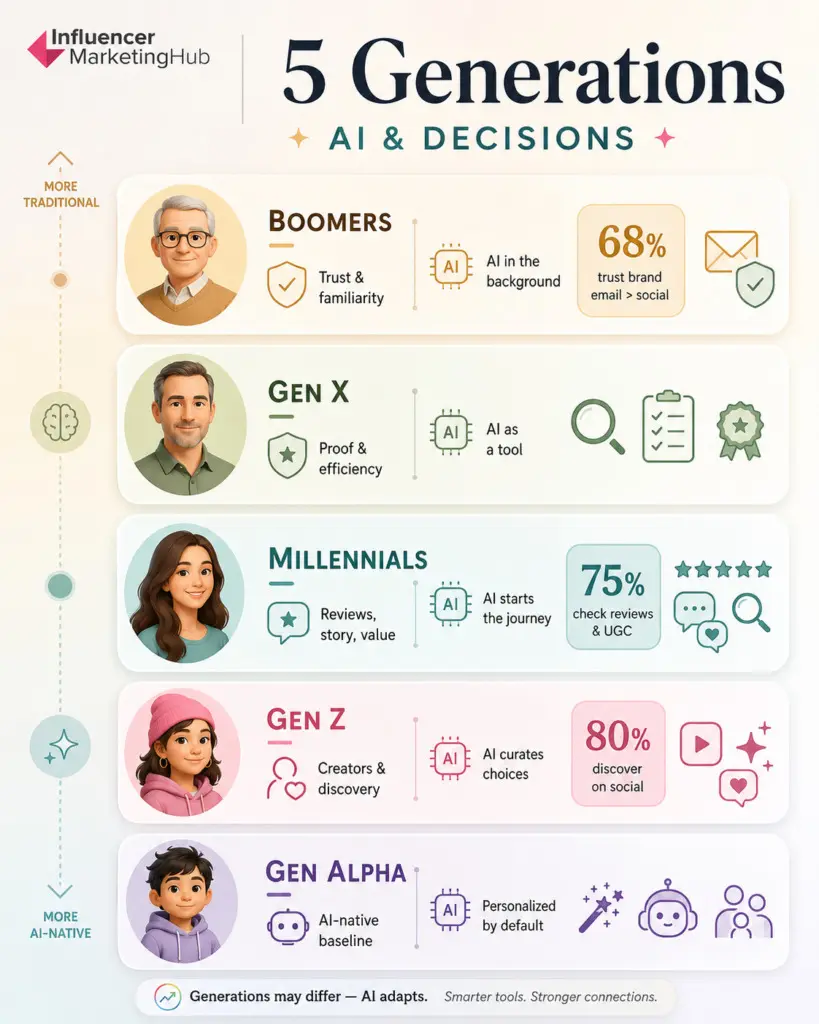
- Silent Generation & Baby Boomers: These generations typically exhibit the lowest trust in AI for purchase decisions. They often use AI tools cautiously, perhaps for basic information retrieval (e.g., "What are the features of X car model?") but prefer traditional sources like established reviews, brand websites, or personal recommendations for actual decision-making. AI-generated summaries may be viewed with skepticism, often prompting them to seek out the original source for verification.
- Generation X: Gen X is generally more comfortable with technology but approaches AI with a pragmatic, often skeptical eye. They might use AI for initial screening or comparing specifications but will heavily rely on their own research, cross-referencing AI summaries with multiple trusted human-curated sources, expert reviews, and peer feedback before making a choice. For Gen X, AI is a utility, not a definitive authority.
- Millennials: As digital natives, Millennials readily adopt AI for convenience. They are likely to use AI for comprehensive product comparisons, personalized recommendations, and even for generating pros and cons lists. While they appreciate the efficiency, they maintain a healthy dose of skepticism, often validating AI outputs with social proof, influencer reviews, and detailed product descriptions. They delegate information gathering but retain final decision authority, often leveraging AI to refine their options rather than dictate them.
- Generation Z: This generation is the most fluent and trusting of AI systems. They are comfortable delegating significant portions of their research to AI, relying on summarized information and AI-curated recommendations. For Gen Z, AI is a personalized concierge, capable of understanding their nuanced preferences and delivering highly relevant, often instant, answers. They are more likely to accept an AI’s interpretation of a brand as authoritative, potentially bypassing direct brand engagement if the AI’s summary is compelling.
Implications for Brands: If a brand’s content is not structured and optimized for AI comprehension – clear, concise, factual, and easily extractable – it risks being misrepresented or entirely overlooked in AI-generated summaries. Brands must ensure their core messaging, unique selling propositions, and key product attributes are readily digestible by AI systems to appear accurately and compellingly at this critical initial stage.
2. The Shifting Sands of Discovery: Multi-Platform AI Search
The concept of "search" has fractured. It no longer resides solely within traditional search engines like Google but extends across diverse platforms: TikTok, Instagram, Reddit, YouTube, and increasingly, AI-powered conversational interfaces layered into all of them.
- Silent Generation & Baby Boomers: These generations primarily stick to traditional search engines (Google, Bing) and often use AI within these familiar interfaces for straightforward queries. They are less likely to seek product discovery on social media platforms and more inclined to follow links to established brand websites or trusted news sources.
- Generation X: While still utilizing traditional search, Gen X has a higher propensity to use platforms like YouTube for product reviews and Reddit for authentic user feedback. AI integration within these platforms, such as YouTube’s AI-generated summaries of video content or Reddit’s AI-powered topic clustering, influences their discovery but is often seen as a supplementary tool rather than a primary search engine replacement.
- Millennials: Millennials embrace a hybrid approach, using Google for factual information, Instagram for visual discovery, and TikTok for trend spotting. They are comfortable with AI-powered personalized feeds across social media and value AI’s ability to filter out noise, though they still actively curate their own discovery journey. They use AI as an intelligent filter, guiding them through vast content landscapes.
- Generation Z: A staggering 40% of Gen Z already uses TikTok and Instagram for search over Google. For them, discovery is inherently visual, social, and often driven by AI algorithms that understand their aesthetic preferences and peer networks. AI-powered social feeds and direct AI chatbots are their primary conduits for finding new products and brands. The "search" experience is a dynamic, interactive conversation with an AI or an exploration of AI-curated content.
Implications for Brands: An "SEO vs. social" mentality is obsolete. The new reality is an integrated ecosystem of search, social, and AI-assisted discovery, with each generation engaging through a different mix. Brands must cultivate a robust digital presence that is discoverable and accurately represented across all these fragmented channels, specifically optimizing content for visual search, short-form video algorithms, and AI summarization across platforms.
3. The Accelerated, Fragmented Consumer Journey: AI-Driven Pathways
The modern consumer funnel is multi-screen and highly fragmented, encompassing CTV (Connected TV), mobile, social media, email, and SMS. The statistic that 87% of consumers use a second screen while watching TV highlights this pervasive fragmentation. AI, however, is accelerating how quickly each generation moves through this path, or, in some cases, bypasses it entirely.
- Silent Generation & Baby Boomers: Their journey remains more linear, often starting with a broad search, followed by detailed website visits, and potentially direct contact (phone or email) for queries. AI might offer initial product suggestions but doesn’t significantly shorten their path.
- Generation X: They appreciate AI’s ability to streamline research and compare products. They might use AI to find the best deals or read synthesized reviews, but the purchase decision often involves navigating multiple brand touchpoints, potentially across different devices, before converting. AI helps them optimize their existing, somewhat traditional, multi-touch journey.
- Millennials: This generation is highly adept at navigating multi-screen journeys, often interacting with a brand across several devices and platforms simultaneously. AI plays a crucial role in maintaining continuity and personalization across these touchpoints, offering dynamic content, personalized ads, and seamless transitions between channels. They leverage AI to make their complex journey more efficient and relevant.
- Generation Z: For Gen Z, the AI-accelerated journey is often compressed. An AI recommendation on TikTok might lead directly to an in-app purchase, or a conversation with an AI chatbot might result in an immediate conversion. They are comfortable with AI consolidating information and presenting a direct path to purchase, often bypassing intermediary steps that older generations might consider essential. The journey is less a funnel and more a hyper-personalized, often instantaneous, AI-driven path.
Implications for Brands: Brands must create a seamless, consistent, and AI-optimized experience across every potential touchpoint. This means ensuring product information, pricing, and brand messaging are synchronized and easily accessible to AI systems, enabling them to guide consumers efficiently regardless of their preferred platform or generational journey.
4. AI-Enhanced Experiential Marketing: Shaping the Path to Engagement
While 70% of consumers report that in-person experiences increase purchase intent, AI isn’t replacing experiential marketing; it’s profoundly determining which experiences reach which people and when.
- Silent Generation & Baby Boomers: These generations value experiences that are easily accessible and clearly communicated through traditional channels or straightforward digital invitations. AI might help them find local events or relevant travel options but doesn’t typically drive their initial interest in an experience.
- Generation X: They seek authentic, high-quality experiences that offer value. AI can assist them in finding unique events, booking tickets, or personalizing travel itineraries. They appreciate AI’s ability to filter through options and present relevant choices for their interests.
- Millennials: Millennials are keen on shareable, curated experiences. AI plays a significant role in recommending events, tailoring travel packages, and even personalizing in-experience content (e.g., through AR filters at a concert). AI helps them discover and enhance experiences that align with their lifestyle and social sharing habits.
- Generation Z: This generation thrives on hyper-personalized, immersive, and often digitally augmented experiences. AI is critical in identifying niche events, suggesting virtual experiences (VR/AR), and even co-creating personalized event narratives. For Gen Z, an AI-curated experience can be more compelling than a generic one, driving strong purchase intent through highly relevant, often interactive, engagements.
Implications for Brands: AI must be integrated into the strategy for promoting and even designing experiential marketing. This includes using AI for targeted outreach, personalizing event recommendations, leveraging AI-powered virtual elements, and optimizing event logistics based on AI-driven insights into generational preferences.
5. Precision Personalization: The AI-Driven Conversion Catalyst
Discounting isn’t disappearing, but generic offers are. The fact that 75% of consumers are more likely to buy from brands that personalize offers underscores the power of tailored incentives. AI is now the engine behind this personalization, and each generation responds to it differently.
- Silent Generation & Baby Boomers: They appreciate clear, value-driven offers. While they may not explicitly expect AI-driven personalization, they respond well to relevant discounts on products they frequently purchase or services that simplify their lives. They are less likely to engage with highly complex or data-intensive personalization.
- Generation X: Gen X values practical, time-saving personalization. AI-driven recommendations for products that complement their existing purchases or alerts for items on their wish list are highly effective. They appreciate efficiency and relevance in their offers.
- Millennials: They expect a high degree of personalization. AI-powered dynamic pricing, personalized product bundles, and tailored content based on their browsing history are key drivers. They view personalization as a sign that a brand understands their needs and values their loyalty.
- Generation Z: This generation demands hyper-personalization, often expecting brands to anticipate their needs before they even articulate them. AI-driven predictive analytics for product launches, highly individualized discount codes, and AI-curated content streams are essential. For Gen Z, generic offers are a turn-off; AI-powered, almost clairvoyant, personalization is the standard.
Implications for Brands: The era of mass marketing is definitively over. Brands must leverage AI to move beyond basic segmentation to true hyper-personalization, tailoring offers, content, and communications to individual consumer profiles. This requires robust data infrastructure and AI models capable of understanding and predicting generational preferences with precision.
Expert Commentary and Broader Implications
"The market landscape is undergoing a tectonic shift," states Dr. Elara Vance, a leading consumer behavior analyst. "The challenge for brands isn’t merely to adopt AI, but to understand the profound psychological interplay between AI and human decision-making, which varies profoundly with age and digital fluency. Those who fail to grasp these generational nuances will find their messaging lost in the digital ether."
Sarah Chen, Marketing Director at a prominent global consumer brand, echoes this sentiment: "Our primary objective has evolved. It’s no longer just about being visible; it’s about ensuring our brand is accurately and compellingly represented by the AI systems that now act as gatekeepers to consumer attention. We’re actively optimizing our content for AI ingestion, recognizing that the AI layer is often the first, and sometimes only, point of contact for a new customer."
The broader implications for brands are clear and far-reaching. An "AI-first" content strategy is no longer optional; it’s imperative. This means crafting content that is not only engaging for humans but also easily interpretable, trustworthy, and actionable for AI systems. Brands must continuously analyze AI’s evolving role in consumer decision journeys, adapt their strategies, and invest in the tools and talent necessary to manage their brand’s representation in the AI layer. Failure to do so risks brand misrepresentation, reduced discoverability, and ultimately, significant losses in market share. Ethical considerations surrounding data privacy and algorithmic bias also demand careful attention, as consumer trust in AI is still fragile and can be easily eroded.
The Real Shift: Precision, Not Just Presence
AI has fundamentally transformed not just where consumers discover brands, but how they decide. Every generation is touched by this transformation, but at different points, with varying levels of trust, and with distinct expectations of AI’s role. The brands succeeding in this new environment are not merely running better campaigns; they are meticulously understanding how AI reshapes the decision-making process for each audience they serve and are proactively showing up correctly at every stage.
The fundamental question for marketers is no longer "What’s our message?" but rather, "Who are we trying to reach, how do they decide, and where is AI already influencing that decision before we even enter the conversation?" Conversion in 2026 and beyond hinges on precision. And precision, in this AI-driven era, means understanding not just your audience, but the intricate AI layer that is increasingly guiding them towards their next purchase.

