

Across the United States, the integrity of federal and state-funded healthcare programs is facing an unprecedented challenge as Medicaid and Medicare fraud cases escalate in both frequency and financial magnitude. What were once viewed as isolated incidents of provider misconduct are now being recognized as a systemic vulnerability that threatens the long-term sustainability of the nation’s healthcare safety net. From improper billing and the provision of undocumented services to sophisticated upcoding schemes and duplicate claims, these fraudulent activities span the entire spectrum of federal programs and state-administered Medicaid plans. This surge in fraud, waste, and abuse (FWA) has exposed deep-seated weaknesses in reimbursement oversight, creating a multi-billion-dollar drain on resources that affects payers, regulators, and, most critically, the American taxpayer.
As the Centers for Medicare & Medicaid Services (CMS), state agencies, and various oversight bodies increase their scrutiny, the focus of the healthcare industry is shifting. It is no longer sufficient for managed care organizations and state plans to merely identify suspicious claims; the new mandate requires demonstrating measurable recovery outcomes, faster turnaround times, and audit processes that can withstand rigorous legal and regulatory defense. The era of passive oversight is ending, replaced by a demand for proactive, data-driven intervention that can stem the tide of material financial leakage before it compromises the solvency of essential health programs.
The Escalating Scale of Healthcare Fraud and Material Leakage
The financial implications of healthcare fraud in the United States are staggering. According to the Department of Health and Human Services (HHS) Office of Inspector General (OIG), Medicaid Fraud Control Units (MFCUs) play a pivotal role in identifying and prosecuting these crimes. Recent reports indicate that Medicare and Medicaid fraud currently result in approximately $6 billion to $7 billion per year in confirmed losses and prevented payments. However, these figures represent only the tip of the iceberg. Enforcement agencies have identified over $14.6 billion annually in active fraud exposure, a figure that encompasses confirmed recoveries, fraud prevented through pre-payment interventions, and exposure identified through ongoing enforcement actions.
This financial leakage is no longer an outlier or a localized issue confined to a handful of states; it has become a structural problem across the entire Medicaid and Medicare landscape. As healthcare spending continues to rise, even a marginal error rate of 1% to 2% translates into hundreds of millions of dollars in losses for individual states. For Medicaid agencies and managed care plans, this represents a board-level financial risk that demands a fundamental rethinking of how payment integrity is managed.
California as the Epicenter: A Case Study in Oversight Gaps
While the challenge is national, the pressure is perhaps most acute in California. The state’s Medi-Cal program, which serves millions of residents, has recently been rocked by multiple fraud cases exceeding $100 million each, particularly within the pharmacy and hospice sectors. These cases have highlighted significant gaps in reimbursement oversight and recovery mechanisms.

The hospice fraud cases in California were particularly egregious, involving "phantom" patients and the billing of services for individuals who were either not terminally ill or were entirely unaware they had been enrolled in hospice care. Similarly, pharmacy fraud schemes have involved the billing of high-cost specialty medications that were never dispensed or were obtained through illegal kickback schemes. These incidents occur against a backdrop of projected state spending growth that is expected to rise at twice the national average. As the volume and complexity of claims increase, Medi-Cal plans face mounting exposure, leaving them under intense pressure to modernize their defensive postures.
A Chronology of Regulatory Evolution and Enforcement
The history of healthcare fraud enforcement in the U.S. has evolved from reactive policing to a more structured, though still lagging, regulatory framework.
- 1965 – The Genesis: The creation of Medicare and Medicaid established the foundation of the modern healthcare system but lacked robust initial fraud protections.
- 1996 – HIPAA and HCFAC: The Health Insurance Portability and Accountability Act (HIPAA) established the Health Care Fraud and Abuse Control (HCFAC) program, a joint effort by the Department of Justice (DOJ) and HHS to coordinate federal, state, and local law enforcement efforts.
- 2010 – The Affordable Care Act (ACA): The ACA introduced enhanced screening requirements for providers and granted CMS more authority to suspend payments where there is a credible allegation of fraud.
- 2020-Present – The Post-Pandemic Surge: The rapid expansion of telehealth and emergency funding during the COVID-19 pandemic created new avenues for fraud, leading to a sharp increase in OIG investigations and a renewed focus on data analytics as a primary tool for detection.
Despite these advancements, the pace of criminal innovation often outstrips the ability of states to respond. Federal oversight of state Medicaid programs has accelerated sharply, particularly in states experiencing rapid spending growth. Regulators are no longer satisfied with retrospective audits; they are demanding higher standards for proactive detection and faster, more imposing interventions.
The Strategic Gap: The Failure of the "Pay-and-Chase" Model
For decades, the standard operating procedure for payment integrity has been the "pay-and-chase" model. This retrospective approach involves paying claims first and then attempting to identify and recoup improper payments through audits and provider reviews conducted weeks or months later. This model is inherently flawed for several reasons:
- Latency: By the time an error or fraud is flagged, the funds have often been moved or the fraudulent entity has dissolved.
- Low Recovery Rates: The administrative cost of chasing small-to-medium improper payments often exceeds the value of the recovery itself.
- Siloed Workflows: Utilization management, care workflows, and payment integrity often operate in isolation, preventing the real-time sharing of data that could stop a fraudulent claim before it is processed.
This strategic gap results in a predictable cycle: errors are detected after the fact, but recovery remains slow, partial, or entirely missed. To close this gap, organizations must move toward an "embedded" payment integrity model where detection leads directly to intervention.
The Next Operating Model: Embedded Payment Integrity
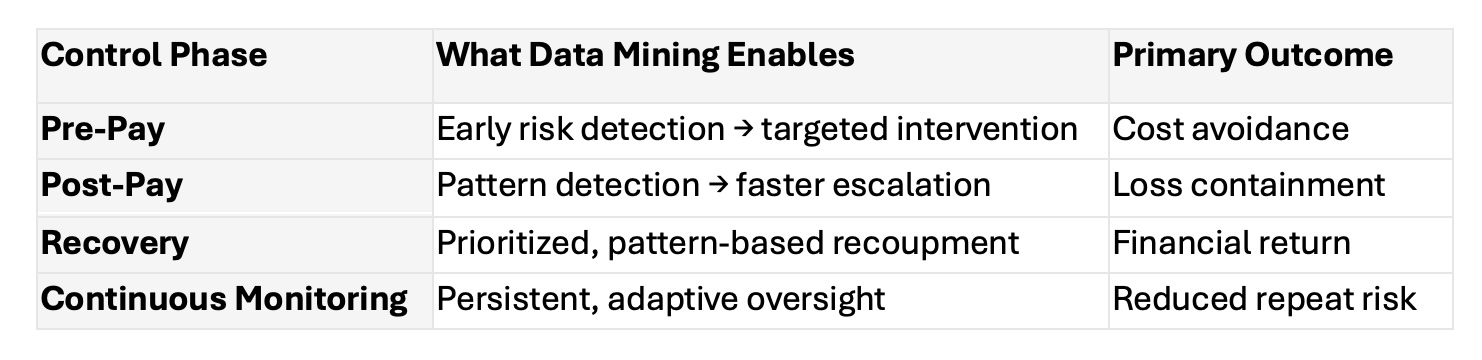
Modernizing healthcare payment systems requires a shift from fragmented, retrospective controls to end-to-end operational models. This next-generation approach is built on four key pillars:
1. Proactive Fraud Detection and Risk Identification
Organizations must identify high-risk claims and providers before improper payments escalate. This involves deploying advanced claims analytics, data mining, and anomaly detection. By using machine learning to establish "normal" billing patterns, systems can flag deviations in real-time. Provider risk scoring—monitoring for sudden spikes in billing volume or unusual combinations of service codes—allows plans to intervene early, potentially preventing millions in losses before a single check is cut.
2. Real-Time Payment Controls and Workflow Integration
Effective integrity requires operational intervention, not just analysis. Embedding controls directly into the claims processing workflow allows for pre-payment claim validation. This ensures that claims that do not meet specific criteria—such as those lacking proper documentation or those billed by unverified providers—are paused for review. Integrating these controls into utilization management ensures that the clinical necessity of a service is verified simultaneously with the billing process.
3. Accelerated Recovery and Financial Resolution
The defining KPI for modern payment integrity is "recovery velocity." To meet new performance metrics, programs must automate the recoupment process. This includes automated provider communication, streamlined documentation management, and integrated support for appeals and dispute resolution. When the recovery process is automated, the time between detection and financial resolution is drastically reduced, improving the plan’s overall financial health and compliance readiness.
4. Scalable Program Integrity Operations
Sustainability in the face of rising fraud requires a governance structure that can scale. Dedicated audit and investigation teams should be equipped with learning feedback loops—where every detected instance of fraud is used to refine the detection algorithms. Detailed performance reporting dashboards are essential for providing boards and regulators with transparent views of recovery ROI and systemic risk exposure.
Stakeholder Reactions and the Push for Accountability
The shift toward more aggressive recovery has met with a variety of responses from healthcare stakeholders. Managed Care Organizations (MCOs) are increasingly viewing payment integrity as a competitive advantage rather than just a compliance burden. Plans that can demonstrate lower error rates and higher recovery velocity are better positioned during contract renewals with state agencies.
On the provider side, there is a push for "defensible" audit processes. Legitimate providers often express concern that overly aggressive automated systems may lead to "false positives," where valid claims are denied or delayed, creating administrative burdens for honest practitioners. Consequently, the industry is seeing a demand for "calibrated" analytics that reduce noise while maintaining high sensitivity to actual fraud.
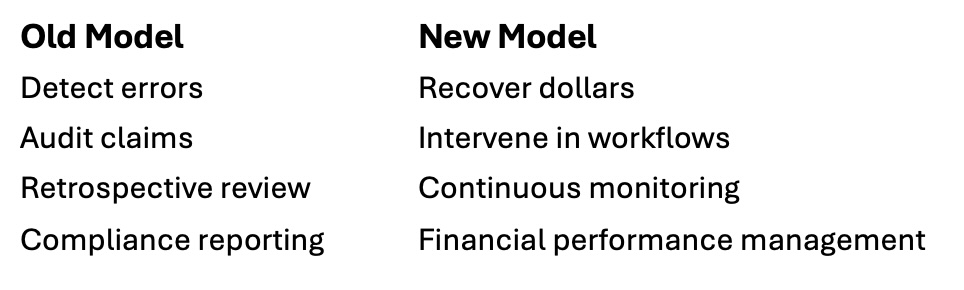
State leaders and oversight bodies, meanwhile, are increasingly focused on transparency. In many jurisdictions, there is growing political pressure to prove that taxpayer dollars are being used efficiently. This has led to the adoption of performance-based contracts for health plans, where a portion of administrative fees is tied directly to the effectiveness of their fraud prevention and recovery efforts.
Future Outlook: The Role of Intelligence in Protecting Healthcare Margins
As we look toward the future, the differentiator in healthcare administration will not be how many issues are detected, but how quickly dollars are protected and recovered. The integration of artificial intelligence and real-time data streaming will allow for even more sophisticated "intelligence layers" that can predict fraud before it occurs.
The recent discoveries of large-scale fraud in California and elsewhere serve as a wake-up call. The vulnerabilities in the system are real, and they are being exploited at a scale that demands a structural response. By moving away from the "pay-and-chase" era and embracing an end-to-end model of embedded integrity, health plans can gain the speed and scale necessary to protect their margins and ensure that resources remain available for those who truly need care.
In conclusion, the fight against Medicaid and Medicare fraud is no longer just a legal or compliance issue; it is a fundamental operational necessity. The transition from identification to intervention represents the next frontier in healthcare management, one where data-driven precision and recovery velocity become the primary metrics of success. Plans that modernize these control points today will be the ones that survive the financial and regulatory headwinds of tomorrow.

