
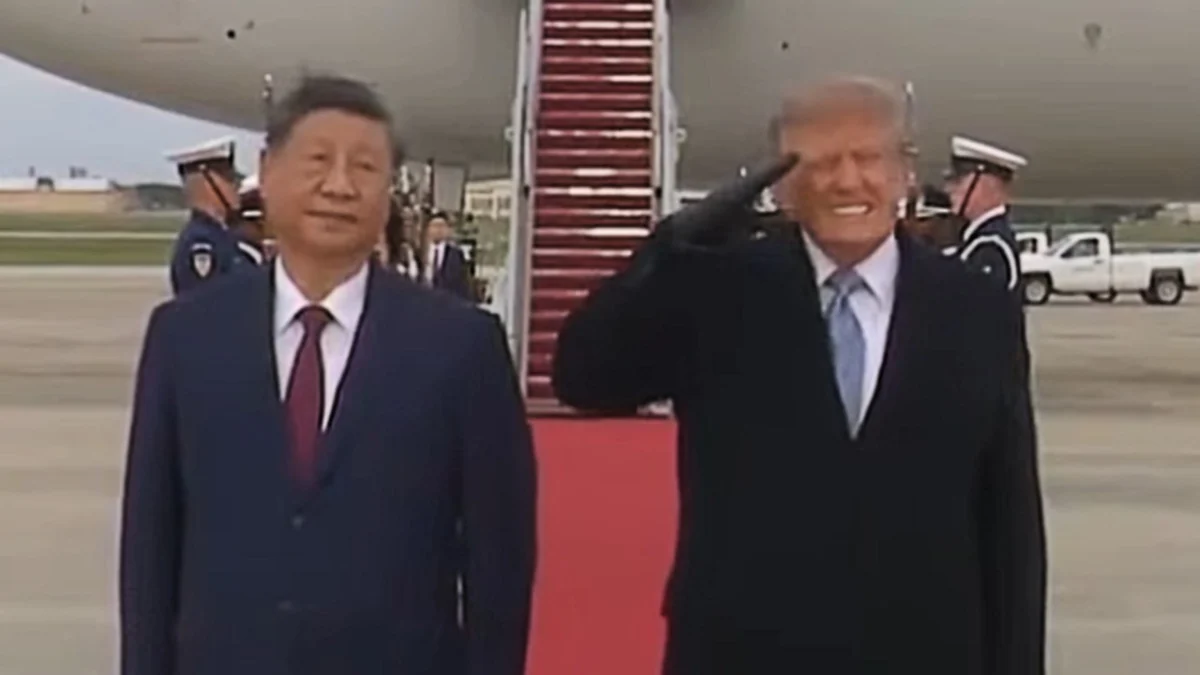
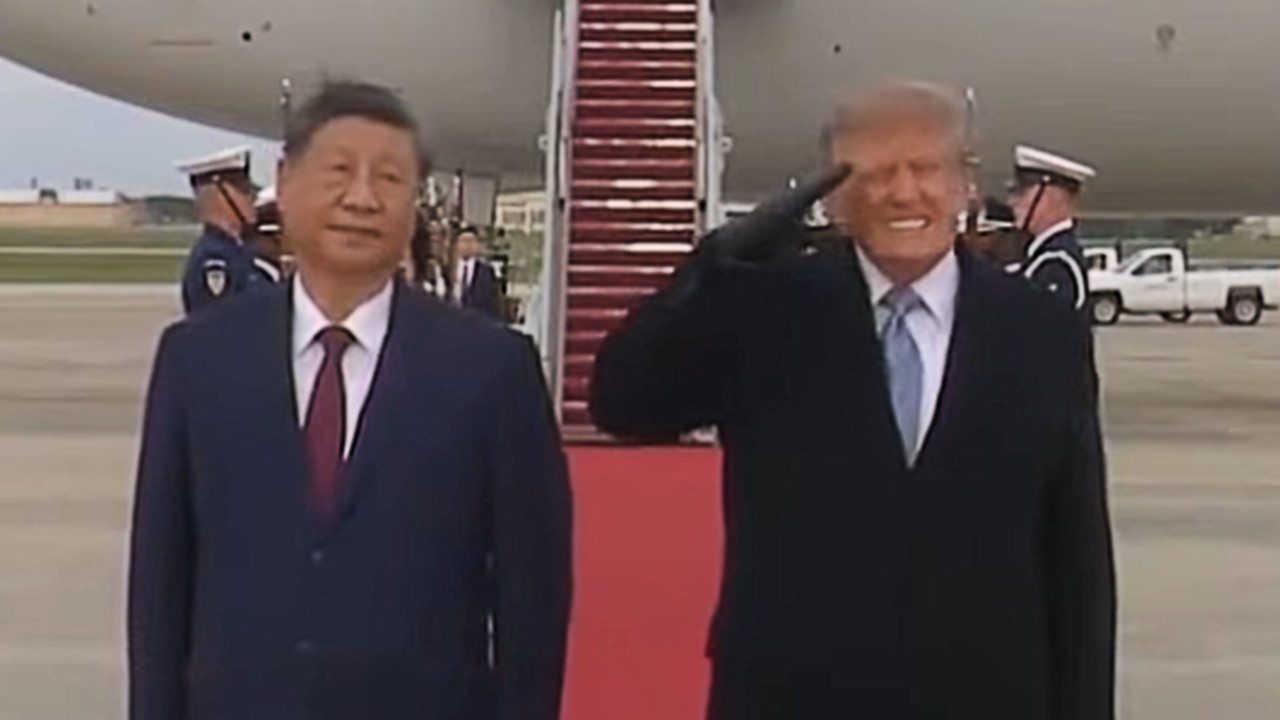
The diplomatic landscape of 2026 was punctuated by a singular, viral moment during a high-stakes bilateral summit in Maryland, where a military flyover became the catalyst for a global conversation on leadership optics and physical composure. On September 23, 2026, while standing on a ceremonial red carpet alongside Chinese President Xi Jinping, U.S. President Donald Trump was captured on high-definition video visibly flinching as a pair of B-1B Lancer bombers roared overhead. The contrast between the two world leaders—Trump startle-reacting to the thunderous noise while Xi remained motionless at attention—immediately ignited a firestorm of social media discourse, political analysis, and internet memes that transcended traditional diplomatic reporting.
The Maryland Summit: Context and Setting
The meeting in Maryland was part of a broader effort to address escalating trade tensions and maritime security concerns in the Indo-Pacific region. As is customary for such state-level visits, the proceedings included a full military honors ceremony. The flyover, featuring the B-1B Lancer—a supersonic variable-sweep wing heavy bomber known for its immense acoustic output—was intended to be a display of American aerial might and a gesture of military cooperation.
According to technical specifications, a B-1B Lancer at low altitude can produce noise levels exceeding 140 decibels, a threshold that is well above the human pain limit and sufficient to trigger an involuntary startle response in most individuals. However, the diplomatic significance of such events often hinges on the ability of leaders to maintain a stoic facade regardless of environmental stressors.
Chronology of the Viral Incident
The event unfolded at approximately 2:15 PM local time. As the official anthem concluded, the two presidents stood side-by-side to receive the salute from the passing aircraft.
- The Approach: The bombers approached from the north at an altitude of approximately 1,000 feet.
- The Impact: As the lead aircraft crossed the vertical plane of the podium, the sonic pressure intensified.
- The Reaction: President Trump was seen wincing, pulling his shoulders upward, and momentarily breaking his salute to squint toward the sky. Simultaneously, President Xi Jinping maintained a rigid posture, his gaze fixed forward, showing no perceptible physical reaction to the sound.
- The Dissemination: Within minutes of the live broadcast, clips of the encounter were uploaded to X (formerly Twitter), TikTok, and Reddit.
Digital Proliferation and Meme Culture
The speed at which the footage traveled highlighted the modern intersection of geopolitics and digital culture. The video gained over 10 million views within the first four hours of its release. Analysis of the spread shows that the "flinch" became a Rorschach test for political affiliation and a goldmine for digital satirists.
One of the earliest high-reach posts came from the political commentary group MeidasTouch, which shared the clip with the caption: "Trump winces in pain during the loud military flyover as Xi shows no reaction." The post garnered 33,000 likes and 4,100 reposts in under 24 hours. The narrative quickly shifted from a simple physical reaction to a commentary on perceived strength and "toughness."
On the social media platform X, the term "mogged"—an internet slang term derived from "AMOG" (Alpha Male Of the Group), used to describe one person physically or aesthetically overshadowing another—began to trend. User @raymackmelon’s post, "Absolutely mogged," received 139,000 likes, suggesting that Xi’s stoicism served as a dominant display over Trump’s involuntary reflex.
Other users utilized established meme formats to frame the event. A popular edit compared Trump’s facial expression to the "I Am A Surgeon" meme, a reference to a dramatic scene from the television show The Good Doctor often used to mock emotional or frantic behavior. On the subreddit r/therewasanattempt, the video titled "to not flinch" climbed to the front page with thousands of upvotes, further cementing the moment in the digital zeitgeist.
Psychological and Physiological Analysis
Experts in human physiology note that the "startle response" is a brainstem reflex that serves as a protective mechanism. It is largely involuntary, involving the contraction of the facial and skeletal muscles.
"The startle reflex is one of the fastest human responses, occurring within milliseconds of a loud noise," noted Dr. Aris Thorne, a specialist in behavioral neurology. "While some individuals can suppress this through intensive training—common in military backgrounds—it is a natural biological reaction. The difference in reaction between President Trump and President Xi could be attributed to a variety of factors, including prior expectation of the noise level, individual sensitivity, or even the use of subtle hearing protection."
However, in the arena of international relations, biological excuses often take a backseat to the "politics of the image." Historically, leaders have gone to great lengths to appear impervious to environmental hazards. The 2026 incident drew immediate comparisons to past "tough guy" imagery associated with both leaders. Trump, who has long cultivated an image of strength and resilience, found this specific footage at odds with his public persona.
Political Implications and Official Responses
While the White House did not issue a formal statement regarding the president’s physical reaction, anonymous aides suggested that the noise level was "unexpectedly high" due to atmospheric conditions in Maryland that day. Conversely, Chinese state-affiliated media outlets subtly amplified the footage, using it to characterize Xi Jinping as a "pillar of stability" and "unshakeable" in the face of external pressure.
The incident also reignited debates surrounding the 2024 assassination attempt on Donald Trump in Butler, Pennsylvania. Critics and conspiracy theorists on social media, such as user @sandibachom, pointed to the Maryland flinch as a point of contention, questioning the consistency of the president’s reactions to sudden, loud noises. While such comparisons are largely speculative and ignore the different contexts of a controlled flyover versus a chaotic security breach, they illustrate how a single viral moment can be weaponized to revisit historical narratives.
Global Media Reception
The international press covered the event with varying degrees of gravity.
- European Outlets: Many focused on the "optics of diplomacy," noting that the incident occurred at a time when the U.S. is asking allies to project a unified, strong front against Chinese economic expansion.
- Asian Media: In Japan and South Korea, the footage was analyzed by body language experts on evening news programs, discussing how such "micro-expressions" can influence the psychological edge in bilateral negotiations.
- Domestic U.S. Media: The coverage was sharply divided along partisan lines. Conservative-leaning outlets ignored the flinch, focusing instead on the policy goals of the Maryland summit. Progressive-leaning outlets and late-night talk shows used the footage as a central theme for commentary on the president’s age and temperament.
Technical Data: The Sound of Power
To understand the severity of the stimulus, one must look at the B-1B Lancer’s acoustic footprint. The aircraft is powered by four General Electric F101-GE-102 augmented turbofan engines, each producing more than 30,000 pounds of thrust. During a low-altitude pass, the "sound pressure level" (SPL) is significant enough to vibrate internal organs.
| Distance from Aircraft | Estimated Decibel Level (dB) | Human Sensation |
|---|---|---|
| 500 feet | 150 dB | Immediate ear damage/Pain |
| 1,000 feet | 140 dB | Threshold of pain |
| 2,000 feet | 125 dB | Extremely loud/Startle |
The proximity of the podium to the flight path suggests the leaders were exposed to roughly 135–140 dB. Xi Jinping’s lack of reaction, therefore, was viewed by many as a remarkable feat of self-control or a testament to high-quality, discreet ear protection.
Conclusion: The Lasting Impact of a Five-Second Clip
The "Donald Trump Flinches Beside Xi Jinping" video serves as a case study in how modern technology and social media can distill complex geopolitical summits into a single, digestible, and highly subjective moment. In an era where "vibes" and "energy" often compete with policy and substance for the public’s attention, a five-second involuntary reflex can become a more potent political tool than a signed trade agreement.
As the 2026 Maryland summit concluded, the official communiqués focused on carbon emissions and maritime borders. However, the public memory of the event remains tethered to the image of two men on a red carpet: one reacting to the raw power of the sky, and the other standing as if carved from stone. Whether this moment has any long-term effect on diplomatic relations remains to be seen, but its place in the pantheon of internet-era political iconography is firmly secured. The incident underscores the reality that for a modern world leader, the camera is always on, and every blink, wince, or flinch is subject to global scrutiny.

