
The digital landscape is currently witnessing a fundamental shift in how web assets are maintained and evolved, moving away from the traditional "launch and decay" cycle toward a model of continuous, agent-led optimization. For decades, the lifecycle of a website has followed a predictable and often frustrating trajectory: a period of intense development culminating in a "perfect" launch day, followed by a slow but inevitable decline in relevance, performance, and technical integrity. This phenomenon, often referred to as digital decay, occurs not because the technology itself breaks, but because the pace of market evolution and consumer expectations consistently outstrips the capacity of human teams to provide manual updates.
Recent industry analysis suggests that the average lifespan of a corporate website before requiring a major overhaul is approximately 18 to 24 months. However, the signs of obsolescence often appear much sooner. Within just six months of launch, many sites suffer from "link rot," outdated messaging, and non-compliance with rapidly changing search engine algorithms or accessibility standards. To combat this, a new category of technology—autonomous website platforms—is emerging, led by innovators like Pierre Burgy and the team behind Fimo. These platforms utilize specialized AI agents to monitor, edit, and optimize websites in real-time, effectively treating the post-launch phase as a beginning rather than an end.
The Chronology of Web Maintenance: From Static to Autonomous
To understand the necessity of autonomous agents, one must examine the history of web development. In the early era of the World Wide Web, sites were largely static HTML files. Updates were manual, cumbersome, and required specialized technical knowledge. The introduction of Content Management Systems (CMS) in the early 2000s democratized the process, allowing non-technical users to update text and images. While this solved the "content bottleneck," it did nothing to address technical performance or design consistency over time.
By the 2010s, the rise of "Headless CMS" and Continuous Integration/Continuous Deployment (CI/CD) pipelines allowed developers to push updates more frequently. Yet, even with these tools, the burden of maintenance remained firmly on human shoulders. Marketing teams were forced to choose between launching new campaigns and fixing broken alt-tags or optimizing image payloads on existing pages.
The current era, beginning around 2023, marks the introduction of "Agentic Web Management." Unlike simple automation—which follows rigid "if-then" rules—autonomous agents are capable of perceiving the state of a website, reasoning about necessary improvements based on a set of goals, and executing those changes with varying degrees of human oversight. This shift represents the first time in the history of the internet that a website can theoretically improve its own performance metrics while its human creators are offline.
Supporting Data: The High Cost of Digital Stagnation
The push for autonomy is driven by more than just a desire for convenience; it is fueled by the measurable costs of stagnation. According to data from various digital performance audits, the impact of a "frozen" website can be quantified across several key metrics:
- Search Engine Visibility: Google’s "Freshness" algorithm update prioritizes content that is regularly updated. Websites that remain static for more than 90 days typically see a 15-20% gradual decline in organic search rankings for competitive keywords.
- Performance Decay: As browsers update and web standards evolve, older code becomes less efficient. A site that passes Core Web Vitals at launch can fail those same tests 12 months later simply because the industry benchmarks for "good" performance have shifted.
- Accessibility Compliance: Legal frameworks, such as the Americans with Disabilities Act (ADA) and the European Accessibility Act, are constantly updated. Manual audits are expensive, often costing between $5,000 and $15,000 for mid-sized sites, yet agents can perform these checks daily for a fraction of the cost.
- Conversion Rates: A/B testing data consistently shows that even minor discrepancies in design—such as a design-system change that fails to propagate to a secondary landing page—can reduce conversion rates by as much as 5% due to a perceived lack of brand professionalism.
The Human-Agent Paradox: Why Full Autonomy Met Resistance
When Pierre Burgy and his team began developing Fimo, the initial goal was total autonomy. The premise was simple: hand the keys to the agents and let them handle everything from copywriting to performance tuning. However, early testing revealed a significant psychological and organizational barrier. Stakeholders across design, development, and marketing were hesitant to grant full control to an AI, even when the AI’s suggestions were technically superior.
This resistance led to a critical realization: a website has no single owner. A designer views the site as a brand statement; a developer views it as a codebase; a marketer views it as a lead-generation tool. Each stakeholder has a different "line of trust." For a developer, allowing an agent to automatically compress images is a "no-brainer." For a brand designer, allowing an agent to change the default theme from light to dark mode is an unacceptable intrusion on creative strategy.
The development of autonomous platforms has therefore pivoted from "doing everything" to "providing granular control." This allows teams to categorize website tasks into three distinct tiers based on the level of judgment required.
Tier 1: The Maintenance "No-Brainers"
The vast majority of website maintenance—estimated at nearly 80% of the total workload—consists of rule-bound, repetitive tasks. These are the chores that human teams often neglect because they lack the time or inclination to perform them. Autonomous agents excel in this category because the parameters of "success" are objective rather than subjective.
Examples of Tier 1 tasks include:
- Asset Optimization: Identifying uncompressed images or legacy file formats and replacing them with modern equivalents like WebP or AVIF.
- Accessibility Hygiene: Ensuring every image has an alt-attribute, every form has a label, and color contrast ratios meet WCAG standards.
- Link Integrity: Scanning for 404 errors and automatically implementing redirects when a URL structure changes.
- Code Propagation: Ensuring that updates to a central design system are reflected across every sub-page and component on the site.
In these instances, industry feedback indicates that teams are not just willing to delegate; they are actively relieved to do so. The delegation of these tasks frees up human talent for higher-level strategic work.
Tier 2: The "Untouchable" Creative Core
Conversely, there are elements of a website that remain the exclusive domain of human judgment. These are tasks defined by "taste" rather than "rules." While an agent can ensure a page is technically perfect, it cannot determine if the emotional resonance of a hero image aligns with a company’s evolving brand identity.
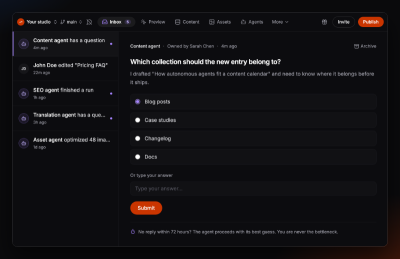
Stakeholders in the creative industry have expressed that while AI can assist in generating options, the final "sign-off" on brand-facing elements is a non-negotiable human responsibility. This tier includes high-level messaging, brand-new design directions, and the overarching user experience strategy.
Tier 3: The Variable Trust Zone
The most complex area of autonomous web management is the middle ground, where the same task may be viewed differently by different team members. This is the zone where trust is earned over time. A marketing manager might initially want to approve every copy change suggested by an agent. However, after seeing the agent successfully optimize ten meta-descriptions for SEO without changing the brand voice, the manager may move that specific task from "requires approval" to "fully autonomous."
This "moving line" of autonomy is the current focus of the industry. Modern platforms are now building "Agent Builders" rather than "Settings Menus." This allows users to compose specialized agents—such as a "Translation Agent" or a "Performance Agent"—and define exactly which parts of the site they can touch and under what conditions.
Broader Implications and Future Outlook
The rise of autonomous websites carries significant implications for the digital economy and the future of professional roles within it. As agents take over the "tedious eighty percent" of web maintenance, the role of the traditional "webmaster" is evolving into that of an "agent orchestrator." Professionals will spend less time fixing broken links and more time defining the parameters and goals for their autonomous fleets.
Furthermore, this technology may bridge the gap between small businesses and large enterprises. Historically, only large corporations could afford the dedicated teams required to keep a website "fresh" and optimized 24/7. Autonomous agents provide a scalable solution that allows a single individual to manage a high-performance web presence that would have previously required a full agency.
The ultimate risk, as identified by Burgy and other industry leaders, is not the potential for an agent to make a mistake, but the certainty of a static website falling behind. In an era where digital presence is the primary interface between a company and its customers, a "frozen" site is a liability. The transition toward autonomous, self-optimizing websites represents a move toward a more resilient, accessible, and performant internet—one where the launch day is no longer the peak of a website’s life, but merely the foundation for its continuous improvement.

