
The global technology sector is currently navigating a significant disconnect between corporate strategy and user sentiment regarding the implementation of artificial intelligence. While major enterprises and software providers have pivoted toward an "AI-first" philosophy, assuming a universal appetite for generative features, emerging data suggests a growing adoption gap. Industry analysts and user experience (UX) researchers are observing that the current wave of AI integration often fails to provide a clear value proposition, frequently resulting in low retention rates and increased cognitive load for the end-user.
This misalignment stems from a fundamental misunderstanding of how users interact with software. Many organizations have integrated AI as a "bolt-on" feature—a separate layer that requires users to deviate from their established workflows. Rather than streamlining operations, these tools often introduce new complexities, requiring users to manage "AI slop," verify hallucinations, and navigate fragmented systems. As the initial novelty of generative AI wanes, the industry is facing a critical turning point where the focus must shift from the mere presence of AI to its practical, reliable utility.
The Evolution of the AI Integration Wave
The current landscape is the result of an unprecedentedly rapid technological rollout that began in late 2022. To understand the current resistance, it is necessary to examine the timeline of the generative AI boom and how it has shaped corporate priorities over the past 24 months.
The launch of ChatGPT in November 2022 served as the catalyst for a "Gold Rush" phase in 2023. During this period, venture capital flowed heavily into AI startups, and legacy software providers felt immense pressure to announce AI integrations to satisfy shareholders. This led to the "Chatbot Era," where conversational interfaces were added to everything from spreadsheets to project management tools, often without rigorous user testing.
By early 2024, the industry entered what Gartner describes as the "Trough of Disillusionment." Organizations began to realize that while AI could generate content quickly, the quality was often inconsistent. The burden of proof shifted to the user, who now had to act as a "human-in-the-loop" editor, often spending more time correcting AI-generated drafts than they would have spent writing from scratch. By mid-2024, studies from institutions such as IBM and NN Group highlighted a significant adoption gap, noting that "powered by AI" was no longer sufficient to drive user engagement.
Analyzing the Value Proposition Gap
The core issue facing AI leaders is the conflation of "feature" with "value." According to research by David Bland and the NN Group, AI is most effectively categorized as a "Key Activity" or a "Key Resource" within a business model, rather than a "Value Proposition" in its own right. When companies market AI as the primary benefit, they often overlook the fact that users do not want "more AI"; they want faster, more reliable solutions to specific problems.
Current AI implementations often suffer from being "AI-first" rather than "user-first." This approach forces users to adapt their mental models to the idiosyncrasies of large language models (LLMs), which are inherently non-deterministic. Unlike traditional software, which provides a predictable output for a given input, AI features can be temperamental. For a professional who relies on precision—such as an accountant or a software engineer—this lack of predictability is not a minor inconvenience; it is a liability.

Furthermore, AI has a tendency to amplify existing organizational shortcomings. If a company has poor data quality, fragmented internal communication, or "technical debt," AI will not fix these issues. Instead, it will synthesize the mess and present it to the user with a confident but potentially inaccurate veneer. This forces the user to navigate internal politics and data inconsistencies that the AI has merely surfaced rather than resolved.
Supporting Data: The Productivity Paradox
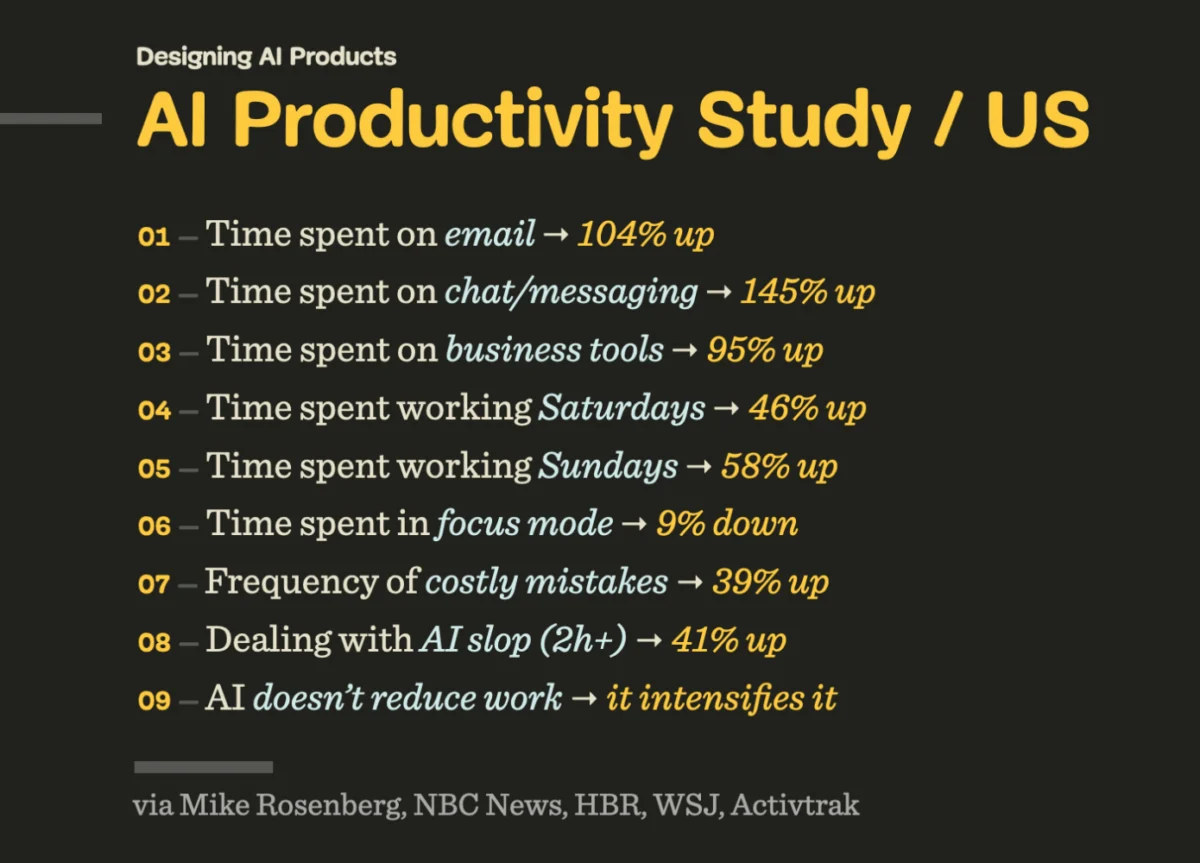
While AI is marketed as a tool to save time, empirical data suggests a more complex reality. Recent studies from sources including Activtrak, Harvard Business Review, and the Wall Street Journal indicate that AI integration has, in many cases, intensified the workload rather than reducing it.
A summary of findings from US-based productivity studies reveals the following trends:
- Time Spent on Communication: Time spent managing emails has increased by 104%, while chat and messaging time has surged by 145%.
- Tool Proliferation: The use of business tools has increased by 95%, contributing to "app fatigue" as users jump between disconnected AI systems.
- Work-Life Balance: There has been a recorded 46% increase in work performed on Saturdays and a 58% increase on Sundays, suggesting that AI is not yet fulfilling the promise of a shorter workweek.
- Error Rates: The incidence of costly mistakes has risen by 39%, largely attributed to the uncritical acceptance of AI-generated data.
- Verification Load: Users report a 41% increase in time spent dealing with "AI slop"—low-quality, AI-generated content that requires significant editing to be usable.
These figures highlight a "productivity paradox." While AI can perform a specific task in seconds, the surrounding ecosystem of verification, integration, and correction creates a net increase in "mental labor." For many employees, AI has not reduced work; it has changed the nature of work into a more exhausting form of oversight.

Psychological Resistance and the Human Element
Beyond technical and productivity concerns, there is a profound psychological component to the current resistance. For many workers, AI was not a tool they chose to adopt; it was an "uninvited guest" introduced by senior leadership. This top-down implementation often triggers a "resistance to change" rooted in deep-seated anxieties about job security.
The Washington Post and the Brookings Institution have mapped the vulnerability of various professions to AI automation. Roles such as software developers and public relations specialists are categorized as "highly exposed," whereas physical labor roles like firefighting remain relatively insulated. When employees in exposed fields are forced to use AI tools that are marketed as "replacements" for their creative output, the result is often resentment rather than excitement.
There is also a cultural pushback against the encroachment of AI into human-centric domains. As noted by industry observers like Bo Young Lee, there is little public demand for AI-narrated children’s books, AI therapists, or AI-generated art. The consensus among many users is a desire for AI to handle the "mundane, annoying, and boring" tasks—the "drudgery" of data entry, scheduling, and filing—to free up time for high-value human activities that involve taste, intuition, and emotional connection.
The Shift Toward "AI-Second" Design Patterns
To bridge the adoption gap, UX experts are advocating for a transition from "AI-first" to "AI-second" design. This philosophy suggests that AI should be subtle, ambient, and supportive, rather than the center of the user experience.

An "AI-second" approach focuses on:
- Deep Integration: Moving away from separate chat boxes and into features that exist within the user’s current workflow.
- Predictability: Ensuring that AI actions are transparent and that the user maintains ultimate control over the final output.
- Task-Specific Automation: Focusing on "boring" tasks that have clear, measurable benefits, such as summarizing long meeting transcripts or organizing unformatted data.
- Mental Model Alignment: Designing tools that adapt to how humans think and make decisions, rather than forcing humans to learn "prompt engineering" to get basic results.
By rebranding AI as "smart automation" or "assisted workflows," companies can lower the barrier to entry and reduce the skepticism associated with the "AI" label. The goal is to create tools that are fast, accessible, and reliable—the same qualities that have driven software adoption for decades.
Implications for Corporate Strategy
The implications for organizations are clear: the "spray and pray" method of AI feature deployment is reaching its limit. Companies that continue to prioritize the quantity of AI features over the quality of user integration risk damaging their reputation and wasting significant capital on high-cost delivery with low ROI.
Moving forward, the successful implementation of AI will require a more disciplined approach to product management. This includes rigorous user testing to identify where AI actually saves time and where it creates "friction." It also requires an honest assessment of internal data health; AI is only as effective as the information it processes.

Furthermore, leadership must address the human element by framing AI as an "augmenting" tool rather than a "replacing" tool. When AI is used to remove the "physical and mental labor that taxes" the employee, it is welcomed. When it is used to automate the rewarding, creative parts of a job, it is resisted.
In conclusion, the reality of the market is that people do not want more AI in their lives; they want more time in their lives. They want software that works consistently and helps them complete their tasks with minimal stress. If AI can achieve that by operating quietly in the background, it will find its place. If it continues to demand the spotlight while delivering unreliable results, the adoption gap will only continue to widen. The future of technology remains human-centric, and the most successful AI will be the one that allows people to spend less time with machines and more time on the work and people they value.

