
Modernizing Web Development: How the Baseline Standard is Reducing Dependency Bloat and Enhancing Browser Native Capabilities has emerged as a critical focal point for software engineering teams seeking to optimize performance and maintainability in an era of increasing web complexity. The web platform has reached a significant milestone where a substantial portion of the functionality previously outsourced to third-party JavaScript libraries is now natively integrated into major browser engines. This shift, spearheaded by the WebDX Community Group and codified through the "Baseline" initiative, represents a fundamental change in how modern applications are architected, potentially allowing developers to shed between 60KB and 90KB of minified, gzipped code from typical mid-sized applications.
The Genesis of the Baseline Initiative
The Baseline project was established by the WebDX Community Group—a collaborative effort involving major stakeholders including Google, Microsoft, Apple, and Mozilla—to provide a clear, standardized status for web features. For years, the web development ecosystem suffered from a lack of clarity regarding when a new CSS property or JavaScript API was "safe" to use without polyfills or external libraries. Baseline addresses this by categorizing features into two distinct tiers: "Newly Available," which indicates a feature has been implemented in all major browser engines (Chrome, Edge, Firefox, and Safari), and "Widely Available," which marks the point 30 months after the feature’s initial cross-browser release.
This 30-month window serves as a crucial buffer for enterprise applications and public-facing websites, ensuring that the vast majority of users—even those on slightly older devices or corporate-managed browsers—can access the functionality without breaking the user experience. By tracking these metrics, the industry is moving away from a reliance on bloated "kitchen sink" libraries like Lodash or Axios toward a more lean, platform-centric approach.
Chronology of the Web Platform’s Evolution
The transition toward native capability has been a multi-year journey marked by several key technical releases:

- 2015–2017: The Foundation. The introduction of the
fetchAPI andPromisearchitecture began the slow displacement of jQuery’s AJAX and early versions of HTTP clients. - 2022: Interop 2022. Major browser vendors began formalizing a commitment to interoperability, focusing on fixing top-tier compatibility issues in CSS and JavaScript.
- 2023: The Birth of Baseline. The WebDX group officially launched the Baseline terminology to simplify the decision-making process for developers auditing their
package.jsonfiles. - 2024: The Utility Surge. Native methods such as
Object.groupByandSetoperations (union, intersection) reached "Newly Available" status, directly challenging utility libraries like Lodash. - 2025–2026: The UI and Temporal Era. The Popover API and Anchor Positioning began reaching cross-browser stability, while the Temporal API entered the final stages of the TC39 process, signaling the eventual end of specialized date-management libraries.
Quantitative Impact: Auditing the Dependency Clusters
The argument for shifting to native features is grounded in performance data. In modern web performance optimization, "JavaScript bytes are the most expensive bytes" because they require parsing and execution time on the main thread, unlike images or CSS. By categorizing dependencies into "clusters," developers can realize significant bundle size reductions.
Internationalization and Formatting
For years, libraries like moment.js, numeral.js, and timeago.js were industry standards. However, the Intl (Internationalization) namespace now provides robust, native alternatives.
- Relative Time:
Intl.RelativeTimeFormatis now Widely Available, allowing for localized strings like "2 days ago" without external code. - Currency and Numbers:
Intl.NumberFormathandles thousands separators, compact notation (e.g., "1.2M"), and currency symbols natively. - List Formatting:
Intl.ListFormatmanages complex linguistic joins like the Oxford comma.
Estimated Savings: Replacing a suite of internationalization libraries can reduce bundle sizes by approximately 14 KB gzipped.
Networking and HTTP Clients
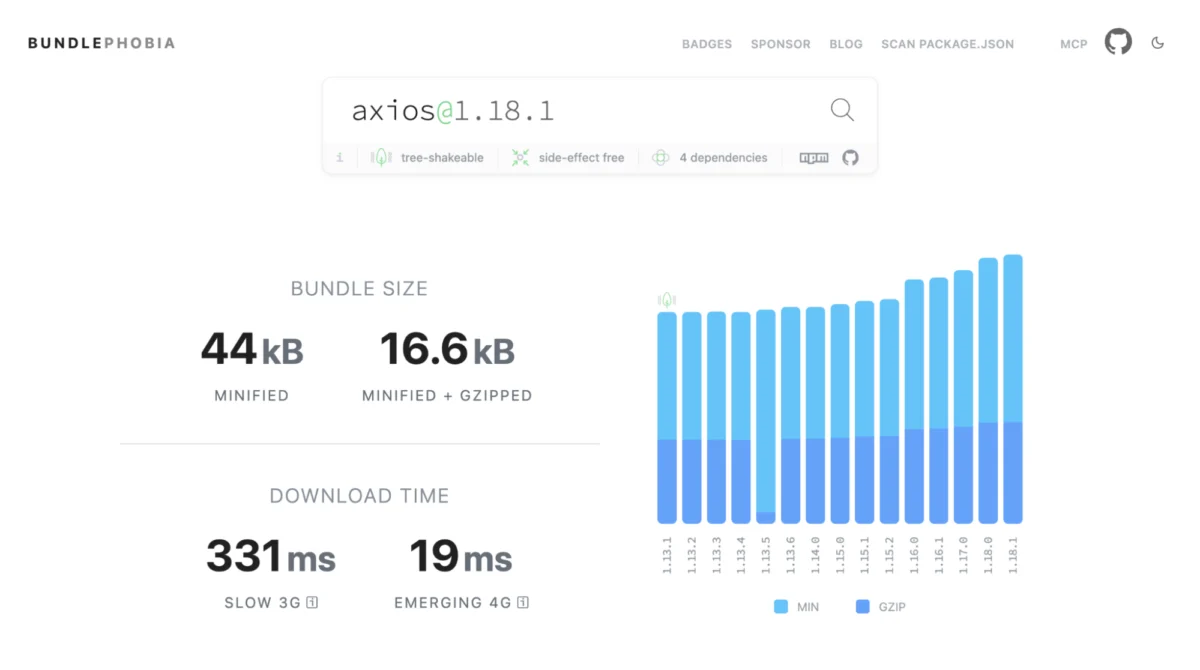
The ubiquitous axios (17 KB gz) is often used for features that the native fetch API now supports, such as request timeouts via AbortSignal.timeout(). While axios remains valuable for advanced interceptors and automatic retries, many applications use it solely for JSON parsing and basic error handling—tasks that require only a few lines of native wrapper code.
Estimated Savings: 17 KB gzipped.
User Interface Primitives
The most significant leap in native capabilities involves UI components. The <dialog> element, now Widely Available, handles focus trapping, accessibility (A11y), and "Top Layer" rendering—functions that previously required libraries like a11y-dialog or focus-trap. Furthermore, the Popover API and the burgeoning CSS Anchor Positioning specification are poised to replace heavy positioning engines like Popper.js and Tippy.js.
Estimated Savings: 24 KB gzipped.
The Three-Question Decision Framework
The WebDX community and performance experts advocate for a rigorous decision framework before removing dependencies. This ensures that the pursuit of a smaller bundle size does not compromise user accessibility or application stability.

- Is the replacement Baseline-safe for the specific audience? Developers are encouraged to check their own analytics. A B2B platform with a forced-update policy can adopt "Newly Available" features immediately, whereas a public-facing utility site may need to wait for "Widely Available" status.
- What is the hidden cost of the swap? Replacing a small library with a native feature that requires a massive polyfill is counterproductive. This is currently the case with the
TemporalAPI; while it is superior to theDateobject, the polyfills are currently larger than existing date libraries likedayjs. - Does the platform feature cover the specific use case? Native features are often designed to be "low-level primitives." They provide the building blocks but may lack the "syntactic sugar" or convenience methods of a mature library.
Industry Implications and Expert Analysis
The shift toward native browser features has profound implications for the software supply chain. The "npm audit" culture, which focuses primarily on security vulnerabilities, is expanding to include "utility audits."
Industry analysts suggest that this trend will lead to a "thinning" of the average JavaScript bundle. "We are moving away from the ‘framework-as-a-platform’ era and back toward ‘platform-as-a-platform,’" notes one senior web architect. "When the browser handles the modal, the focus trap, and the date formatting, the framework’s job becomes much simpler: managing state and data flow."
Furthermore, the reliance on fewer third-party dependencies reduces the "attack surface" for supply chain vulnerabilities. Every library removed from package.json is one less vector for potential security exploits or breaking changes introduced by maintainers.
The Temporal API: A Case Study in Calculated Patience
The ongoing rollout of the Temporal API serves as a cautionary tale for over-eager modernization. Designed to fix the long-standing flaws of the 1995-era Date object, Temporal offers immutable objects and sophisticated timezone handling. However, as of early 2026, it has not yet reached "Widely Available" Baseline status due to pending stable releases in some browser engines.
Current data shows that the official Temporal polyfill weighs approximately 44 KB gzipped, whereas dayjs is only 3 KB. In this instance, the "native" route is currently less efficient for the end-user than the library route. This highlights the importance of the 30-month "Widely Available" milestone in the Baseline standard.

Future Outlook: Toward a "Zero-Dependency" UI
As the web platform continues to evolve, several upcoming features are expected to reach Baseline status, further reducing the need for JavaScript:
- CSS Container Queries: Already reaching widespread support, reducing the need for JS-based resize observers.
- Native Masonry Layout: A pending CSS specification that could eliminate the need for heavy grid-positioning libraries.
- Navigation API: A modern alternative to the History API that simplifies client-side routing.
The conclusion for development teams is clear: the "install-and-forget" mentality regarding dependencies is no longer viable in a high-performance environment. Regular audits against the Baseline standard are becoming a best practice for maintaining competitive, fast-loading web applications. By handing functionality back to the browser, developers can focus on building unique features rather than reinventing the foundational primitives of the web.

