
The Evolution of the CSS Complexity Paradox
For
years, the industry standard for responsive design and interactive components relied on JavaScript APIs like ResizeObserver or IntersectionObserver. These tools provided a clear, imperative path for managing state and layout. However, the period between 2021 and 2024 saw a rapid standardization of high-level CSS features that promised to move this logic directly into the stylesheet. The "Interop" initiatives—a collaborative effort by Google, Apple, Microsoft, and Mozilla—accelerated the deployment of these features, leading to a surge in migrations.
In these migrations, a common pattern has emerged: a developer replaces fifty lines of JavaScript with five lines of CSS, resulting in a "red diff" (a pull request where more code is deleted than added). While this is traditionally viewed as a sign of progress, the reality in large-scale production environments is often different. By shifting logic from an imperative language (JavaScript) to a declarative one (CSS), the visibility of logic is often obscured, making it harder for teams to reason about the application’s state when bugs inevitably arise.
Chronology of CSS Capabilities and Adoption (2021–2026)
The transition to modern CSS has occurred in several distinct phases, each introducing new layers of interaction:
- 2021–2022: The Birth of Container Queries. CSS Container Queries began landing in stable browser versions, allowing elements to style themselves based on their own size rather than the viewport. This effectively challenged the dominance of JavaScript-based layout managers.
- 2022–2023: The :has() Revolution. Often called the "parent selector,"
:has()allowed CSS to query the presence of children or siblings, moving complex state-based styling away from React or Vue logic and into the browser’s CSS engine. - 2023–2024: Native Nesting and Cascade Layers. CSS Nesting brought Sass-like syntax to the browser, while Cascade Layers (@layer) were introduced to help manage specificity.
- 2025–2026: The Migration Backlash. As these features reached maturity, teams began reporting "phantom bugs"—layout shifts, specificity wars, and performance regressions—that were difficult to trace because the logic was split across different technological boundaries.
Analyzing Behavioral Fragmentation
One of the primary risks identified in modern front-end architecture is "shared ownership" of component behavior. When a migration is incomplete or poorly documented, a single component may have its state managed by both JavaScript and CSS. For instance, a dashboard card might use a CSS Container Query to adjust its layout while a legacy JavaScript ResizeObserver continues to toggle classes for typography or accessibility features.
Technical audits show that when a designer requests a change—such as moving a breakpoint from 480px to 600px—a developer might update the CSS without realizing the JavaScript observer remains anchored to the old value. This results in "Frankenstein states" where a component is neither fully in its "small" state nor its "large" state, leading to broken UI patterns that are difficult to reproduce in isolation.

Technical Side Effects: The Block Formatting Context
The introduction of container-type: inline-size does more than enable queries; it fundamentally alters how the browser treats an element’s layout. According to MDN documentation, declaring an element as a container establishes a new Block Formatting Context (BFC). This change has three significant implications that often go unnoticed during a migration:
- Margin Collapse Suppression: In standard flow, vertical margins of adjacent elements often collapse into one. However, an element that establishes a BFC prevents its children’s margins from collapsing with its own. This can lead to unexpected spacing increases, such as a card growing by 20–40 pixels simply because a container query was added.
- Float Interaction: Elements with a BFC will not overlap floats. While this can be a solution for certain layout issues, it can also cause components to shift or shrink unexpectedly if they are placed near floated images or sidebars.
- Size Containment: Inline-size containment prevents an element from deriving its width from its children. In scenarios where a card is part of a flexbox or grid layout with "fit-content" properties, adding container queries can cause the element to collapse to zero width, effectively making it vanish from the UI.
The Specificity War: Nesting and the :has() Selector
The convenience of native CSS nesting and the power of the :has() selector have introduced new challenges in managing the CSS Cascade. While these tools allow for shorter, more readable selectors, they often carry a "weight" that is not immediately obvious.
Under the CSS specification, the & selector in nesting and the :is()/:has() pseudo-classes take on the specificity of the most specific element in their selector list. This means a nested rule can inadvertently inherit the weight of an ID or a complex class elsewhere in the stylesheet.
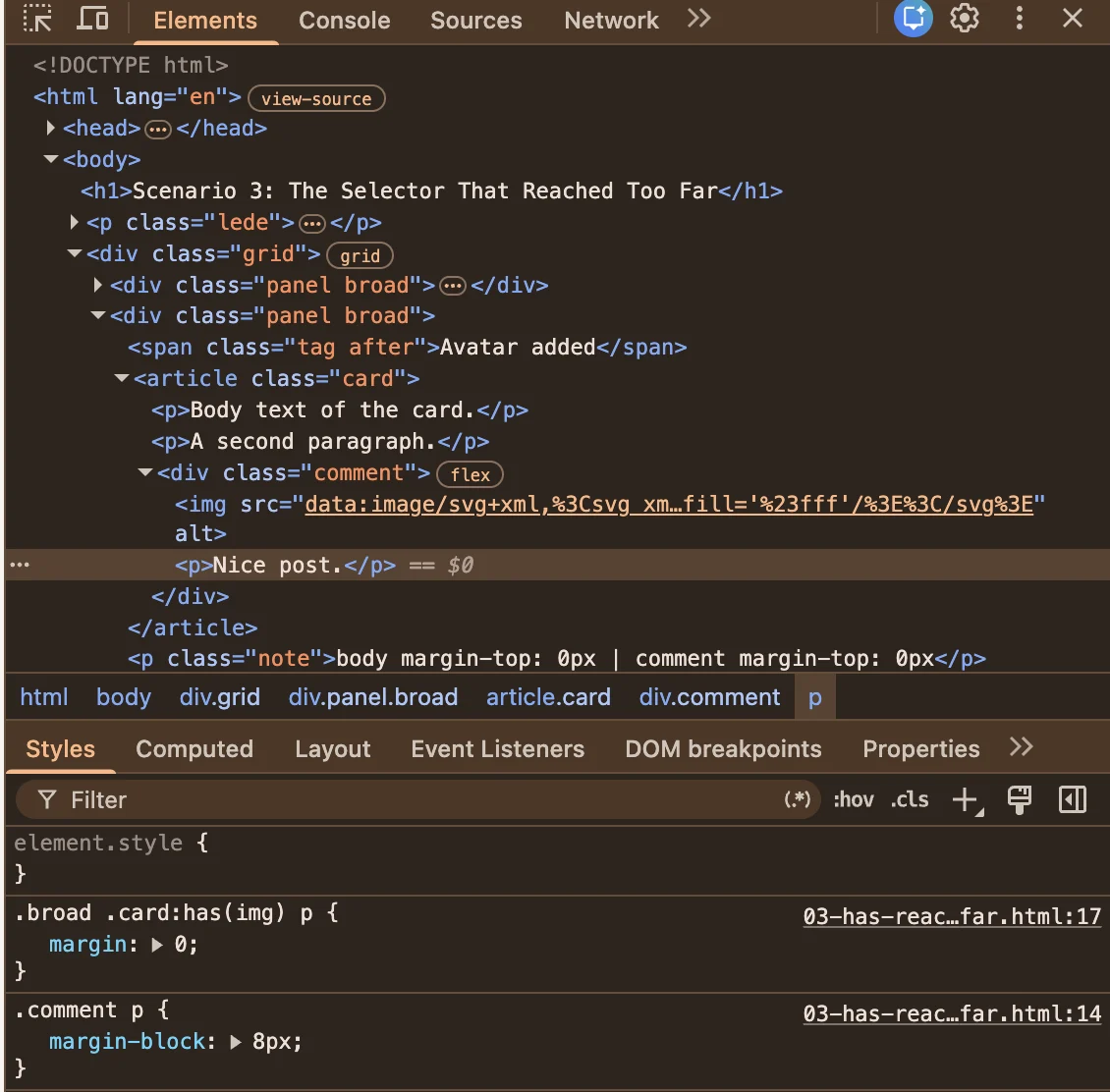
Furthermore, the reach of :has() is often underestimated. A selector like .card:has(img) p might be intended to style paragraphs within a card that contains an image. However, if that card also contains a nested "comment" component with its own images and paragraphs, the outer CSS rule will "leak" into the inner component. This breaks the principle of encapsulation, leading to spacing and styling bugs in sub-components that the developer never intended to touch.
Performance Audits: The Hidden Cost of "Smart" Styles
A common justification for moving logic to CSS is performance, based on the assumption that browser-native engines are always faster than JavaScript. However, recent performance traces conducted in Chromium-based browsers suggest that complex CSS selectors can trigger massive restyling overhead.
In a controlled test involving a list of 5,000 rows, researchers examined the impact of combining multiple :has() rules. While a single :has() rule anchored to the <body> element might only take 1.4ms to process, adding a second, seemingly unrelated :has() rule can cause a "systemic interference." In one instance, toggling a single class on one row forced the browser to restyle all 5,001 elements on the page, increasing the processing time to 7ms. While still within the 16.7ms window for a 60Hz frame, this cost scales linearly. At 20,000 rows, the processing time jumped to 31ms, causing noticeable "jank" and dropped frames.
These findings highlight that CSS is not a performance silver bullet. The browser must still perform the work of calculating styles and layouts, and declarative logic can sometimes make it harder for the engine to optimize which elements need updating.

Official Responses and Industry Perspectives
The web development community remains divided on the implications of these features. Igor Roztropiński, a prominent front-end commentator, questioned in early 2026 whether modern front-end complexity is "essential or accidental," suggesting that developers might be over-engineering solutions with new tools.
On the other hand, browser vendors and spec writers like Miriam Suzanne have emphasized that tools like Cascade Layers were specifically designed to solve these issues. Suzanne’s original proposal for cascade layers noted that the goal was to allow developers to manage order-of-appearance and specificity explicitly, rather than relying on the "accidental" outcomes of selector weight.
However, industry experts point out a significant gap: most documentation is written from a "greenfield" perspective (starting a new project from scratch). In "brownfield" projects (migrating existing, complex codebases), the interaction between old "spaghetti" CSS and new modern features creates a friction that current documentation rarely addresses.
Strategic Framework: The Migration Checklist
To mitigate these risks, technical architects are recommending a rigorous checklist before any migration from JavaScript to CSS:
- Ownership Identification: Does this behavior have more than one owner? All related JavaScript observers and legacy classes must be deleted simultaneously with the CSS implementation.
- BFC Impact Assessment: Will
container-typeorcontain: layoutaffect margin collapsing or float interactions in the surrounding layout? - Containment Strategy: If the element uses size containment, is its width or height explicitly defined by its parent?
- Scope and Combinators: Are selectors constrained by child combinators (
>) to prevent styles from leaking into nested components? - Specificity and Layers: Have the new rules been placed in a Cascade Layer (@layer), and if so, how do they interact with unlayered legacy styles?
- Performance Baseline: Does a DevTools performance trace show an unusual number of "Elements Affected" by a style recalculation after the change?
Broader Impact and Implications
The shift toward modern CSS represents a maturation of the web platform, but it also demands a higher level of "CSS Literacy" from developers. The era where CSS was seen as a simple "painting" language is over; it is now a sophisticated logic engine with its own set of side effects and performance pitfalls.
The broader implication for the industry is a shift in how we define "clean code." A short, elegant CSS file is not necessarily "clean" if it makes the wider application harder to reason about, debug, or optimize. As front-end systems continue to grow in scale, the successful teams will be those that view CSS not as a way to "delete JavaScript," but as a powerful—and potentially volatile—component of a complex technical ecosystem. The goal of modern development should not be "less code," but "less complexity," and achieving that requires a deep understanding of how every new tenant in the codebase interacts with the existing residents.

