
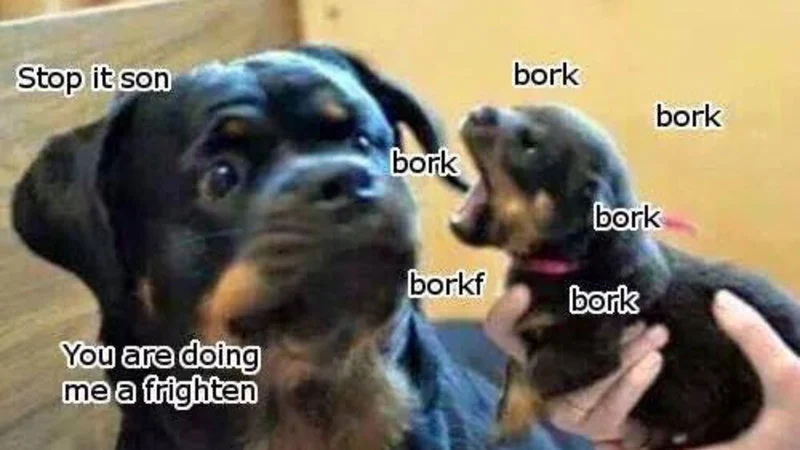
The digital landscape of the mid-2010s was characterized by a significant shift in internet linguistics, a phenomenon that saw the emergence of highly stylized, intentional ungrammaticality known as "DoggoLingo" or "Barkanese." At the forefront of this movement was the viral phrase and associated image macro series known as Stop It Son, You Are Doing Me A Frighten. This phrase, typically paired with images of animals—most notably primates and canines—engaging in startled or overwhelming interactions, represents a pivotal moment in the evolution of wholesome internet humor. As a linguistic artifact, it exemplifies the "doing me a [noun/verb]" syntactic structure that dominated social media platforms like Reddit, Tumblr, and Facebook between 2015 and 2017.
The Genesis of a Digital Lexicon
The origins of Stop It Son, You Are Doing Me A Frighten are rooted in the broader "DoggoLingo" trend, which gained mainstream momentum around 2014. This dialect of internet slang relies on a set of predictable morphological and syntactic alterations, such as the addition of the "-er" suffix (e.g., "pupper," "doggo"), the use of "heck" as a universal intensifier, and the re-purposing of verbs as nouns.
In the case of "doing me a frighten," the phrase utilizes a specific grammatical inversion. Standard English would dictate the phrase "you are frightening me" or "you are giving me a fright." By transforming the verb "frighten" into a noun and preceding it with the transitive construction "doing me a," the phrase creates a sense of childlike innocence and exaggerated vulnerability. This stylistic choice is designed to anthropomorphize the subjects of the memes, suggesting a level of cognitive complexity and emotional sensitivity that resonates with a broad audience.
Chronology and Viral Proliferation
While the exact "patient zero" of the phrase remains difficult to isolate due to the decentralized nature of image board culture, the phrase saw a documented surge in 2016. Digital historians and meme archivists point to a series of specific uploads that catalyzed the phrase’s journey into the cultural zeitgeist.
- Early 2016: The Linguistic Foundation. The "doing me a…" template began appearing in various forms across Reddit’s r/rarepuppers and similar subreddits. Variations included "doing me a concern" and "doing me a bamboozle."
- Mid-2016: The Gorilla Interaction. One of the most recognizable iterations of the meme involved a photograph of two gorillas. In the image, a younger gorilla appears to be screaming or acting boisterously toward an older, visibly weary gorilla. The caption "Stop it son, you are doing me a frighten" was applied to this specific dynamic, perfectly capturing the generational friction and the older animal’s perceived exhaustion.
- Late 2016 to 2017: Peak Saturation. According to data from search engine analytics, interest in the phrase peaked during this period. The meme expanded beyond its original animal subjects to include characters from popular media, including Pokémon (notably Popplio) and various household pets.
- 2018–Present: Legacy and Archival Status. While the phrase has largely moved out of the daily vernacular of the "cutting edge" internet, it remains a staple of "wholesome" meme culture. It is frequently cited in academic discussions regarding the development of internet-specific dialects.
The Anatomy of the Imagery
The visual component of Stop It Son, You Are Doing Me A Frighten is as essential as its text. The imagery typically follows a two-panel or single-panel format where a clear power imbalance or behavioral contrast is evident.

In the "Gorilla" variant, which remains a primary example of the meme’s efficacy, the younger primate’s open-mouthed vocalization serves as the "frighten," while the older primate’s closed-eyes or turned-away posture serves as the "stop it." This visual storytelling allows the viewer to project human-like parental fatigue onto the animals. Other notable versions include:
- The Lion Variant: A cub pouncing on a male lion, captioned with "Stop it dad u r doin me a scare."
- The Tiger Variant: A mother tiger reacting to her cub’s play-aggression with the caption "You are doing me an annoy."
- The Pug/Canine Variant: Small dogs reacting to larger objects or sudden movements, emphasizing the "heckin" nature of the scare.
These images utilize a specific color palette and low-fidelity aesthetic typical of 2016-era memes, often featuring Impact font or the more modern, sans-serif styles associated with mobile image-editing apps.
Quantitative Analysis and Engagement Metrics
Data gathered from digital repositories such as Know Your Meme indicates that the "Stop It Son, You Are Doing Me A Frighten" entry has accumulated dozens of related images and videos, reflecting a high level of user-generated content (UGC) contribution. Analysis of the 24 primary images associated with the entry shows a diverse range of species, suggesting that the meme’s appeal is not limited to a specific animal fandom but rather the universal theme of "overwhelming enthusiasm versus the desire for peace."
On platforms like Imgur, the "Gorilla" version of the meme has garnered hundreds of thousands of views, while on Reddit, threads featuring the "doing me a frighten" syntax frequently reached the "Front Page" (now "Popular") during the meme’s height. The engagement metrics suggest that the phrase’s success was driven by its "remixability"—the ease with which users could apply the text to their own pets or found images.
Sociological and Linguistic Implications
The rise of Stop It Son, You Are Doing Me A Frighten has been the subject of minor linguistic scrutiny. Dr. Gretchen McCulloch, an internet linguist and author of Because Internet, has noted that the "DoggoLingo" phenomenon represents a sophisticated understanding of English grammar. To "break" the rules of grammar so consistently and predictably requires a native-level fluency.
From a sociological perspective, the meme belongs to the "Wholesome Meme" movement. Unlike the cynical or aggressive humor that characterized the early 2000s (e.g., "Advice Animals" or "Edgelord" culture), this era of memetics focused on empathy, soft emotions, and the celebration of the mundane. The "frighten" in the meme is never a true threat; it is a "spook" or a "scare"—a harmless disruption of domestic or natural tranquility.

Furthermore, the meme reflects a broader trend of "Internet Speak" bleeding into real-world interactions. During the peak of the meme’s popularity, pet owners frequently used the phrase in video captions on platforms like Vine and Instagram, further cementing the "pupper" dialect as a legitimate sub-language of the digital age.
Official Responses and Cultural Impact
While "memes" rarely receive official statements from government bodies, the cultural impact of the "doing me a frighten" syntax was noted by brands and animal welfare organizations. Several social media managers for major pet food brands adopted the "DoggoLingo" style in their marketing campaigns during 2016 and 2017 to appear more "relatable" to the millennial and Gen Z demographics. This commercialization, however, often signaled the "death" of the meme among core internet subcultures, as the transition from organic viral content to corporate marketing typically marks the end of a meme’s lifecycle.
In the realm of digital art, the meme inspired various fan illustrations. Artists on platforms like DeviantArt and Tumblr created stylized versions of the "frightened" animals, often exaggerating their features to heighten the comedic effect. The phrase "doing me a frighten" even appeared on unofficial merchandise, such as t-shirts and mugs, highlighting its transition from a digital screen to a physical consumer product.
Conclusion: The Endurance of the "Frighten"
As we look back at the trajectory of Stop It Son, You Are Doing Me A Frighten, it serves as a testament to the power of linguistic innovation in online communities. It was more than just a funny caption; it was a building block for a new way of communicating affection and humor through the lens of the animal kingdom.
Today, the phrase exists as a nostalgic marker for a specific era of the internet—a time before the hyper-polarization of social media platforms, when a screaming baby gorilla and a tired father could unite millions in a shared moment of "heckin" amusement. The meme’s legacy persists in the continued use of "doing me a…" constructions, proving that while specific images may fade, the grammatical structures created by the internet have a surprising degree of permanence.
Ultimately, Stop It Son, You Are Doing Me A Frighten remains a cornerstone of digital folklore. It illustrates the human tendency to find humor in the chaotic yet harmless interactions of nature and the creative ways in which language adapts to express the nuances of the modern, interconnected experience. Whether through a gorilla, a lion, or a pug, the "frighten" continues to resonate as a lighthearted acknowledgment of life’s many small, startling moments.

