
The digital landscape is currently witnessing a fundamental shift in how web presence is maintained and optimized, moving away from the traditional "launch and decay" cycle toward a model of continuous, autonomous evolution. For decades, the lifecycle of a corporate website has followed a predictable and often frustrating trajectory: a period of intense development followed by a peak of perfection on launch day, and a subsequent, slow decline into obsolescence. This phenomenon, often referred to by industry experts as "digital decay," occurs not because the underlying technology fails, but because the human resources required to keep a site synchronized with a shifting market are often diverted to new projects.
Pierre Burgy, a prominent figure in the web development space and co-founder of the autonomous website platform Fimo, argues that the industry has long treated this decay as an inescapable law of nature. However, the emergence of autonomous agents—AI-driven entities capable of performing complex, rule-based tasks—is beginning to challenge this paradigm. By integrating these agents into the core infrastructure of a website, organizations can ensure that their digital storefronts remain as current and performant as they were on the day they were first deployed.
The Phenomenon of Digital Decay and the Cost of Inaction
The primary driver behind the push for autonomous websites is the sheer volume of maintenance required to keep a modern site competitive. According to industry data, the average lifespan of a website is between two and three years. During this time, the "drift" from its original intent can be significant. This drift is caused by several factors: shifting brand messaging, new competitor launches, updates to design systems that are not universally applied, and the slow accumulation of technical debt such as unoptimized images or broken links.
Research from various digital marketing firms suggests that outdated content and poor performance can lead to a significant drop in user engagement. A study by Akamai found that a 100-millisecond delay in website load time can hurt conversion rates by up to 7%, while uncompressed images and outdated SEO metadata can result in a steady decline in organic search rankings. Despite these risks, many organizations find it difficult to justify the continuous expenditure of high-value developer time on routine maintenance tasks.
The current alternative is a "frozen" site—a digital asset that remains static until it becomes so misaligned with the company’s goals that a total rebuild is required. This cycle is not only expensive but creates periods of significant vulnerability where the company’s primary digital touchpoint does not accurately represent its current state.
The Architecture of Autonomy: How Agents Function
The concept of an autonomous website relies on "agents"—specialized AI programs designed to monitor, identify, and fix specific issues without direct human intervention. Unlike traditional automation, which follows rigid "if-this-then-that" logic, autonomous agents utilize large language models (LLMs) and computer vision to understand context and intent.
In a fully realized autonomous ecosystem, the work is typically divided into three distinct categories based on the level of judgment required:
-
Rule-Bound Maintenance (The No-Brainers): This category encompasses roughly 80% of website maintenance. It includes tasks such as ensuring accessibility compliance (WCAG), optimizing image assets for different devices, fixing broken redirects, and ensuring that design system tokens (like colors or spacing) are consistently applied across all pages. These tasks are defined by objective rules rather than subjective taste, making them ideal candidates for full delegation.
-
Subjective Judgment (The Untouchables): At the opposite end of the spectrum are tasks that define a brand’s identity and "feel." An agent can verify if a page meets contrast requirements, but it cannot decide if a specific design evokes the correct emotional response from a target audience. This layer of "taste" is where human value is highest and where professional designers and marketers are most protective of their roles.
-
The Variable Middle (The Gray Area): This is where the challenge of autonomy becomes a design problem rather than a technical one. Many tasks fall into a middle ground where the decision to delegate depends on the individual’s role and level of trust. For instance, a developer might view a change to "dark mode" as a simple technical default, while a brand designer might see it as a critical aesthetic choice.
Chronology of the Shift Toward Autonomous Web Platforms
The path to autonomous websites has been paved by several technological milestones over the last two decades:
- 2000s: The Rise of the CMS. Platforms like WordPress and Drupal allowed non-technical users to update content, but the underlying structure remained static and required manual oversight.
- 2010s: The Headless and Jamstack Revolution. Decoupling the frontend from the backend allowed for faster, more secure sites, but increased the complexity of maintenance as content and code became more distributed.
- 2020-2022: AI Integration. Early AI tools began assisting with copy generation and basic image editing, but these were largely "co-pilot" tools requiring constant human prompting.
- 2023-Present: The Agentic Era. Platforms like Fimo began developing systems where AI is not just a tool but an active participant in the site’s lifecycle. This period marks the transition from "human-led, AI-assisted" to "AI-led, human-governed" maintenance.
Industry Reactions and the Trust Barrier
The introduction of autonomous agents has met with a mixture of enthusiasm and skepticism within the tech community. While the promise of reduced "chore" work is universally appealing, the prospect of a website changing itself "while you sleep" triggers concerns regarding brand consistency and security.
Feedback from early adopters of autonomous platforms indicates that the primary barrier to implementation is not the capability of the AI, but the lack of a single "owner" for most websites. Because a site involves designers, developers, SEO specialists, and content creators, each stakeholder has a different "line" for what they are willing to delegate.
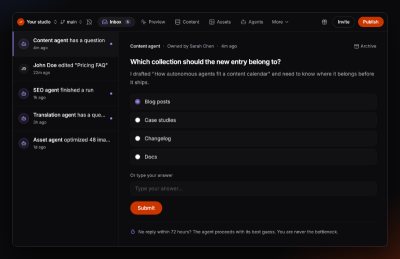
"Almost nobody actually wants a website that changes entirely on its own," Pierre Burgy noted during his analysis of the development of Fimo. The realization led his team to shift their focus from "total autonomy" to "configurable autonomy." This allows users to build specific agents for specific tasks—such as a dedicated "Accessibility Agent" or a "Translation Agent"—and gradually expand their permissions as they prove their reliability.
Analysis of Implications: A New Era for Digital Professionals
The rise of autonomous websites is likely to redefine professional roles within the digital economy. Rather than being replaced, developers and designers may find their roles shifting toward "Agent Orchestration."
From a financial perspective, the ROI of autonomous maintenance is compelling. By automating the 80% of tasks that are repetitive and rule-based, companies can redirect their human talent toward high-impact creative and strategic work. Furthermore, a site that never "falls behind" maintains its value longer, potentially extending the time between expensive total redesigns.
However, this shift also introduces new risks. The "black box" nature of some AI decisions requires robust logging and "before-and-after" inspection tools. For autonomy to be viable, every action taken by an agent must be transparent and reversible. The industry is currently developing standards for "Agent Logs," which serve as a digital paper trail for every modification made to a site.
Broader Impact on the Global Web
If autonomous websites become the standard, the overall quality of the internet could improve significantly. We may see a dramatic reduction in broken links, unoptimized mobile experiences, and inaccessible content—issues that currently plague even high-budget corporate sites.
Moreover, for small to medium-sized enterprises (SMEs) that lack the budget for a dedicated web team, autonomous agents could provide a level of technical excellence previously reserved for tech giants. This democratization of high-end web maintenance could level the playing field in the digital marketplace.
Ultimately, the goal of autonomy is to solve the problem of the "frozen site." By acknowledging that a website is a living entity that exists in a state of constant flux, organizations can move past the limitations of the launch-day peak. The future of the web belongs to sites that do not just work, but actively learn and improve, ensuring that the best version of a site is always the one that exists today, rather than the one that shipped a year ago. The risk is no longer that an agent might make a mistake; the risk is that a static site will inevitably become a relic of a company that no longer exists.

