
The global mental health landscape is undergoing a radical digital transformation as traditional healthcare systems struggle to meet skyrocketing demand. According to data released by the World Health Organization (WHO) in late 2025, over one billion people are currently living with mental health conditions, creating a care gap that requires an urgent and unprecedented scale-up of services. In response, the digital health sector has seen a surge in mobile applications, with approximately 20,000 mental health-related products now available on the market. However, as the industry matures, a critical realization has emerged among product designers and clinicians: for these tools to be effective, they must move beyond mere utility and adopt an "Empathy-Centred UX" (User Experience) that prioritizes the inherent vulnerability of the user.
Designing for mental health is fundamentally different from designing for productivity or entertainment. When a user opens a mental health application, they are often in a state of high cognitive load, anxiety, or emotional exhaustion. Traditional UX patterns—such as bright, high-contrast interfaces, aggressive notification "streaks," and immediate paywalls—can be actively harmful in this context. Industry experts now argue that empathy is not a decorative feature but a functional requirement. By treating the user’s emotional state as the primary environment in which the product operates, developers can build the trust necessary for long-term therapeutic engagement.
The Evolution of Digital Mental Health Interventions
The journey toward empathy-centred design has been accelerated by the failure of early-generation health apps to retain users. Research indicates that many mental health apps suffer from high abandonment rates, often because the interface fails to account for the user’s diminished cognitive capacity during moments of crisis. Historically, the "gamification" of health—using badges, points, and daily streaks—was seen as the gold standard for retention. However, for users struggling with depression or burnout, a "broken streak" notification can trigger feelings of shame and failure, leading them to delete the app entirely.
The shift toward a more humane framework involves three core pillars: reimagining onboarding as a companionable conversation, creating low-stimulus emotional interfaces, and developing retention engines that prioritize agency over manipulation. This framework aims to bridge the gap between clinical efficacy and user-centric design.
Pillar I: Reimagining Onboarding as a Supportive Conversation
In the competitive landscape of app stores, the onboarding process is often viewed as a race to collect data and convert users to premium tiers. In the context of mental health, however, onboarding is the "first date" where trust is either established or lost. A clinical, checklist-style approach can feel dismissive to someone seeking immediate relief.
Case Study: Teeni and the Narrative Approach
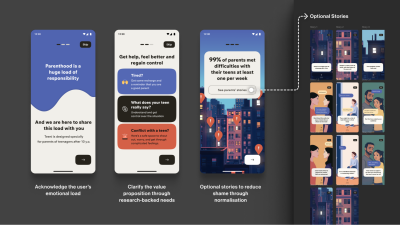
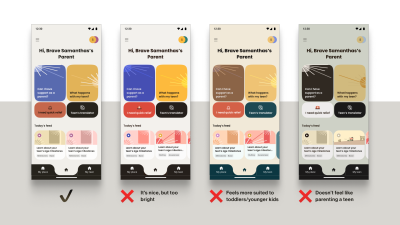
The parenting app Teeni provides a blueprint for empathy-first onboarding. Recognizing that parents of teenagers often feel a sense of personal failure, the app avoids immediate data extraction. Instead, it utilizes a "city-at-night" metaphor with lit windows to normalize the user’s experience. By presenting optional, animated stories of other parents facing similar challenges, the app delivers a "micro-dose" of relief before asking for user information.
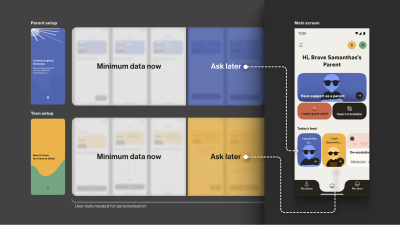
This approach utilizes "Progressive Profiling." Rather than demanding a comprehensive history upfront, the system collects only the essentials—such as the child’s age and the parent’s role—to provide an immediate, relevant feed. More sensitive details are gathered gradually as the user begins to feel safe within the digital environment. This strategy acknowledges that a distressed user may not have the patience for long forms, ensuring that the path to support remains frictionless.
Pillar II: Engineering the Low-Stimulus Emotional Interface
The second pillar of the framework focuses on the visual and sensory environment. Clinical research suggests that individuals experiencing anxiety or depression often have a reduced attention span and a lower tolerance for high-stimulation visuals. This makes the application of Web Content Accessibility Guidelines (WCAG 2.2) a mandatory baseline, but empathy-centred design goes further by adopting a "low-arousal" visual language.
Sensory Grounding and the ‘Bear Room’
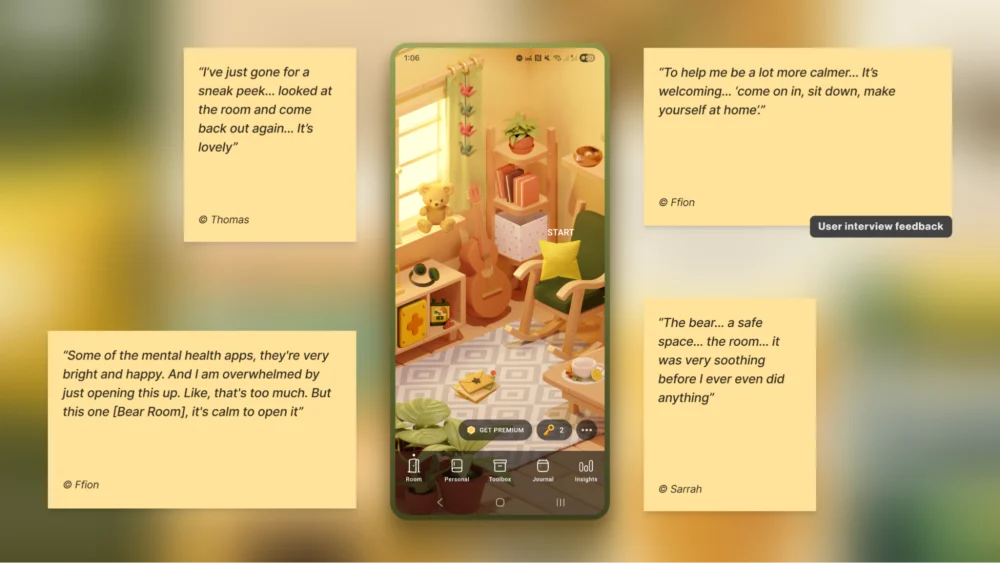
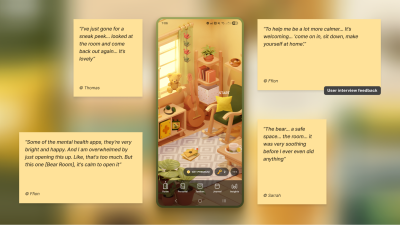
In the stress-relief application Bear Room, designers moved away from the "too bright, too happy" aesthetic common in early wellness apps. Based on user interviews with individuals suffering from PTSD and depression, the app implemented an earthy, non-neon palette and eliminated jarring animations.
The interface also incorporates sensory grounding techniques. For instance, a digital "bubble-wrap" micro-interaction offers kinetic relief through haptics and sound, providing a controlled sensory interruption to cycles of anxious thoughts. This is not gamification in the traditional sense; it is a tactical tool for emotional regulation.
Furthermore, the integration of voice assistants has proven vital for accessibility. During acute stress, the cognitive effort required to type can be prohibitive. By offering voice-first flows—where users can "vent" or describe their feelings through speech—apps can utilize "affect labeling." This psychological process of putting feelings into words has been shown to reduce emotional intensity, allowing the app to analyze the user’s state (without diagnosing) and suggest tailored coping mechanisms.
Pillar III: Ethical Retention and the Rejection of Dark Patterns
The third pillar addresses the ethical dilemma of retention. While businesses need users to return, mental health apps must avoid the "dopamine loops" used by social media. The goal is to foster a supportive rhythm of use that acknowledges the non-linear nature of healing.
The ‘Key Economy’ vs. Punitive Streaks
The Bear Room team developed the "Key Economy" as a compassionate alternative to daily streaks. In this model, users earn "keys" for logging in every few days, a cadence that respects the reality of mental health fluctuations. Crucially, these keys are never used to gate essential SOS tools; they are only used to unlock advanced content or aesthetic customizations.
Perhaps the most significant innovation in this pillar is the ability for users to "gift" their earned keys to others in the community. This transforms retention from a self-focused chore into an act of altruism. By drawing on the "IKEA Effect"—where users place higher value on things they help create—the app allows users to customize their digital "safe space" (e.g., placing personal photos in a digital frame), deepening their psychological ownership of the tool.
Data Privacy and the Ethics of AI-Mediated Support
As mental health apps increasingly rely on AI to analyze voice inputs and provide personalized content, data privacy has become the ultimate test of trust. With frequent headlines regarding data breaches and the sale of sensitive health information, users are understandably hesitant to be vulnerable with a digital interface.
A professional UX framework must address this through "Radical Transparency." This includes:
- Concise Consent: Moving away from 50-page Terms of Service toward GDPR-style, clear-language notices before any audio or sensitive data is processed.
- Data Sovereignty: Providing an obvious "Delete All Data" option that is as easy to find as the "Sign Up" button.
- Anonymized Community: In tools like Bear Room’s "Letter Exchange," where users send anonymous supportive notes to strangers, AI is used as a safety filter rather than a data harvester, ensuring that radical vulnerability does not lead to a loss of privacy.
Analysis of Implications: The Future of Trust-Based Design
The move toward Empathy-Centred UX represents a broader shift in the technology industry away from "attention-at-all-costs" toward "value-in-context." For the mental health sector, the implications are profound. As these apps become more sophisticated, the line between a digital tool and a clinical intervention blurs.
Success in this field will no longer be measured solely by Daily Active Users (DAU) or time-in-app. Instead, the industry is moving toward "Meaningful Engagement" metrics—evaluating whether the app helped the user achieve a positive psychological state or successfully navigate a crisis.
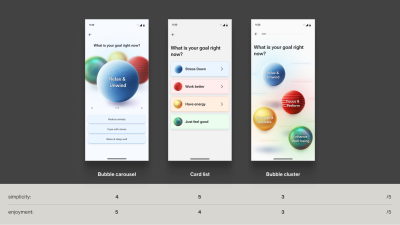
However, this increased responsibility brings increased scrutiny. Designers must balance the "gaming effect" (enjoyment) with therapeutic integrity. If an app becomes too much of a game, it risks trivializing the user’s condition; if it is too clinical, it loses the engagement necessary to be effective. The "sustainable balance" identified in recent design frameworks suggests that the highest achievement of the craft is empowering user well-being while maintaining a predictable, non-judgmental digital environment.
In conclusion, the billion-person care gap identified by the WHO cannot be closed by technology alone, but it can be narrowed by technology that respects human fragility. By implementing a framework of supportive onboarding, low-stimulus interfaces, and ethical retention, the next generation of mental health apps can move from being simple utilities to becoming trusted companions in the journey toward wellness. Trust, ultimately, is the only metric that matters in the architecture of the human mind.

