
The architectural landscape of web development is currently witnessing a significant pivot in how complex user interactions are managed, particularly within the React ecosystem. For years, the prevailing mental model among software engineers has been that forms are inherently user interface (UI) components. This perspective has led to the widespread adoption of stacks such as React Hook Form (RHF) paired with Zod for validation. While this approach remains the gold standard for standard data entry—such as login screens, settings pages, and basic Create, Read, Update, and Delete (CRUD) operations—it is increasingly coming under scrutiny as forms evolve into complex decision engines.
Industry analysts observe that as business requirements become more sophisticated, the traditional component-driven model often reaches a breaking point. When forms begin to incorporate intricate visibility rules, cascading derived values, and non-linear navigation based on real-time user input, the logic often "leaks" from the business layer into the UI layer. This transition from a simple input collector to a complex rule engine necessitates a reevaluation of architectural choices, moving from component-centric designs to schema-driven frameworks like SurveyJS.
The Historical Progression of Form Management in React
To understand the current tension between these two models, one must look at the chronology of form handling in the React framework. In the early days of React, "controlled components" were the primary method for handling inputs, requiring developers to manually sync state with every keystroke. This was followed by the era of Redux Form, which centralized form state but often introduced significant performance bottlenecks due to frequent re-renders across the entire application tree.
The introduction of React Hooks in 2019 revolutionized the space, leading to the rise of React Hook Form. This library focused on uncontrolled components and performance optimization, allowing for isolated re-renders. When coupled with Zod, a TypeScript-first schema declaration and validation library, developers gained a powerful toolset for building type-safe, performant forms. However, the industry is now identifying a "complexity ceiling" where the code required to maintain these forms becomes a liability rather than an asset.
Analyzing the Component-Driven Breakdown
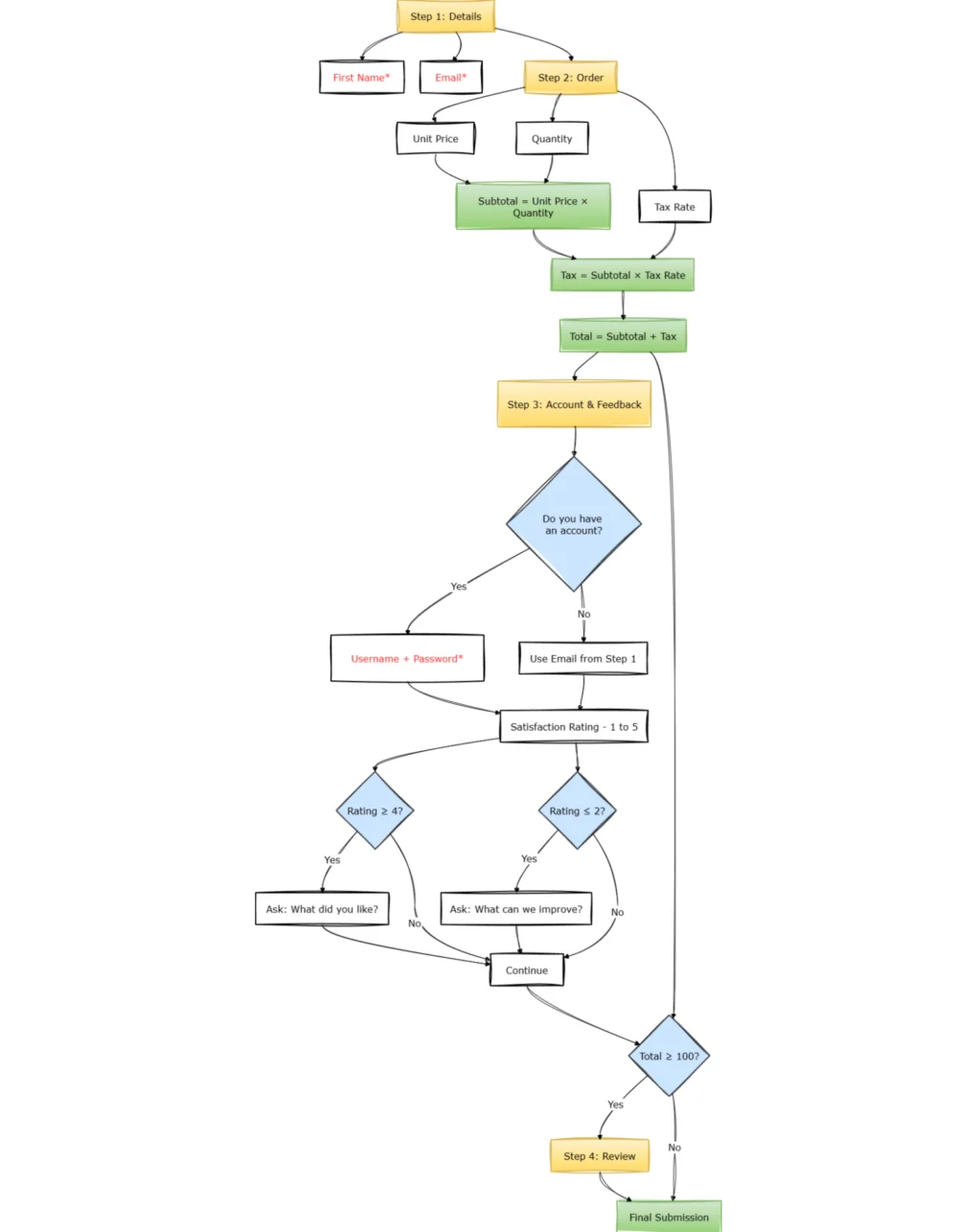
In a traditional React Hook Form and Zod implementation, the form’s behavior is typically distributed across several locations. Validation logic resides in the Zod schema, while conditional visibility and navigation logic are embedded directly within the JSX via conditional rendering. For example, a multi-step order form might use the useWatch hook to monitor specific fields, triggering useMemo hooks to calculate subtotals or taxes.
While this is idiomatic React, it creates an "inspectability" problem. As business logic grows, the Zod schema often requires superRefine blocks to handle cross-field dependencies that its standard declarative structure cannot express. Consequently, an engineer attempting to understand the form’s behavior must mentally execute the logic across the schema, the hook definitions, and the component’s return statement.
Data from enterprise software audits suggest that maintenance costs for these "logic-heavy" components can increase by as much as 40% over the lifecycle of a project as requirements change. When a business stakeholder requests a change to a visibility rule, it requires a full development cycle: code modification, unit testing, pull request review, and deployment.
The Emergence of Schema-Driven Runtimes
The alternative gaining traction in large-scale enterprise environments is the schema-driven model, exemplified by libraries such as SurveyJS. In this paradigm, the form is treated not as a set of UI components, but as a data structure—typically a JSON object. This schema defines everything from the visual structure and field types to the complex mathematical expressions and conditional logic.
Under this model, the React component serves merely as a "host" or a runtime environment. The logic is centralized in the JSON schema, which is then parsed by a dedicated model. This decoupling offers several strategic advantages:
- Centralization: All rules regarding visibility (
visibleIf), calculations (expression), and navigation are contained within a single object. - Portability: Because the form is represented as JSON, it can be stored in a database, versioned independently of the application code, and even edited by non-engineers using visual builders.
- Reduced Component Complexity: The React side of the implementation is drastically simplified, often reduced to a few lines of code that initialize the model and handle the final submission.
Comparative Data: Logic Distribution and Maintenance
A comparative analysis of the two approaches reveals a stark difference in where "architectural weight" is placed. In a standard multi-step form with four pages and ten conditional rules:
- RHF + Zod Stack: The logic is distributed across approximately four different files or code blocks (Schema, State Management, Calculation Hooks, and UI Branches).
- SurveyJS Stack: 100% of the business logic is contained within the JSON schema, while the React component handles only the integration with the API.
Market research into developer productivity suggests that for forms exceeding 20 fields or incorporating multi-page branching, schema-driven approaches reduce the "time-to-market" for updates by nearly 60%. This is primarily due to the ability to update form behavior without refactoring the underlying UI architecture.
Official Responses and Industry Perspectives
Technical architects at leading SaaS providers have noted that the choice between these models is often a matter of "Separation of Concerns." In a statement regarding modern form architecture, one lead engineer at a prominent fintech firm noted, "We realized our forms weren’t just inputs anymore; they were legal contracts with hundreds of ‘if-then’ scenarios. Keeping that in React state was a recipe for technical debt. Moving to a schema-based engine allowed our compliance team to review the logic in a readable format without needing to read JSX."
Conversely, proponents of the component-driven approach argue that for highly bespoke UI designs—where every input requires custom animations or unique layouts—the flexibility of React Hook Form is indispensable. They argue that schema-driven models can sometimes feel like a "black box," making it more difficult to implement highly specific CSS-in-JS patterns or micro-interactions.

Strategic Framework for Decision Making
To assist organizations in choosing the correct model, industry experts suggest a "deletion test." If an organization were to delete the form, would they be losing a UI component or a business policy?
When to remain with React Hook Form + Zod:
- The form is a "leaf node" in the application, such as a login or a simple profile update.
- The layout requires highly custom, non-standard UI components that do not follow a grid or list pattern.
- The validation logic is simple and does not depend on external state or complex cross-field calculations.
- The development team is small and requires the fastest possible initial implementation.
When to transition to SurveyJS or Schema-Driven Models:
- The form is "dynamic," meaning its structure changes based on user responses.
- The form behavior needs to be updated frequently by non-developers or requires versioning.
- The form acts as a decision engine, calculating scores, totals, or risk profiles in real-time.
- The organization manages a large volume of different forms and needs a standardized way to render them.
Broader Impact and Future Implications
The shift toward schema-driven forms is part of a broader trend in software engineering known as "Data-Driven UI." As Artificial Intelligence and Machine Learning become more integrated into software development, the ability to generate and modify UI through data structures (like JSON) rather than hard-coded components becomes a significant advantage.
Furthermore, as global privacy regulations (such as GDPR and CCPA) become more stringent, the ability to centralize and audit form logic becomes a compliance necessity. Schema-driven models provide a clear, human-readable audit trail of what data is being collected and under what conditions certain questions are asked.
In conclusion, the evolution of forms in React represents a maturing of the framework. While the component-driven model served the industry well during the rise of single-page applications, the increasing complexity of digital business processes demands a more robust, decoupled approach. By recognizing when a form has transitioned from a UI element to a rule engine, developers can choose the architecture that ensures long-term maintainability and operational efficiency. The future of web interaction lies not just in how forms look, but in how intelligently they can process the data they inhabit.

