
The smart home landscape has long been dominated by complex and often expensive systems, presenting a significant barrier to entry for many consumers. However, Athom B.V., the company behind the highly regarded Homey smart home platform, has taken a decisive step to democratize advanced home automation with the introduction of the Homey Pro mini. This new offering aims to deliver the core power and flexibility of its flagship Homey Pro at a significantly more accessible price point, potentially redefining the smart home hub market for a broader audience. The strategic investment from LG in Athom B.V. further signals a commitment to innovation and market expansion within the burgeoning smart home sector.
Bridging the Gap: The Genesis of Homey Pro mini
The original Homey Pro has been lauded by enthusiasts for its comprehensive device compatibility, robust automation capabilities, and extensive app ecosystem. However, its premium pricing and more demanding hardware specifications have positioned it as a solution primarily for dedicated smart home aficionados. Recognizing this gap, Athom B.V. has engineered the Homey Pro mini to retain the essential functionalities that make the Homey platform so compelling, while streamlining certain aspects to achieve a lower cost of entry. This strategic move is designed to attract a new wave of users who are seeking a powerful yet user-friendly smart home hub without the premium investment.
Design and Core Specifications: A Compact Powerhouse

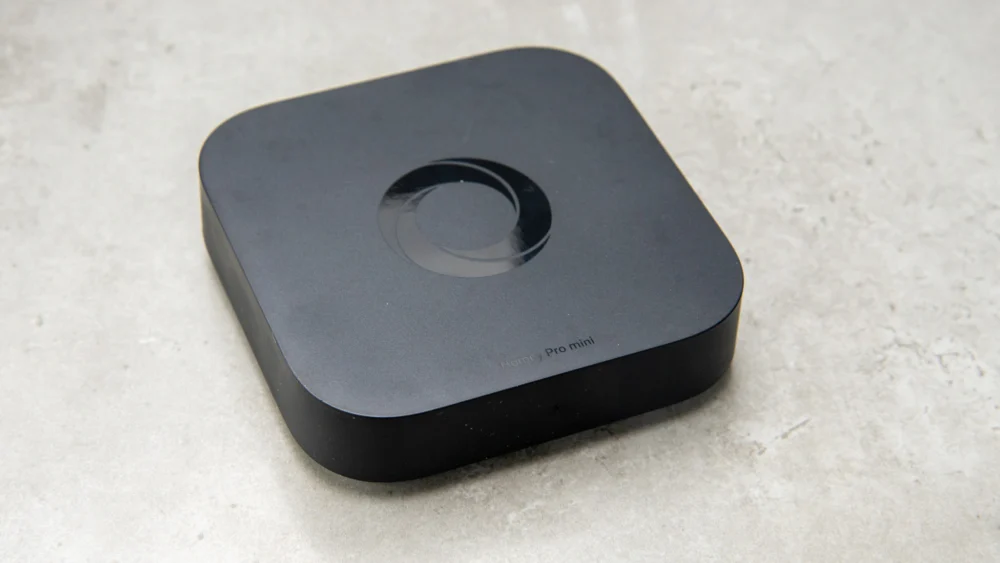
Visually, the Homey Pro mini diverges from the distinctive cylindrical form factor of its larger sibling. It adopts a more conventional, yet elegant, square design with softly rounded edges, making it unobtrusive in any home environment. The device’s rear panel houses a USB-C port for power and an Ethernet port, a feature notably absent from the standard Homey Pro unless an optional adapter is used. This preference for a wired connection, while sacrificing built-in Wi-Fi, aligns with a commitment to network stability, a crucial factor for reliable smart home operation. The underside of the unit features mounting anchors, offering discreet placement options on walls.
Internally, the Homey Pro mini is powered by a 1.5GHz processor, mirroring the capabilities of the Homey Pro. However, it features 1GB of RAM, which is half that of the original Pro and a quarter of the more recent 2026 Pro model. This reduction in RAM directly impacts the number of applications that can be simultaneously active. The Homey Pro mini supports between 20 and 25 apps, a notable decrease from the 60 supported by the original Pro and over 100 by the newer Pro. For the average household, however, this limit is considered more than adequate, encompassing a wide range of popular smart home devices and services.
Protocol Support: Focused Functionality for Modern Homes
A key differentiator of the Homey Pro mini lies in its protocol support. It offers robust compatibility with Thread, Zigbee, and Matter, the latter being a rapidly growing standard designed to unify smart home devices. Crucially, it omits support for Z-Wave, Bluetooth, 433MHz, and Infrared (IR) protocols. These omissions are strategic, targeting the most prevalent communication methods used in contemporary smart homes.
For users who require support for these additional protocols, Athom B.V. offers a compelling solution: the Homey Bridge. This accessory can be paired with the Homey Pro mini, providing access to the excluded protocols. Impressively, the combined cost of a Homey Pro mini and a Homey Bridge remains lower than that of a standalone Homey Pro, presenting an even more economical upgrade path for users whose needs evolve. This modular approach enhances the long-term value proposition of the Homey ecosystem.

Installation and User Experience: Seamless Integration
The setup process for the Homey Pro mini is designed to be intuitive and user-friendly. Through the accompanying Homey app, users can easily detect and add the hub to their network. The app then guides the user through the creation of their virtual home, allowing them to map out their existing rooms. This guided setup ensures that even novice users can quickly establish a functional smart home environment.
For households with existing Homey Pro devices, the HomeyLink app provides a unified interface to manage both the Pro and Pro mini units. While this integration offers a consolidated view of all connected devices, there are minor limitations regarding the complexity of automations that can be created across different hub types.
Features and Performance: Powering Advanced Automations
The Homey platform has continuously evolved, and the Homey Pro mini benefits from these advancements. Device compatibility has seen significant improvement over the years, moving beyond basic integrations to offer more nuanced control. The platform’s embrace of Matter has streamlined the integration of newer devices, while a robust cloud-based infrastructure ensures continued support for older devices and a growing number of manufacturers.

The platform’s ability to integrate a diverse range of devices is exemplified by its support for the Ring Alarm system. While previously limited to individual Z-Wave sensors, the official Ring integration now encompasses cameras and doorbells. Furthermore, a community-developed Ring Security app allows for cloud-based connection to the Ring Base Station, enabling users to control their alarm system and utilize it as a trigger for Homey automations. This showcases the power of the Homey ecosystem, combining official integrations with community-driven innovation.
Matter support also simplifies the addition of devices like the Aqara Valve Controller T1, with straightforward integration via its M200 hub. Similarly, Tado X devices connect seamlessly, providing access to advanced control features. Unlike some other platforms, such as Apple’s HomeKit, which can sometimes offer only rudimentary triggers, Homey empowers users with granular control over their devices. For instance, Tado X devices can be used to initiate automations based on a wide array of parameters, including on/off states, temperature fluctuations, humidity levels, and scheduled conditions. This allows for highly personalized automation scenarios, such as initiating a Flow (Homey’s term for an automation) only when the temperature has remained above 18°C for a sustained period of 20 minutes.
The "And" option within Homey’s Flow creation tool further enhances its automation capabilities. This feature allows for the triggering of automations based on multiple conditions simultaneously, leading to more sophisticated and context-aware control. For example, a motion sensor can be configured to activate Hue lights only when motion is detected, the ambient light level falls below a specified threshold, and the time is between sunrise and sunset. This intelligent automation ensures lights are activated only when needed, preventing unnecessary energy consumption.
Moreover, Homey’s flexibility extends to executing different actions based on specific input combinations. A prime example is the scenario where locking an office door can trigger multiple actions: closing the blinds and turning off a smart plug. Concurrently, if it is after sunset, the garden lights can be activated, providing a safe path through the garden back to the house. This level of conditional logic and multi-action automation sets Homey apart from many other mainstream smart home platforms, offering a depth of control that caters to even the most discerning users.
Broader Implications for the Smart Home Market

The introduction of the Homey Pro mini signifies a pivotal moment for the smart home industry. By offering a powerful and flexible smart home hub at a more accessible price point, Athom B.V. is effectively lowering the barrier to entry for advanced home automation. This move is likely to attract a wider demographic of consumers who may have previously been deterred by the cost or complexity of existing high-end systems.
The success of the Homey Pro mini could encourage other manufacturers to develop more affordable yet capable smart home hubs, fostering greater competition and innovation within the market. This, in turn, could lead to a wider adoption of smart home technology, transforming how people interact with their living spaces. The emphasis on Matter support also aligns with industry-wide efforts to create a more interoperable and user-friendly smart home ecosystem, reducing fragmentation and simplifying device management.
Furthermore, the strategic partnership with LG underscores the growing interest from major technology corporations in the smart home sector. This collaboration suggests a potential for further integration of Homey’s technology into other LG products and services, potentially creating a more cohesive and intelligent home environment for consumers. The long-term implications could include enhanced interoperability between entertainment systems, appliances, and home control hubs.
Testing Methodology: Ensuring Rigorous Evaluation
The-Ambient, the publication behind this review, employs a rigorous and time-tested methodology for evaluating smart home devices. Their reviews are not based on short-term assessments but rather on extensive "living with" periods, ensuring that the performance and reliability of the devices are thoroughly scrutinized in real-world conditions. This approach is critical for smart home hubs, as they are designed to operate within a complex ecosystem of interconnected products.

The publication’s testing process focuses on identifying what truly matters to consumers, enabling direct comparisons between competing products. Their commitment to objectivity, fairness, and independence is paramount, with no direct payment received for reviews. This ensures that readers receive unbiased and trustworthy information to guide their purchasing decisions. Their detailed guide on testing robot vacuum cleaners, for instance, provides a glimpse into the depth and breadth of their evaluation criteria, setting a high standard for their smart home device reviews.
Conclusion: A Smart Investment for the Modern Home
The Homey Pro mini emerges as a compelling proposition for anyone looking to build a sophisticated and personalized smart home system without breaking the bank. It successfully distills the essence of the Homey platform’s power and flexibility into a more affordable package. While it makes certain concessions in terms of RAM and protocol support compared to its larger sibling, these are calculated decisions that cater to the needs of the majority of households. The option to expand functionality with a Homey Bridge further enhances its adaptability. For those seeking a smart, intuitive, and incredibly capable smart home hub, the Homey Pro mini stands out as a brilliant and accessible choice, marking a significant step forward in making advanced home automation a reality for everyone.

