
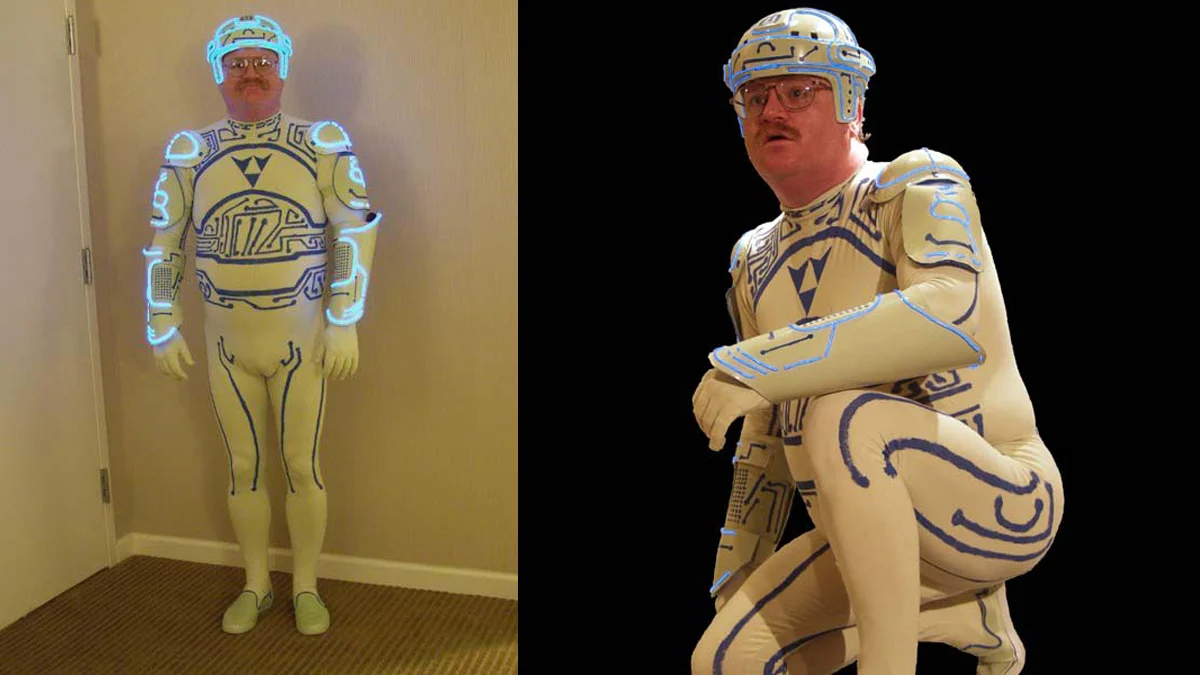
In the early 2000s, the landscape of the internet was a nascent ecosystem of forums, tech blogs, and burgeoning viral phenomena. It was within this digital frontier that Jay Maynard, an American computer programmer, transitioned from a specialized hobbyist to one of the most recognizable figures in early internet history. Known globally as the Tron Guy, Maynard’s journey began with a meticulously crafted homage to the 1982 science fiction classic Tron. His homemade electroluminescent costume did more than win awards at science fiction conventions; it served as a catalyst for discussions regarding digital identity, fan culture, and the eventual intersection of internet fame with mainstream media.
The Genesis of a Digital Icon
The origin of the Tron Guy persona dates back to April 2004, specifically centered around the Penguicon science fiction and fantasy convention in Michigan. Maynard, a seasoned programmer with an affinity for technical challenges, spent significant time constructing a suit that replicated the glowing aesthetic of the characters in the film Tron. Unlike modern cosplayers who have access to advanced 3D printing and standardized LED strips, Maynard utilized electroluminescent (EL) wire and panels, a technology that required a sophisticated understanding of circuitry and power management.
His suit was not merely a garment but an engineering project. It featured complex wiring integrated into a spandex and foam base, designed to mimic the neon-lit armor of the film’s digital gladiators. At Penguicon 2.0, Maynard’s craftsmanship was officially recognized with the Best Workmanship award in the masquerade competition. Seeking to share his technical process with the wider tech community, Maynard uploaded detailed photographs and notes to his personal website. On April 18, 2004, he submitted his project to Slashdot, a premier hub for technology news at the time. His post was a response to an earlier thread about DIY Tron costumes, where he noted that he had been "deep into making my own" and wanted to share the results, which he believed were "quite good."
The Slashdot Effect and Rapid Viral Spread
The submission to Slashdot triggered what was then commonly known as the "Slashdot Effect," where a massive influx of traffic from the site would frequently crash smaller servers. Maynard’s website became the epicenter of a viral storm. Within days, the images of Maynard in his glowing suit—often posed with a serious, dedicated expression—were being shared across humor sites and forums such as FARK, BoingBoing, and Team Xbox.
The reaction from the online community was a mixture of genuine admiration for his technical skill and the lighthearted irony that defined early internet humor. Maynard became a "nerd icon," representing a demographic of fans who were unapologetic about their passions. This rapid spread was a precursor to the modern meme cycle, demonstrating how a niche community project could achieve global visibility without the aid of centralized social media algorithms.
Transitioning to Mainstream Media
By May 2004, less than a month after his initial post, Maynard’s fame crossed the threshold from the internet to television. He was invited to appear on Jimmy Kimmel Live, marking one of the earliest instances of a purely "internet famous" individual being featured on a major late-night talk show. This appearance solidified his status as a cultural fixture. Maynard handled his newfound celebrity with a level of poise and self-awareness that endeared him to both tech enthusiasts and general audiences.
In the years following his initial rise, Maynard utilized his platform for more than just entertainment. In 2006, he participated in the "We Are The Web" campaign, a music video that featured other early internet celebrities like Leslie Hall and Randy Constan (the Peter Pan Guy). The project was an advocacy effort for network neutrality, highlighting Maynard’s commitment to the health and openness of the digital environment that had granted him his fame. This move demonstrated an early understanding of the "influencer" as a political and social advocate.
Cultural Parody and the Cataloging of Virality
As the decade progressed, Maynard’s image became shorthand for the internet meme phenomenon. This was most notably captured in the South Park Season 12 episode "Canada on Strike," which aired on April 2, 2008. The episode featured a "waiting room" of internet celebrities, including the Numa Numa Guy, the Star Wars Kid, and Tay Zonday, all waiting for their "theoretical" internet dollars. Maynard’s inclusion in this roster confirmed his status as a member of the "first class" of digital legends.

Further media engagement occurred in 2009 when Maynard appeared on the Comedy Central show Tosh.0. In a "Web Redemption" segment, comedian Daniel Tosh provided Maynard with a platform to reflect on his experience with fame. The segment highlighted the enduring nature of Maynard’s persona; five years after his initial viral moment, he remained a relevant and sought-after guest, a rarity in the typically ephemeral world of internet trends.
The Tron: Legacy Conflict and Corporate Engagement
The announcement and subsequent release of the sequel film Tron: Legacy in 2010 presented a unique moment for Maynard. For years, he had been the unofficial face of the franchise, keeping the brand alive in the public consciousness during a period when Disney had largely sidelined the property. However, the relationship between the fan and the corporation proved to be complex.
In December 2010, Maynard wrote a review for Wired magazine, where he praised the technical achievements of Tron: Legacy but expressed profound disappointment in Disney’s marketing strategy. He argued that the studio had failed to engage with the organic fan base that had sustained interest in the original film. Maynard famously noted that Disney had not reached out to him for any promotional capacity, despite his role in "awakening the franchise from the dead in the minds of the public."
The tension peaked when TMZ reported that Maynard was barred from wearing his iconic suit to a screening of the sequel at his local movie theater. The incident sparked a debate regarding corporate control over fan expression. While the theater cited safety and distraction policies, many in the tech community viewed it as an affront to the man who had championed the brand for over half a decade. This era marked a shift in how corporations handled "super-fans," moving toward a more integrated, albeit sometimes friction-filled, marketing approach.
Later Years and the America’s Got Talent Incident
In 2011, Maynard continued to seek new avenues for his persona, auditioning for the sixth season of America’s Got Talent. His appearance was intended to showcase his electroluminescent technology and his status as a pioneer of digital culture. However, the experience was largely negative. The judges, seemingly disconnected from the nuances of internet subcultures, treated the act with derision. Maynard was booed by the audience and dismissed by the panel, a moment that many fans felt was a disrespectful treatment of a cultural pioneer by legacy media.
Despite this, Maynard’s commercial viability remained intact. In August 2011, he starred in a commercial for Duck Brand duct tape. The advertisement featured high-production values, showing multi-colored tape rolls racing like light cycles from the film, eventually revealing the sequence as a product of Maynard’s imagination. The commercial was well-received by the tech community, viewed as a more appropriate and respectful use of his iconic status than his experience on reality television.
Analysis of Impact and Legacy
The story of Jay Maynard is a foundational chapter in the history of the modern internet. He represents the transition from the "analog" fan—who built things in garages for local conventions—to the "digital" celebrity—whose work is seen by millions instantaneously.
Several key implications arise from Maynard’s career:
- The Democratization of Fame: Maynard proved that a single individual with a technical skill set and a unique vision could command a global audience without the backing of a PR firm or a talent agency.
- The Evolution of Fan Advocacy: His involvement in net neutrality campaigns showed that internet celebrities could leverage their visibility for serious policy discussions, a precursor to modern digital activism.
- Corporate-Fan Friction: The disconnect between Maynard and Disney during the release of Tron: Legacy serves as a case study for how intellectual property holders can sometimes misjudge the value of organic, grassroots brand ambassadors.
- The Preservation of Digital History: As an early meme, Maynard’s trajectory has been documented and archived, providing a roadmap for how viral fame can be sustained over decades through a combination of technical innovation and personal authenticity.
Today, Jay Maynard remains a regular fixture at technology and science fiction conferences. He continues to advocate for the principles of the open web and remains a beloved figure among the generation of users who saw the internet evolve from a text-based medium into the visual, video-driven powerhouse it is today. The "Tron Guy" is not just a man in a glowing suit; he is a symbol of the creative, eccentric, and fiercely independent spirit that defined the early World Wide Web.

