
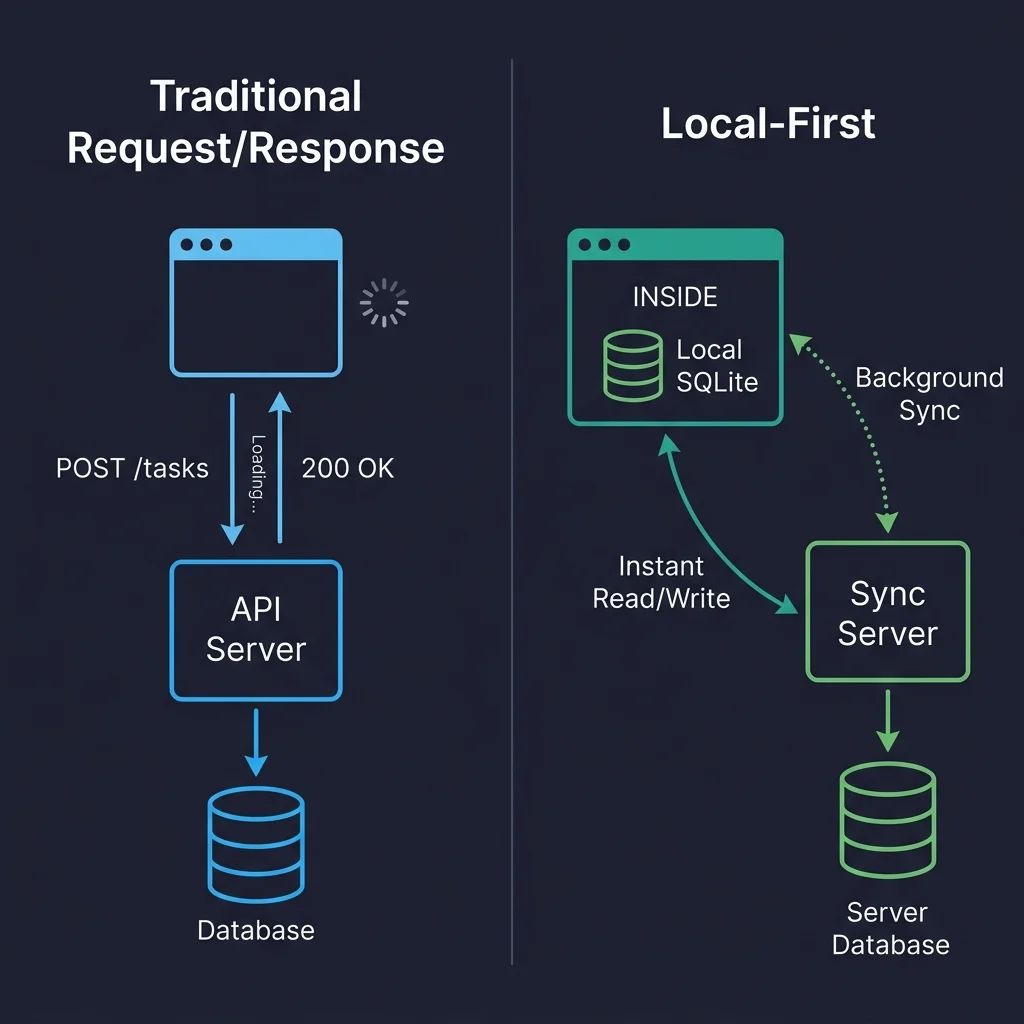
The landscape of web application development in 2026 has reached a significant inflection point, characterized by the transition from traditional cloud-centric models to local-first architecture. This architectural shift represents a fundamental change in how data is stored, synchronized, and owned, moving away from the "thin client" model that has dominated the industry for over a decade. While early discussions regarding local-first principles were often relegated to academic research, recent advancements in browser capabilities, storage APIs, and synchronization engines have transformed these concepts into viable production standards for high-performance applications.
The Definitive Shift: Defining Local-First in the Modern Era
In the current development environment, a distinction has been formalized between "offline-first" and "local-first" methodologies. Industry analysts note that while offline-first strategies focus on graceful degradation during network loss—treating the server as the ultimate source of truth—local-first architecture treats the user’s device as a primary node in a distributed system. In this model, the application reads from and writes to a local database, rendering UI updates instantaneously and synchronizing with external peers or servers in the background.
This transition is driven by the realization that even high-speed 5G and fiber connections are subject to latency, jitter, and "lie-fi" scenarios where a connection is reported but fails to transfer data. By adopting a local-first approach, developers eliminate the traditional request-response cycle for primary user interactions, effectively reducing perceived latency to nearly zero.
A Chronology of Local-First Development (2019–2026)
The trajectory of local-first software can be traced through several key milestones that moved the technology from theory to widespread implementation:
- The 2019 Whitepaper: The Ink & Switch research lab published "Local-First Software," outlining seven ideals: fast performance, multi-device support, offline capability, collaboration, longevity, privacy, and user ownership. At the time, tooling was considered insufficient for mainstream commercial use.
- The Rise of WebAssembly (WASM) (2021–2023): The maturation of SQLite compiled to WebAssembly allowed developers to run robust, relational databases directly within the browser environment, bypassing the limitations of earlier storage solutions like LocalStorage.
- The OPFS Breakthrough (2024): The widespread adoption of the Origin Private File System (OPFS) provided web applications with a high-performance, sandboxed file system. This allowed SQLite WASM to achieve near-native performance by providing synchronous access handles within Web Workers.
- The Sync Engine Explosion (2025): A competitive market emerged for synchronization middleware, with platforms like PowerSync, ElectricSQL, and Triplit providing the "plumbing" necessary to bridge client-side SQLite with server-side Postgres databases.
- Standardization in 2026: Current trends show a "spectrum of local-first" adoption, where developers integrate these patterns into specific high-interaction features—such as document editors or project boards—rather than forcing a total architectural overhaul for every application.
Infrastructure and Storage Standards: SQLite and OPFS
In 2026, the technical stack for a local-first application has largely standardized around SQLite running via WASM. Historically, web storage was limited to IndexedDB, which, while capable of storing large datasets, was often criticized for its complex API and lack of relational query support.
Data from 2025 performance audits indicates that SQLite WASM, when paired with OPFS, can execute complex read queries in under 2 milliseconds on modern hardware. This is a staggering improvement over the 50ms to 500ms round-trip times typical of REST or GraphQL API calls.
However, the implementation is not without technical hurdles. Engineering teams report that Safari’s implementation of OPFS has historically lagged behind Chromium-based browsers, occasionally requiring fallbacks to IndexedDB-backed persistence. Furthermore, the inclusion of a full SQL engine adds approximately 400KB (gzipped) to the initial JavaScript bundle, a factor that requires careful lazy-loading strategies to maintain optimal Time to Interactive (TTI) metrics.
Conflict Resolution and Synchronization Logic
The primary challenge of local-first architecture remains the reconciliation of data across multiple independent replicas. When two users modify the same record while offline and subsequently reconnect, the system must determine the "correct" state without losing user input.
Conflict-Free Replicated Data Types (CRDTs)
For real-time collaborative environments, such as shared text editing or design tools, CRDTs have become the industry standard. Libraries like Yjs and Automerge allow for mathematical certainty in data convergence. According to recent developer surveys, Yjs is currently the most utilized library due to its extensive ecosystem and integration with popular rich-text editors.
Last-Write-Wins (LWW) and Semantic Conflicts
For structured data like task lists or inventory records, many teams opt for a "Last-Write-Wins" (LWW) approach at the field level. This minimizes complexity by using timestamps and client IDs as tiebreakers.
Industry experts caution, however, against ignoring "semantic conflicts." These occur when data merges cleanly at a structural level but creates a logical error—for example, two users successfully booking the same meeting room for the same time slot across different devices. In 2026, the recommended pattern for resolving these issues involves server-side validation during the "write-back" phase. Rather than rejecting the write and causing state divergence, servers are increasingly configured to accept the write but flag a "Sync Violation," prompting the user to resolve the logical conflict manually.
Industry Analysis: When to Avoid Local-First Models
Despite the performance benefits, senior architects warn against the "silver bullet" fallacy. Local-first is increasingly viewed as an "over-engineered" solution for specific categories of applications:
- Server-Generated Data: Analytics dashboards, social media feeds, and search engines, where the server is the primary producer of data, gain little from local-first replication.
- Strong Transactional Consistency: Systems requiring ACID guarantees across all users—such as banking, high-frequency trading, or real-time inventory management for scarce goods—remain better suited for traditional centralized architectures.
- Massive Datasets: Applications dealing with petabytes of data that cannot feasibly be partitioned or synced to a mobile device continue to rely on cloud-querying models.
Technical debt remains a significant concern. Implementing a sync engine adds a layer of complexity to authentication and authorization. Because the client is no longer a "thin view," authorization must be enforced at the sync boundary, ensuring that the server only replicates rows the user is permitted to see.

Broader Impact and Future Implications
The shift toward local-first has profound implications for user privacy and the future of Artificial Intelligence. As data resides primarily on the user’s device, end-to-end encryption (E2EE) becomes significantly easier to implement. This has turned "privacy-by-design" from a marketing slogan into a technical reality for many productivity tools.
Furthermore, the rise of "Local AI" is converging with local-first architecture. By keeping both the data and the inference models on-device, developers are creating a new class of "Privacy-First AI" applications. These tools can process sensitive user information without ever transmitting it to a third-party server, mitigating both latency and security risks.
Expert Perspectives and Market Outlook
"The best architecture is the one your team can debug at 2 AM," noted one veteran systems engineer during a 2025 symposium on distributed systems. This sentiment reflects a growing pragmatism in the field. While the allure of "instant" apps is strong, the "complexity budget" of a team must be respected.
Looking ahead to the remainder of 2026 and into 2027, the industry expects further stabilization of the "Sync Layer." The emergence of PGlite (Postgres in WASM) suggests a future where the exact same SQL dialect can run on both the client and the server, potentially simplifying the developer experience and reducing the abstraction overhead currently required by sync engines.
In conclusion, local-first architecture has graduated from an experimental research project to a cornerstone of modern web performance. For applications centered on user-generated content and real-time collaboration, the move toward local-first is no longer a matter of "if," but "how." As the tooling continues to mature, the distinction between "web app" and "native app" performance will continue to blur, ultimately benefiting the end-user through faster, more reliable, and more private digital experiences.
Chronology Summary
- October 2019: Ink & Switch Whitepaper defines the 7 ideals of local-first.
- June 2022: SQLite WASM becomes officially supported, enabling SQL in browsers.
- January 2024: OPFS achieves stable support across all major browser engines.
- March 2025: Mainstream adoption of sync engines like PowerSync for enterprise SaaS.
- May 2026: Integration of local-first data with on-device AI models becomes a standard practice for privacy-focused startups.

