
The digital landscape is currently witnessing a fundamental shift in how web presence is maintained, moving away from the static "launch and leave" model toward a paradigm of continuous, agent-driven optimization. For decades, the lifecycle of a website has followed a predictable and somewhat tragic trajectory: a peak of perfection on launch day followed by a slow, inevitable decline into obsolescence. This phenomenon, often referred to as digital entropy, occurs not because the underlying code breaks, but because the pace of market evolution, design trends, and technological standards quickly outstrips the ability of human teams to provide manual updates. Pierre Burgy, a prominent figure in the web development space and co-founder of the autonomous website platform Fimo, argues that the solution lies in autonomous agents—AI-driven entities that manage the tedious upkeep of a site—though the implementation of such technology requires a nuanced understanding of human control and creative agency.
The Problem of Digital Entropy and the "Peak Launch" Fallacy
In the traditional development cycle, a website is at its absolute zenith the moment the final branch is merged and the site goes live. At that specific second, every link works, every image is optimized for current devices, and the messaging is perfectly aligned with the company’s current goals. However, the "law of nature" in web development suggests that from this point forward, the site only becomes less relevant.
Industry data supports this observation. According to research on digital longevity, the average lifespan of a website before a major redesign is approximately two to three years. Yet, the decay begins much sooner. Search engine algorithms change hundreds of times a year, accessibility standards (such as WCAG) evolve, and browser updates can subtly alter how CSS is rendered. When a team launches a site and moves on to the next project, the site becomes a "period piece"—a snapshot of a company that no longer exists in that exact form. The challenge for modern enterprises is that manual maintenance is expensive and often takes a backseat to new feature development.
The Emergence of Autonomous Web Agents
The concept of an autonomous website aims to break this cycle of decay. Rather than waiting for a human developer to notice a broken meta tag or an uncompressed image, autonomous agents—software programs designed to perform tasks without continuous human intervention—monitor the site in real-time. These agents are programmed to identify regressions, optimize performance, and even propagate design system changes across hundreds of pages.
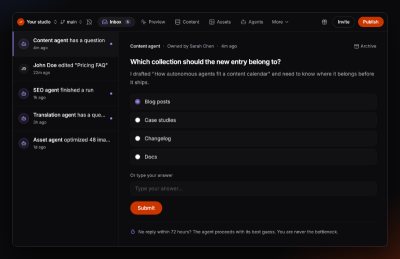
As envisioned by Burgy and the team at Fimo, a fully realized autonomous system would operate while the human team sleeps. One agent might detect that a recent design system update failed to reach the pricing page and automatically apply the fix. Another might identify high-resolution images uploaded by a marketing intern and compress them to improve PageSpeed Insights scores. A third could monitor for accessibility regressions, ensuring that the site remains compliant with legal standards. This "version worth wanting" promises a site that is measurably better each morning than it was the night before.
The Psychological Barrier to Full Autonomy
Despite the technical feasibility of these agents, the path to adoption has revealed a significant non-technical hurdle: the human need for control. When Fimo first began developing its autonomous platform, the initial assumption was that users would want to hand over the keys entirely. The goal was total autonomy—a "set it and forget it" solution for the web.
However, user behavior suggested otherwise. Early adopters expressed hesitation, not necessarily due to a lack of trust in the AI’s capabilities, but because of the complex ownership structure of a corporate website. A website is rarely the domain of a single individual; it is a shared asset between designers, developers, marketers, and legal teams. Each stakeholder has a different threshold for what they are willing to delegate to an algorithm. This realization shifted the focus from "how to make a site autonomous" to "where to draw the line of autonomy."
Categorizing the Three Tiers of Digital Labor
Through the development of Fimo, a framework emerged for understanding which tasks are suitable for AI and which require human judgment. This framework divides web maintenance into three distinct categories:
1. The Rule-Bound Chores (The 80 Percent)
The vast majority of website maintenance consists of repetitive, rule-based tasks. This includes maintaining accessibility compliance, updating metadata, optimizing assets, and fixing broken links. These tasks require no creative "taste"; they are either correct or incorrect based on established standards. Developers and designers are often relieved to delegate this work, as it represents the "joyless" aspect of their roles. Agents excel here because they do not suffer from fatigue and can scan thousands of pages in seconds—a feat impossible for human auditors.
2. The Untouchable Domain of Taste
At the opposite end of the spectrum is work that involves brand identity, emotional resonance, and creative direction. While an agent can confirm that a page meets contrast requirements, it cannot determine if a layout "feels" right or if the copy strikes the appropriate tone for a specific audience. This is the core value of the human professional. High-level strategic decisions and aesthetic judgments remain firmly off-limits to autonomous agents, as they define the soul of the brand.
3. The Contextual Middle Ground
The most challenging area is the middle ground, where a task’s suitability for automation depends entirely on the observer’s role. For example, changing a website’s default theme to "dark mode" is technically simple for an agent. To a developer, this might be a routine preference update. To a brand designer, however, the default theme is a fundamental statement about the brand’s visual identity. Because "right" is a function of a person’s specific value to the organization, autonomy must be granular and adjustable.
A Chronology of Web Management Evolution
To understand the significance of autonomous agents, one must look at the historical progression of web technology:
- The Static Era (1990s): Hand-coded HTML files. Maintenance required manual editing of every page.
- The CMS Revolution (2000s): Tools like WordPress and Drupal allowed non-technical users to update content, but the underlying structure remained static and prone to technical debt.
- The Modern Stack (2010s): Headless CMS and Jamstack improved performance and developer experience but increased the complexity of maintaining consistency across fragmented services.
- The Autonomous Era (2020s-Present): The integration of LLMs (Large Language Models) and specialized agents allows the site to self-correct and evolve without manual intervention.
Market Data and the Cost of Inaction
The shift toward autonomous maintenance is driven by more than just convenience; there is a significant economic incentive. A 2023 study on web performance found that a one-second delay in page load time can lead to a 7% reduction in conversions. Furthermore, companies facing ADA (Americans with Disabilities Act) lawsuits related to website inaccessibility have seen a steady rise, with thousands of cases filed annually in the United States alone.
Autonomous agents provide a continuous "insurance policy" against these risks. By automating the technical hygiene of a site, organizations can maintain high SEO rankings and legal compliance without the overhead of constant manual audits. Industry analysts suggest that as AI agents become more sophisticated, the "Total Cost of Ownership" (TCO) for enterprise websites could drop by as much as 40% over a five-year period.
Industry Responses and Professional Implications
The reaction from the tech community has been a mix of optimism and caution. "The goal isn’t to replace the developer, but to elevate them," says one senior software architect. "If I don’t have to spend my Monday morning fixing broken redirects and alt-text, I can spend it building the features that actually drive revenue."
Conversely, some designers express concern that "autonomous" could lead to "homogenized." If agents are all following the same optimization rules, there is a risk that the web becomes visually repetitive. This is why the Fimo model emphasizes that the "line of autonomy" is personal and moveble. Users are encouraged to start with narrow delegations—such as an accessibility agent—and widen the scope of autonomy only as the agent earns trust through documented performance.
The Future of the "Living Website"
The ultimate goal of autonomous technology is to transform the website from a static document into a living organism. In this future, the launch of a site is not the finish line, but the starting point. By utilizing agents that learn from user interactions and technical requirements, the site can stay in a state of "perpetual launch," always reflecting the current state of the business it represents.
The real risk, as Burgy concludes, is not that an agent will make an unauthorized change, but that the site will remain frozen in time. A frozen site eventually becomes a liability. The rise of autonomous agents represents a shift in responsibility: humans provide the vision, the taste, and the strategy, while the agents provide the tireless labor required to keep that vision alive in an ever-changing digital world. As trust in AI grows, the boundary between human intent and autonomous execution will continue to blur, leading to a web that is more accessible, more performant, and more resilient than ever before.

