
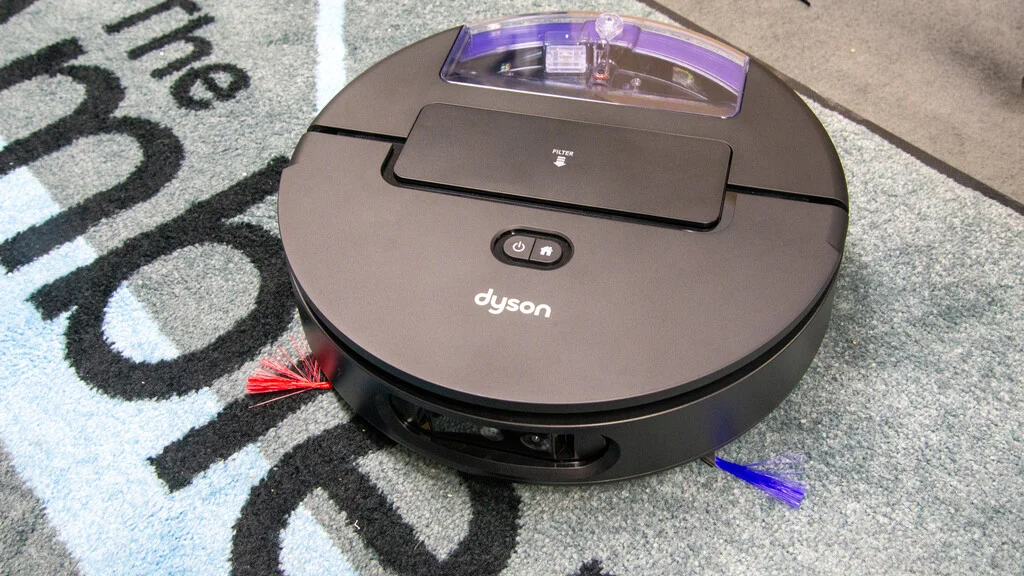
The Dyson Spot+Scrub Ai represents a significant evolutionary leap for Dyson in the increasingly sophisticated realm of robotic home cleaning. Building upon the lessons learned from its predecessors, most notably the Dyson 360 Vis Nav, this new iteration introduces a suite of features that align it with current market expectations: a bagless self-emptying and self-cleaning docking station, and an integrated roller-based mopping system. While the Spot+Scrub Ai demonstrates commendable capability in both vacuuming and mopping, its premium pricing places it in direct contention with a market offering increasingly adept solutions that either excel further in mopping efficacy or provide more seamless transitions across mixed flooring environments. Furthermore, the accompanying Dyson app, while functional, presents a somewhat limited user experience when compared to the more feature-rich interfaces of its closest rivals.
Dyson’s strategic approach to the robotic vacuum market has, in recent years, been characterized by a slower pace of innovation compared to the rapid advancements seen from other manufacturers. This has, at times, left its previous offerings, such as the Dyson 360 Vis Nav reviewed in October 2023, appearing somewhat dated in the face of emerging technologies. The introduction of the Dyson Spot+Scrub Ai aims to recalibrate this balance, incorporating many of the advanced functionalities that consumers have come to expect, including robust mopping capabilities, automated dirt disposal and dock maintenance, and sophisticated obstacle avoidance systems. The critical question for consumers remains: does this latest offering from Dyson justify its considerable investment in a market brimming with formidable alternatives?

A Generational Leap in Design and Docking Technology
The Dyson 360 Vis Nav, a product of its time, featured a conventional charging dock, necessitated manual bin emptying, lacked mopping functionality, and relied on a camera-based navigation system that proved less efficient than contemporary LiDAR solutions. These limitations, despite its powerful vacuuming performance, somewhat detracted from its overall value proposition. The Dyson Spot+Scrub Ai, in stark contrast, presents a decidedly more modern aesthetic and, crucially, integrates a comprehensive self-empty and self-cleaning docking station.
This new docking station immediately conveys its Dyson lineage, most notably through the signature purple dustbin, reminiscent of the company’s renowned cordless vacuum cleaners. True to Dyson’s design philosophy, the dock’s bin is entirely bagless. Users can simply remove the bin via its integrated handle and utilize a pull-up ejection mechanism to transfer collected debris into a larger household bin. This bagless design eliminates ongoing consumable costs, a significant advantage for budget-conscious consumers. The substantial 3-liter capacity of this bin means that manual emptying is likely to be required only once every 100 days, translating to roughly every two to three months for the average household. The primary maintenance requirement involves periodic washing of the filter to ensure sustained suction power, a manageable trade-off for the absence of disposable bags.

The docking station also incorporates significant water tanks for the mopping function: a 2.3-liter reservoir for fresh water and a 2.1-liter tank for dirty water. The system intelligently alerts users when either tank requires refilling or emptying, contributing to a seamless automated cleaning experience. Additionally, a dedicated detergent dispenser is integrated into the dock, designed for use with non-foaming cleaning solutions. While Dyson offers its own proprietary hard floor cleaner, it is not included as standard, necessitating the purchase of an alternative or Dyson’s own solution separately.
Transitioning from Dyson’s previously distinctive, often unconventional, robot vacuum shapes, the Dyson Spot+Scrub Ai adopts a more familiar circular form factor, aligning it with the design language of many leading competitors, such as the Roborock Saros 10. Standing at 110mm in height, it retains the ability to navigate under standard furniture like sofas. The pop-up filter on the top surface is easily accessible for regular cleaning, essential for maintaining optimal performance.
Beneath the robot, the Spot+Scrub Ai is equipped with two side brushes designed to dislodge dirt from room perimeters. This marks a departure from Dyson’s prior models, which often relied on wider brush bars and specialized suction techniques for edge cleaning. However, the absence of articulated side brushes that can extend to capture debris in tight corners represents a notable oversight, especially considering the device’s premium positioning.

The main cleaning mechanism features a standard brush bar alongside a wide roller brush. This roller is continuously supplied with clean water from the dock, and as it scrubs the floor, it squeegees the dirty water into the waste tank, preventing the redistribution of grime. A key innovation is the roller’s ability to extend 40mm to the side, facilitating comprehensive edge cleaning and access to challenging areas like the underside of cabinet overhangs or refrigerator doors. This articulated mopping system is designed to lift off the ground when transitioning onto short-pile carpets, preventing unnecessary wetting. However, it lacks a specialized seal to prevent moisture from seeping into deeper pile carpets, which could be a limitation for households with varied carpet types.
Navigating the Smart Home Ecosystem: The MyDyson App
Control and customization of the Dyson Spot+Scrub Ai are managed through the MyDyson app, the central hub for all of Dyson’s connected smart home devices. Upon initial setup, the robot undertakes a rapid mapping run, facilitated by its onboard LiDAR sensor, a significant improvement over the time-consuming mapping processes of earlier Dyson models. The app then generates an initial room layout, which can be easily edited by splitting or merging rooms to accurately reflect the home’s configuration.

Users can define no-go and no-mop zones, set virtual thresholds, and designate furniture locations within the mapped environment. While other robot vacuum platforms, such as those from Roborock and Dreame, allow for quick-select cleaning zones around virtual furniture (e.g., around a dining table), the Dyson app’s furniture placement serves primarily as a visual marker on the map rather than an interactive cleaning command trigger. Instead, cleaning tasks are limited to selected rooms or a user-defined rectangular "Target Area."
The app offers distinct cleaning modes: Vacuum and Wash, Vacuum only, Wash only, and Vacuum then Wash. Within these modes, users can select from four vacuum power levels, including an automatic setting, and three different hydration levels for the mopping function. When choosing the "Vacuum then Wash" mode, the mop performs a single pass. While the mop can be set for one or two wash repetitions in "Wash" and "Vacuum and Wash" modes, the app does not support multiple vacuum passes, and the overall array of advanced cleaning options is relatively constrained.
This emphasis on automated operation is characteristic of Dyson’s approach. The Spot+Scrub Ai incorporates Dyson’s signature green light technology, designed to highlight microscopic dust particles on the floor, a feature familiar to users of Dyson’s cordless vacuum cleaners. Complementing this, the front-facing cameras assist the robot in identifying stains, optimizing its cleaning approach, and effectively navigating around common household obstacles.

Performance Metrics: Power, Precision, and Limitations
The Dyson Spot+Scrub Ai boasts a formidable suction power of 18,000Pa, positioning it as a highly capable cleaner. While some flagship competitors may offer marginally higher suction figures, Dyson’s performance on carpets is robust, delivering a thorough clean that minimizes the need for frequent manual intervention – typically requiring intervention only every two to four weeks.
On hard floors, the robot excels at collecting dust from open areas. However, its performance at the edges of rooms can leave behind more stubborn debris, indicating a potential area for refinement. The mopping function is effective against everyday messes such as muddy footprints. Yet, it struggles with more tenacious, sticky substances like dried ketchup. Even with the application of a kitchen cleaner, the Spot+Scrub Ai encountered difficulties in fully removing such stains, a disappointing limitation for a device with a primary mopping function.

In terms of acoustics, the robot operates at a noise level of 57.2dB when set to its highest suction power, a remarkably quiet operation that allows for comfortable coexistence during cleaning cycles. Battery life is a strong suit, with the device rated for up to 200 minutes of operation. In practical testing, it proved capable of cleaning an entire floor of a typical house, encompassing a full vacuum pass and two mop passes on a higher setting, with sufficient charge remaining for subsequent spot cleaning or revisiting areas.
Market Positioning and Comparative Analysis
The Dyson Spot+Scrub Ai undoubtedly represents a significant advancement over Dyson’s previous robotic cleaning offerings, particularly in its sophisticated navigation and the integration of a comprehensive mopping system. However, its overall suction power, while strong, has seen a slight reduction compared to some earlier models. The primary challenge for the Spot+Scrub Ai lies in the intensely competitive landscape of the robotic vacuum market.

For a comparable price point, consumers can opt for alternatives that offer superior mopping performance. The Narwal Flow, for instance, delivers a more effective mopping experience, while the Roborock Saros 10 (which has since been superseded by the Saros 20 as the flagship model) provides significantly greater flexibility in cleaning modes and floor type management. Crucially, both of these rivals also boast more advanced and feature-rich applications, offering a wider spectrum of cleaning customization and control.
Were the Dyson Spot+Scrub Ai priced more competitively or equipped with a few additional differentiating features, its recommendation would be more straightforward. As it stands, prospective buyers seeking a high-performance robotic vacuum cleaner would be well-advised to explore the stronger alternatives available in the current market, as detailed in comprehensive guides to the best robot vacuum cleaners.
Methodology for Evaluating Robotic Cleaners

The reviews provided are the outcome of extensive, long-term "living with" tests, ensuring a comprehensive understanding of each device’s performance within a real-world domestic environment. Robotic cleaners are typically integrated into larger smart home ecosystems, designed to offer a diverse range of cleaning functionalities. Consequently, a superficial evaluation of a week or less is insufficient to provide a definitive verdict.
As dedicated specialists in smart home technology, the testing team possesses the expertise to discern critical features and accurately benchmark performance against comparable alternatives. Reviews are meticulously crafted to be thorough, objective, and impartial, with no direct financial compensation received for product endorsements. Further details on the rigorous methodology employed for testing robot vacuum cleaners can be found in the dedicated guide.
Frequently Asked Questions

Can detergent be used with the Dyson Spot+Scrub Ai?
Yes, the Dyson Spot+Scrub Ai features a dedicated detergent tank within its dock, compatible with non-foaming cleaning solutions.
Specifications Overview
- Product Type: Robot Vacuum and Mop
- UK RRP: £1049.99
- US RRP: $1199.95
- Dimensions: 370 x 373 x 110mm
- Release Date: 2026
- Suction Power: 18,000Pa
- Dustbin Capacity: 3 Liters
- Fresh Water Tank Size: 2.3 Liters
- Available Modes: Vacuum and Wash, Vacuum only, Wash only, Vacuum then Wash
- Dock Type: Self-emptying, Self-cleaning
- Charge Time: 3 hours
- Battery Life: Up to 200 minutes

