
The Reolink Solar Floodlight Cam offers a compelling solution for homeowners seeking robust outdoor security without the common hurdles of complex wiring, mandatory subscriptions, or intricate installation. This integrated unit combines a solar-powered design, an internal battery, and a floodlight camera into a single, streamlined device. While it may not rival Reolink’s premium Elite Floodlight in terms of ultra-high resolution or extreme lighting power, it delivers a solid 2K camera, a capable 1000-lumen floodlight, and an efficient solar charging system designed to maintain operation even under less-than-ideal sunlight conditions. For those prioritizing straightforward, cost-effective outdoor surveillance with no ongoing fees, the Reolink Solar Floodlight Cam emerges as a highly recommended option within the brand’s extensive product lineup.
Introduction to a Streamlined Security Solution
Reolink has established a reputation for its commitment to refining security camera technology, and the Solar Floodlight Cam appears to be a direct response to a growing consumer demand for accessible, hassle-free home protection. This model eschews the need for power outlets and traditional wiring, making it an ideal choice for locations where electrical installation is impractical or prohibitively expensive. Its design philosophy centers on user-friendliness and long-term cost savings, a stark contrast to some competitors that necessitate recurring monthly fees for full functionality.

Compared to Reolink’s more advanced offerings like the Elite Floodlight WiFi, which focuses on delivering superior resolution, enhanced illumination, and a hardwired installation for maximum reliability, the Solar Floodlight Cam adopts a more approachable stance. This is reflected in its significantly lower price point, often found well under the $100 mark, making it an attractive entry point into smart home security. The integration of a solar panel and internal battery within a compact floodlight form factor liberates users from the constraints of traditional power sources. Furthermore, Reolink’s continued emphasis on local storage and on-device artificial intelligence processing ensures that users maintain control over their data and security features without relying on cloud-based services, unless they choose to opt-in.
Design and Installation: Simplicity at its Core
Reolink’s design aesthetic has evolved from its earlier, more utilitarian beginnings, and the Solar Floodlight Cam continues this trend. While unequivocally a security device, its form factor feels more refined and purpose-built for outdoor environments. The unit is characterized by its compact, somewhat boxy profile, featuring dual adjustable floodlights flanking the central camera lens.
Below the primary lens, a discreet infrared LED facilitates night vision capabilities. The underside of the device houses essential components: a Passive Infrared (PIR) sensor for motion detection, a speaker grille for two-way audio and siren functionality, a microSD card slot for local storage, and a concealed power button.

The microSD card slot is protected by a weather-resistant flap, and a separate, sealed cover conceals the USB-C power input. A notable point of differentiation from some of Reolink’s higher-tier models is the absence of a screw-secured enclosure for the card slot, which could present a minor security vulnerability if the device were to be tampered with and removed.
Included in the package are the camera unit itself, a USB-C charging cable, a robust mounting bracket, necessary screws and wall plugs, and a small installation tool. A helpful positioning guide sticker aids in optimal placement, and the overall mounting process is remarkably swift, often completed within a few minutes. Once the bracket is securely attached to the wall, the camera mounts via a screw-in mechanism and can be precisely angled using a flexible ball-and-socket joint, offering considerable latitude in positioning.
The setup process adheres to Reolink’s established and user-friendly pairing protocol. Users are prompted to scan a QR code on the device, followed by using the camera to scan a secondary code generated within the Reolink mobile application. This streamlined procedure typically takes only a couple of minutes from unboxing to full operational readiness. Crucially, the creation of a Reolink account is not mandatory for basic functionality, unless users wish to utilize cloud storage options or integrate the camera with smart assistants like Amazon Alexa or Google Home.
Connectivity options are comprehensive, supporting both 2.4GHz and 5GHz Wi-Fi bands, along with Wi-Fi 6 compatibility. This advanced Wi-Fi standard can contribute to a more stable and reliable video stream, particularly in environments with robust outdoor network coverage.

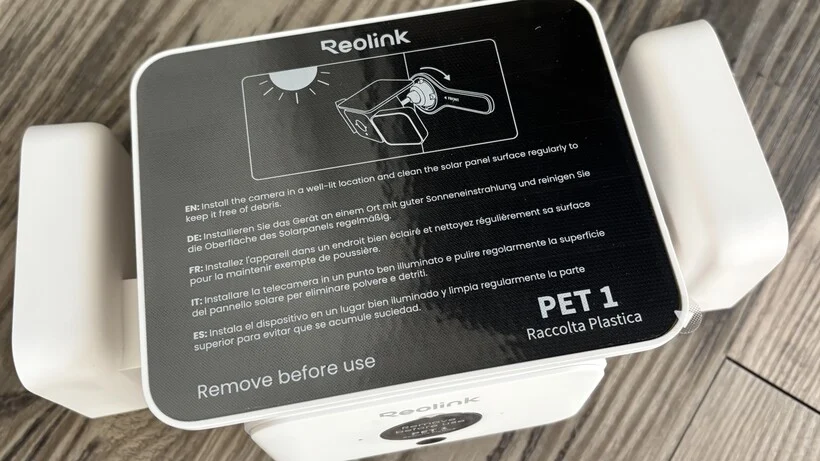
The integrated solar panel is a key design element, seamlessly incorporated into the top of the unit. This self-contained approach eliminates the need for separate solar panels or additional wiring, simplifying installation and maintaining a clean aesthetic. However, this integrated design does present a limitation: the solar panel’s angle cannot be adjusted for optimal sun exposure. For users requiring maximum solar charging efficiency, Reolink offers the option to connect a secondary, external solar panel.
Features and App Functionality: Deep Control, Minimal Fees
Post-installation, the Reolink Solar Floodlight Cam operates through the Reolink mobile application. This platform is widely recognized for its extensive feature set within the security camera market, though its depth can sometimes feel overwhelming for novice users. The advantage of this comprehensive nature is the granular control it affords users over nearly every aspect of the camera’s operation, from motion detection sensitivity and recording parameters to alert customization.
Out of the box, the system provides a functional baseline with minimal configuration. However, the true value of the Reolink app becomes apparent when users begin to fine-tune the settings to match their specific environment and security needs. A significant feature is the intelligent detection system, which can differentiate between people, vehicles, and animals. This capability dramatically reduces the number of false alerts, a common annoyance with less sophisticated security cameras. Furthermore, users can create custom schedules for different detection types, allowing, for instance, for people detection to be active overnight while vehicle detection is prioritized during daytime hours.

Alerts are delivered via push notifications to the user’s smartphone. To prevent notification fatigue, the object-based detection is invaluable, allowing users to tailor triggers to specific categories like human presence, pet activity, or vehicle movement.
Local storage is facilitated by a microSD card, with support for capacities up to 512GB. A significant draw for consumers is the absence of mandatory subscription fees for accessing recorded footage. For users requiring expanded storage, recordings can be routed through a Reolink Home Hub or a Network Video Recorder (NVR) system.
Optional cloud storage plans are available, offering a free tier with limited capacity and several paid tiers that scale based on storage size and retention period. Reolink’s cloud pricing remains competitive compared to major players like Ring or Nest. The free plan typically provides 1GB of storage with a 7-day history, while paid options range from approximately $3.49 to $10.49 per month, offering increased storage and longer retention.
The AI detection system demonstrates reliable performance in distinguishing between different types of motion. While not infallible, it effectively minimizes the unnecessary alerts that often plague entry-level security cameras. Recorded footage can be easily filtered within the app by event type, and individual clips can be saved directly to a mobile device. The interface even offers visual overlays to highlight detected people, vehicles, and animals, simplifying the review process.

A crucial detail for users to note is the default download quality of recorded footage. The app may save lower-quality "fluent" clips by default; users are advised to adjust this setting to full resolution during the initial setup for optimal clarity. Advanced users can also access bitrate controls for further tuning. Video management on the device presents a more rigid approach compared to some alternatives. Individual clip deletion is not supported, meaning users must either format the entire storage card or rely on the system’s automatic overwriting of older footage.
The device includes two-way audio functionality, allowing for real-time conversations with individuals near the camera. Additionally, a built-in 110dB siren can be activated either manually through the app or automatically in response to detected motion events. While the speaker output is functional, it tends to be somewhat thin, which is typical for devices in this category.
Performance: Balancing Power and Efficiency
The performance of the Reolink Solar Floodlight Cam is solid, though it is positioned below the company’s flagship cameras, a natural consequence of its price point and power management system. The 2K resolution provides sufficient detail for everyday security monitoring. Faces, vehicles, and general movement are clearly identifiable during daylight hours, though it does not achieve the same level of sharpness as Reolink’s higher-end 4K models.

Night vision performance is highly dependent on ambient lighting conditions. When the floodlights are active, the camera switches to full-color night vision, offering strong clarity and usable detail for identification purposes. In the absence of illumination, the camera reverts to black-and-white infrared, which remains functional but yields less detailed imagery.
A slight delay can be observed between the detection of motion and the activation of the floodlights. This brief interval results in a short period of infrared-only capture before full lighting engages. While noticeable, this delay is generally not critical in real-world operational scenarios.
The floodlights themselves deliver 1000 lumens of illumination, which is ample to effectively light up driveways, entry points, and garden areas. While this intensity does not rival that of Reolink’s higher-end floodlight systems, it still provides a strong deterrent effect rather than simply ambient lighting.
One of the most impressive aspects of the Solar Floodlight Cam is its solar performance. Reolink’s "SolarEase" system is engineered to enhance charging efficiency, with claims of up to 26 percent conversion efficiency. This system is designed to facilitate charging even in suboptimal conditions, such as consistent cloud cover or partial shade.

In testing scenarios under mixed UK sunlight, the battery charge increased from 38% to 61% in approximately three hours. Following a few days of consistent sunshine, the battery consistently remained near full capacity for extended periods. Overnight power drain typically reduced the charge to around 40%, but the system demonstrated a rapid recovery during daylight hours. Reolink’s estimate of up to three months of operation on a full charge appears realistic for periods of low activity, provided there is reasonable solar exposure.
Final Thoughts: A Practical Choice for the Budget-Conscious
The Reolink Solar Floodlight Cam occupies a valuable niche within Reolink’s product ecosystem, serving as a more accessible and lower-maintenance alternative to its higher-specification floodlight cameras. It is not engineered to compete on sheer resolution or raw illumination power. Instead, its primary strengths lie in its ease of installation, its reliance on solar power for sustained operation, and its commitment to a genuinely subscription-free user experience.
While there are inherent trade-offs, such as the resolution limitations compared to premium models, the unprotected nature of the storage slot, and the fixed design of the integrated solar panel, these compromises are thoughtfully balanced by a system that is remarkably simple to install, easy to maintain, and capable of independent operation for extended durations.

For consumers who prioritize dependable outdoor security without the encumbrance of wiring, ongoing subscription fees, or unnecessary complexity, the Reolink Solar Floodlight Cam stands out as one of the brand’s most practical and user-friendly offerings. Its ability to deliver essential security features powered by the sun makes it a compelling choice for a broad range of homeowners.
Testing Methodology
Our reviews are built upon a foundation of extensive, long-term testing. Smart home security cameras, by their nature, are designed to integrate within an ecosystem and operate continuously. Therefore, a brief evaluation period is insufficient to provide a comprehensive verdict. As dedicated smart home technology testers, we understand the critical factors that matter and how a particular device stacks up against its market alternatives. Our reviews are meticulously crafted to be thorough, objective, and impartial, and we do not accept direct payment for reviewing any device. Further details on our rigorous review process for smart security cameras can be found in our dedicated guide.
Frequently Asked Questions

Do you have to pay for cloud storage with the Reolink Solar Floodlight Cam?
No, the Reolink Solar Floodlight Cam supports local recording via a microSD card, eliminating the need for mandatory cloud storage fees.
Score
[A score would typically be placed here, e.g., 4/5 stars, based on the original article’s scoring system.]

