
The professional landscape for user experience (UX) design is undergoing a fundamental transformation as artificial intelligence (AI) integrates into the product development lifecycle, effectively merging the traditionally distinct roles of design and engineering. By early 2026, the industry has seen a decisive shift in hiring requirements, where the long-standing debate over whether designers should code has been settled by market demand rather than academic consensus. Today’s recruitment trends on platforms such as LinkedIn indicate that UX professionals are increasingly expected to master AI-augmented development, technical orchestration, and the delivery of production-ready code. This evolution represents a departure from the "vibe-centric" design models of the past, pushing practitioners toward a "design engineer" hybrid model that prioritizes technical execution alongside human-centered aesthetics.
The 2026 Job Market: A Shift Toward Technical Proficiency
The current trajectory of the design industry is marked by a significant divergence in growth patterns between traditional and digital roles. According to data from labor statistics and industry forecasts, traditional graphic design roles are projected to grow by a modest 3% through 2034. In contrast, roles categorized under UX, UI, and Product Design are expected to see a 16% increase over the same period. This growth, however, is not a simple expansion of existing duties; it is intrinsically linked to the rise of AI-driven product development.
In the current fiscal environment, "design skills" have ascended to the top of the most in-demand capabilities for technology firms, often surpassing traditional back-end coding and cloud infrastructure in specific sectors. Corporations are no longer seeking designers who merely provide visual specifications; they are recruiting for "technical translators" capable of bridging the gap between complex AI logic and user-facing interfaces. A recent industry survey conducted by Lyssna indicates that 73% of designers now view AI as a primary collaborator. However, this collaboration has led to what many analysts describe as "role creep," where designers are tasked with prompting React components into existence and managing Git repositories—tasks once reserved for specialized front-end engineers.
A Chronology of the UX Evolution
To understand the current state of the industry in 2026, it is necessary to trace the technological milestones that led to this convergence:
- The Prototyping Era (2010–2018): UX design focused on wireframes and static mockups. Tools like Sketch and early Figma allowed for high-fidelity visuals, but the "handoff" to developers remained a hard border.
- The Integration Surge (2019–2023): Design systems began to bridge the gap. Tokenization allowed design choices (colors, spacing) to be represented as code, but the structural logic remained with engineering.
- The Generative AI Breakthrough (2024–2025): The introduction of Large Language Models (LLMs) capable of generating functional JSX, CSS, and JavaScript components enabled designers to bypass traditional development bottlenecks. Tools like Figma’s AI-to-code plugins became industry standards.
- The Design Engineering Mandate (2026): Production-ready prototyping becomes a standard deliverable. Job descriptions for Senior UX roles now frequently list proficiency in AI-assisted coding and technical debugging as "non-negotiable" requirements.
The Competence Trap and the "Averagely Competent" Dilemma
While the promise of AI suggests that designers can now achieve the output of an engineer, technical analysts warn of a "competence trap." The narrative circulating in corporate boardrooms suggests that because an AI agent can generate a functional JavaScript event handler, the designer prompting it does not need to understand the underlying architecture. In practice, this often results in professionals who are "averagely competent" in two fields rather than experts in one.
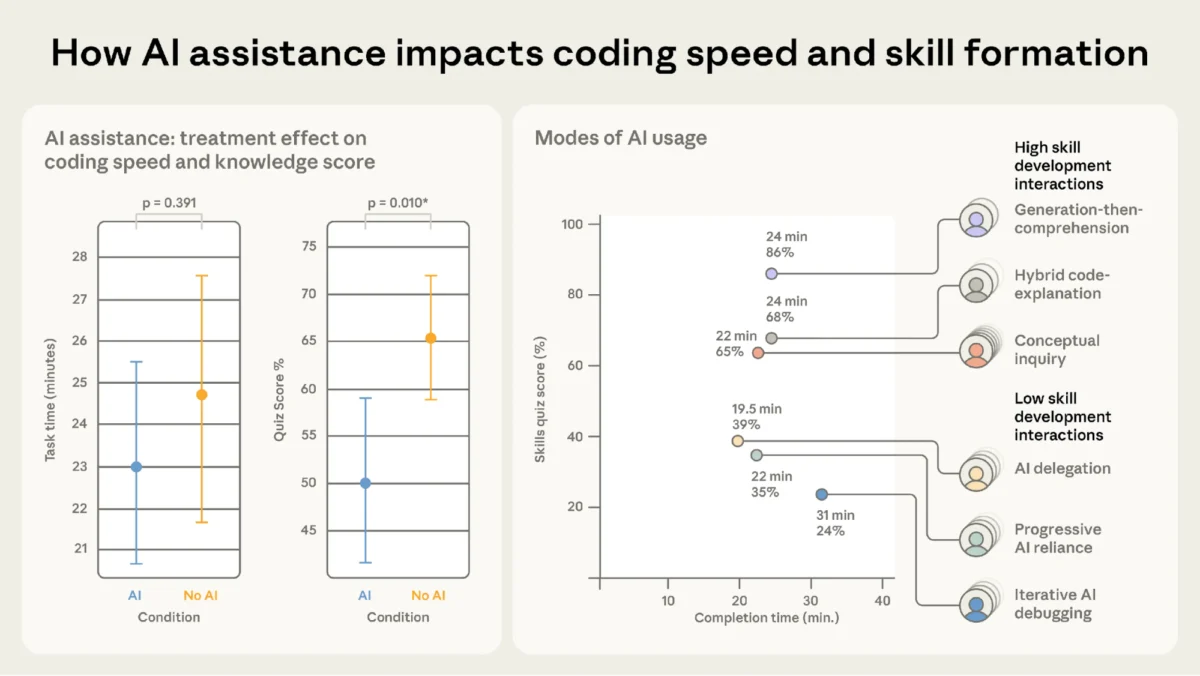
Data from research conducted by Anthropic suggests that while AI assistance significantly increases the speed of coding for novices, it can actually impede the formation of deep technical skills. Designers who rely on AI to ship components without a foundational understanding of computer science may find themselves unable to manually trace logic when a component fails during high-traffic events. This transition from "expert designer" to "liability coder" is a growing concern for Chief Technology Officers (CTOs) who prioritize system stability over the speed of initial deployment.
The Economic Impact of Quality Debt and the "Rework Tax"
The rush to have designers ship production code has introduced a new form of financial inefficiency: the "Rework Tax." When designers provide AI-generated code that lacks technical optimization, it often results in "Quality Debt." This debt manifests in several critical areas:

- Bloated Codebases: AI-generated components often include redundant libraries or unoptimized logic, leading to slower page load times and increased server costs.
- Accessibility Non-Compliance: Automated code generation frequently overlooks ARIA (Accessible Rich Internet Applications) labels and keyboard navigation standards, exposing companies to legal risks and accessibility lawsuits.
- Security Vulnerabilities: AI tools may suggest outdated or insecure coding patterns that do not align with a company’s internal security protocols.
- Maintenance Hurdles: Code that does not follow a company’s specific naming conventions or state management patterns becomes a "puzzle" for engineers, requiring significant hours of refactoring.
Industry reports suggest that for every hour a designer saves by using AI to generate code, engineering teams often spend two to three hours fixing or integrating that code into the broader system architecture. This paradox challenges the initial cost-saving assumptions made by businesses looking to streamline their development cycles.
Industry Reactions and the Guardian Model
The response from the design and engineering communities has been polarized. Some veteran designers argue that the reallocation of value—prioritizing speed of output over the quality of the user experience—is a fundamental threat to the craft. They contend that the UX designer’s primary value lies in cognitive load analysis, ethnographic research, and empathy—skills that AI cannot currently replicate.
In contrast, a new cohort of "Design Engineers" argues that the merger is inevitable. They suggest that by controlling the code, designers ensure that the final product matches their original vision more accurately than a traditional handoff would allow.
To mitigate the risks of this transition, many forward-thinking organizations are moving away from the "Solo Full-Stack Designer" model. Instead, they are adopting a collaborative framework where:

- Designers use AI to explore more iterations and test functional prototypes earlier in the cycle.
- Engineers act as "technical auditors," reviewing AI-generated code for security, scalability, and performance.
- Product Teams value the "human complexity" of a design rather than just the speed at which a feature is pushed to a repository.
Broader Implications and Future Outlook
As the industry moves toward the latter half of the decade, the "AI Infatuation" phase is expected to cool, giving way to a more nuanced approach to product development. Businesses that have prioritized "designer-shipped code" without adequate engineering oversight are already beginning to face a reckoning of technical debt and security breaches.
The long-term success of UX professionals in this environment will likely depend on their ability to remain "guardians of the user experience." This involves using AI to augment design thinking—allowing for faster iteration and more robust testing—while refusing to abandon the specialized expertise required to ensure designs are technically sound, accessible, and secure.
For the UX designer, the 2026 landscape is not necessarily a nightmare, but a call to re-specialize. The most successful practitioners will be those who master the "orchestration" of AI tools without losing sight of the human on the other side of the screen. By positioning themselves as the bridge between technical capability and human-centered design, they ensure their relevance in an increasingly automated world.
Summary of Strategic Requirements for Modern UX Roles
To remain competitive in the current market, UX professionals are adopting a checklist of new competencies:

- Technical Literacy: A baseline understanding of front-end frameworks (e.g., React, Vue) to audit AI-generated output.
- AI Prompt Engineering: The ability to write precise prompts that include constraints for accessibility and performance.
- Quality Assurance: Developing the skills to test components across various devices and network speeds.
- Strategic Advocacy: The ability to explain to stakeholders why "fast" AI-generated code may not always be "good" code, advocating for the necessary time to ensure quality and human-centeredness.
The industry’s evolution serves as a reminder that while tools change, the core mission of UX design remains the same: to solve human problems. The integration of AI and code is simply the latest medium through which that mission is executed.

