
The World Wide Web Consortium (W3C) and major browser engines have officially introduced a transformative set of CSS functions—sibling-index() and sibling-count()—marking a significant shift in how developers handle mathematical layouts and staggered animations. These functions, part of the CSS Values and Units Module Level 5, allow the browser to expose its inherent knowledge of the Document Object Model (DOM) tree directly to stylesheets. For years, front-end engineers have relied on complex workarounds, such as pre-processor loops or JavaScript-injected inline styles, to achieve effects that are now possible with a single line of declarative code. This advancement represents a milestone in the "CSS-first" philosophy, reducing the reliance on scripting for purely visual concerns and improving the performance and maintainability of modern web applications.
The Technical Shift: From Manual Indexing to Native Tree-Counting
For over a decade, creating a staggered animation—where a series of items fade in one after another—required developers to manually assign an index to each element. In the era of Sass and Less, this typically involved writing @for loops that generated dozens of :nth-child() selectors. For a list of ten items, a developer would generate ten separate rules, each hardcoding a CSS variable like --idx. If a dynamic list grew beyond the pre-defined loop limit, the animation would either fail to stagger or require a recompilation of the stylesheet.
Alternatively, developers turned to JavaScript, looping through DOM elements after they had rendered to apply inline styles such as style="--index: 3". While functional, this approach introduced "layout thrashing" risks and created a fragile dependency between the DOM structure and the script. The core frustration for the development community was that the browser already possessed the data; it built the DOM tree and knew exactly which element was the third or tenth child. However, until the approval of CSSWG issue #4559, CSS lacked the syntax to access this internal metadata.
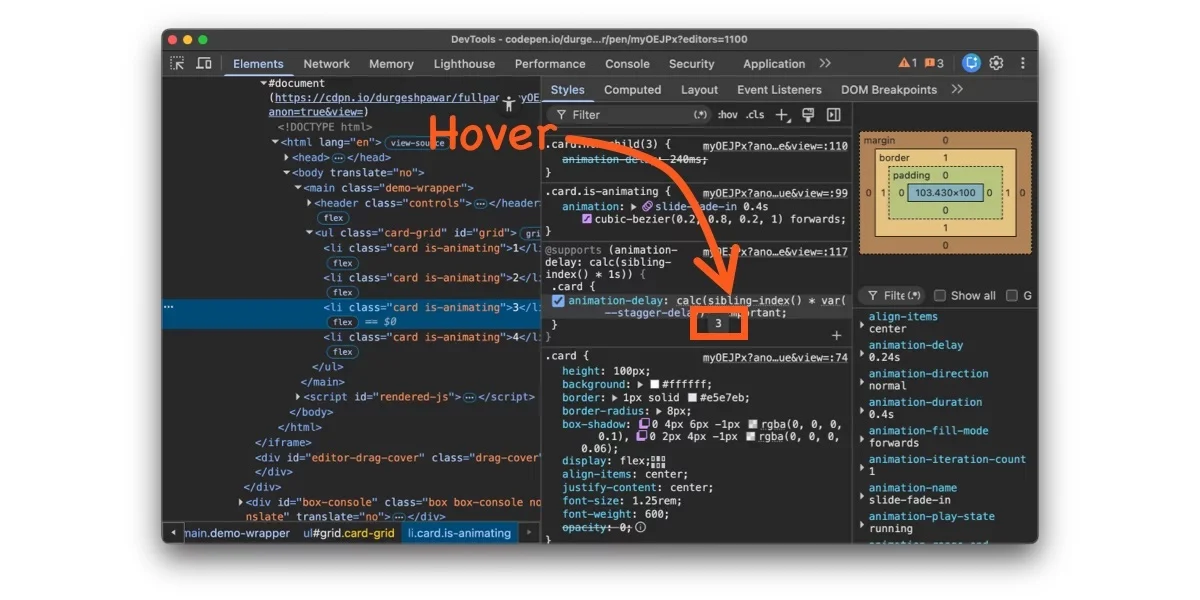
With the introduction of sibling-index() and sibling-count(), the browser now resolves these values dynamically during the cascade phase. The sibling-index() function returns an integer representing the position of an element among its siblings (starting at 1), while sibling-count() returns the total number of siblings in the parent container. This allows for calculations like animation-delay: calc(sibling-index() * 100ms);, which works seamlessly whether a list contains five items or five thousand.
Chronology and Development of the Specification
The journey toward native tree-counting functions began in earnest within the CSS Working Group (CSSWG) several years ago. The proposal was driven by the need to simplify common design patterns that were disproportionately difficult to implement.
- Initial Proposal (2020-2021): Discussions intensified around CSSWG issue #4559, where engineers argued that
:nth-child()was an insufficient tool for calculation because it is a selector, not a value-producer. - Drafting Phase (2022-2023): The functions were integrated into the CSS Values and Units Module Level 5. During this time, the working group refined the behavior of these functions regarding pseudo-elements and the Shadow DOM.
- Browser Implementation (2024-2025): Chrome and Edge began implementing the functions in early 2025, with stable releases appearing in Version 138 (June 2025). Apple’s WebKit team followed shortly after, shipping support in Safari 26.2.
- Current Status: As of mid-2025, the functions are part of the "Baseline" path for modern browsers, with Mozilla Firefox currently tracking implementation under Bugzilla issue #1953973.
Core Mechanics and Mathematical Integration
One of the most powerful aspects of sibling-index() and sibling-count() is that they resolve to raw <integer> types. Unlike the counter() function, which returns a string primarily intended for the content property of pseudo-elements, these new functions can be used anywhere a number is accepted. This includes integration with calc(), min(), max(), and the recently introduced trigonometric functions like sin() and cos().
Proportional Layouts and Hue Distribution
The ability to use sibling-count() in the denominator of a fraction opens up new possibilities for responsive design without media queries. For instance, a tab bar can now automatically calculate the width of its children using width: calc(100% / sibling-count());. This ensures that as tabs are added or removed dynamically via a Content Management System (CMS), the layout adjusts perfectly without additional logic.
Furthermore, designers can leverage these functions for automated color theory. By using the HSL (Hue, Saturation, Lightness) color model, a developer can distribute hues evenly across the color wheel:
background-color: hsl(calc((360deg / sibling-count()) * sibling-index()), 70%, 50%);.
This creates a mathematically perfect rainbow or color gradient that adapts to the number of elements present in the DOM, a task that previously required a JavaScript color library.
Advanced Radial Geometry
By combining tree-counting with native CSS trigonometry, complex radial layouts—such as circular menus or hexagonal grids—can be achieved in pure CSS. By calculating an --angle based on the sibling index divided by the total count, developers can position items around a center point using sin() and cos() within a calc() function. This removes the need for JavaScript coordinate calculations, which often lead to "jank" or visual stuttering during window resizing or DOM updates.
Technical Limitations and "Gotchas"
Despite the power of these functions, the specification includes several nuances that developers must navigate to avoid unexpected behavior.
The "Display: None" Anomaly
A critical distinction in the spec is that sibling-index() operates on the DOM tree, not the layout tree. This means that elements with display: none are still counted. If a developer has a list of ten items and hides the second item using display: none, the third item still returns a sibling-index() of 3, even though it appears to be the second visible item. This behavior is intentional but requires developers to physically remove filtered nodes from the DOM if they require a continuous, gap-less index for their animations or layouts. In contrast, visibility: hidden and opacity: 0 also maintain the index, which is generally more intuitive as those elements still occupy space in the layout.
Shadow DOM Scoping and Security
The functions are strictly scoped to the local DOM tree. In the context of Web Components, sibling-index() will only see siblings within the same Shadow Root. It cannot "see" through a <slot> to count projected light DOM elements. This is a deliberate design choice to maintain the encapsulation of Web Components. Furthermore, for security reasons, if an external stylesheet attempts to access these values via the ::part() pseudo-element, the browser returns a value of zero. This prevents malicious or third-party CSS from probing the internal structure of a component to infer private data.
Performance Considerations
While native CSS functions are generally faster than JavaScript equivalents, they are not computationally free. Adding, removing, or reordering children in a large container triggers a style recalculation for all subsequent siblings. In most UI scenarios—such as navigation menus or card grids—the performance impact is negligible. However, for extreme use cases involving tens of thousands of nodes, such as a virtualized stock ticker, the engine must perform significant work to update the cascade. Industry experts recommend continuing to use JavaScript-managed virtualization for massive datasets to maintain a 60fps frame rate.

Industry Reactions and Broader Implications
The web development community has largely met the arrival of these functions with acclaim. Leading CSS architects have noted that these functions solve the "final mile" of declarative styling. By moving tree-logic into CSS, the "separation of concerns" is reinforced: JavaScript handles behavior and data fetching, while CSS handles the visual representation of that data’s structure.
From an accessibility standpoint, experts caution that while these functions change visual order and timing, they do not alter the semantic structure of the page. A list visually reordered using sibling-index() math will still be read by screen readers in its original DOM order. Developers are urged to ensure that aria-posinset and aria-setsize attributes are updated via JavaScript if the visual layout significantly departs from the source order, ensuring a consistent experience for users of assistive technology.
Future Prospects: The Extension of Tree-Counting
The CSS Working Group is already discussing extensions to these functions to provide even more granularity. A proposed of <selector> argument, similar to the syntax used in :nth-child(n of .active), would allow sibling-index() to count only those siblings that match a specific class or state. This would resolve the issues currently faced with display: none, allowing for dynamic filtering that maintains a sequential index.
Additionally, proposals for children-count() and descendant-count() are currently under review. These would provide a "vertical" view of the tree, allowing a parent element to style itself based on the number of children it contains—a long-requested feature that would effectively act as a "quantity query" in native CSS.
As browser support approaches 100%, sibling-index() and sibling-count() are set to become standard tools in the front-end arsenal. By bridging the gap between the DOM’s structure and CSS’s styling capabilities, the W3C has provided a more robust, performant, and elegant way to build the dynamic interfaces of the future. For now, developers are encouraged to use @supports (z-index: sibling-index()) to provide progressive enhancement, ensuring that while modern browsers enjoy mathematical layouts, legacy environments remain functional with static fallbacks.

