
The modern web development landscape is currently undergoing a significant paradigm shift as the gap between native browser capabilities and external library requirements continues to close. For over a decade, developers have relied heavily on the Node Package Manager (npm) ecosystem to fill gaps in the web platform, often resulting in bloated applications that ship excessive amounts of JavaScript to the end user. However, the emergence of the "Baseline" initiative—a collaborative effort by the WebDX Community Group involving Google, Microsoft, Apple, and Mozilla—is providing a clear roadmap for when developers can safely discard these external dependencies in favor of native browser features.
In a typical mid-sized JavaScript application, it is common to find between 60KB and 90KB of minified and gzipped dependencies that perform tasks the browser can now handle natively. These tasks range from complex date formatting and array grouping to UI components like modals and tooltips. As browsers ship updates at an accelerated pace, the "audit" of a project’s package.json file has become a critical exercise in performance optimization and long-term maintainability.
The Baseline Framework: A New Standard for Browser Compatibility
To understand the current state of web development, one must first understand the "Baseline" classification system. Historically, developers relied on "Can I Use" or MDN compatibility tables, which often provided fragmented data that was difficult to translate into business decisions. The Baseline initiative simplifies this by categorizing features into three distinct stages.
The first stage is "Limited Availability," where a feature is only supported by some browsers. The second is "Newly Available," indicating that the feature has become supported across all major engines (Chrome, Edge, Firefox, and Safari). The final and most critical stage is "Widely Available," which occurs 30 months after a feature reaches the "Newly Available" status. This 30-month window is a calculated buffer designed to ensure that the vast majority of users have updated their browsers to versions that support the feature.
By adhering to this cadence, engineering teams can make data-driven decisions about when to remove polyfills and libraries. The shift toward native features is not merely about reducing file sizes; it is about leveraging the browser’s highly optimized internal code, which typically executes faster and with better memory efficiency than user-land JavaScript.

Chronology of Web Platform Advancements (2020–2026)
The timeline of web platform evolution shows a rapid acceleration in the delivery of high-level APIs. In 2020 and 2021, the focus remained on core language improvements and early-stage UI primitives. By 2023, the Intl (Internationalization) API had matured significantly, rendering many formatting libraries obsolete.
In 2024, the "Popover API" reached Newly Available status, providing a standardized way to handle floating UI elements without the need for complex z-index management or external positioning libraries. By early 2025, the Intl.DurationFormat API completed the internationalization suite, allowing for the localization of time durations across all major engines. Most recently, in 2026, the "CSS Anchor Positioning" API and the "Temporal" API have moved into the spotlight, promising to replace the last remaining bastions of heavy external utility libraries.
Detailed Analysis of Dependency Clusters
The Internationalization Suite
One of the most immediate areas for optimization is internationalization. For years, libraries like moment.js, numeral.js, and timeago.js were industry standards. Today, the Intl namespace provides a robust alternative.
The Intl.RelativeTimeFormat API, now Widely Available, handles localized strings such as "3 days ago" or "yesterday." Similarly, Intl.NumberFormat manages currency, percentages, and compact notation (e.g., "1.2M") with native precision. Data suggests that replacing a suite of internationalization libraries can save an average of 14KB gzipped. Because these features are built into the browser, they do not require the user to download large locale data files, which are often the hidden "weight" of internationalization libraries.
Networking and the Fetch API
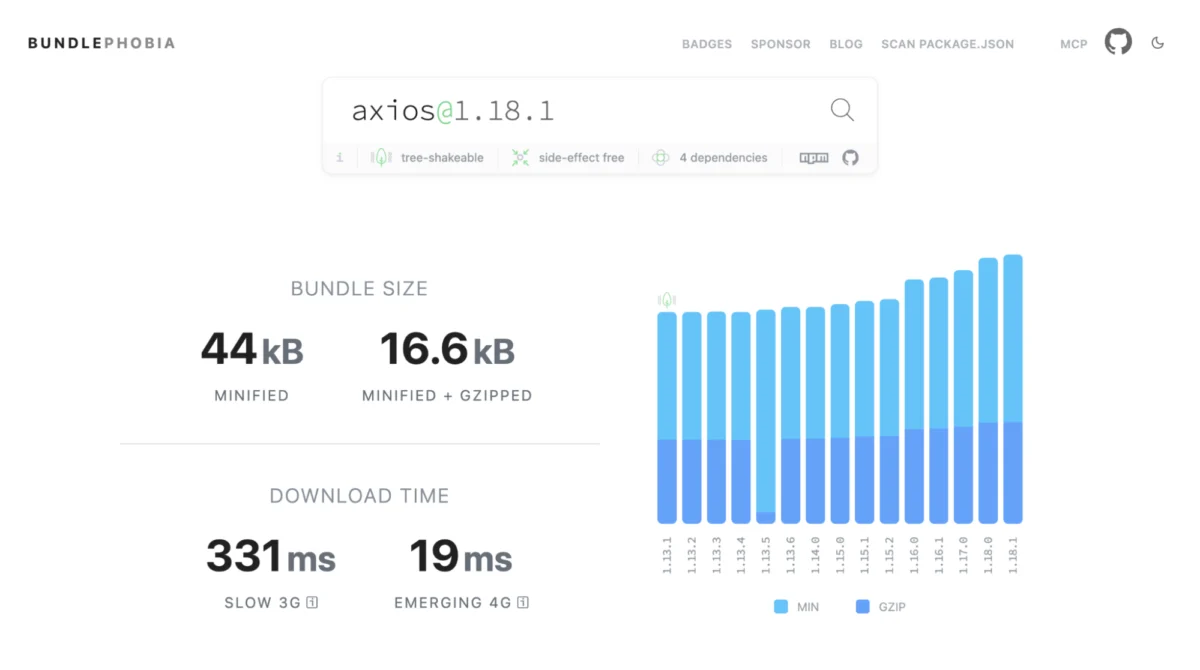
The transition from specialized HTTP clients like Axios (17KB gzipped) to the native Fetch API represents a broader shift toward standardized web protocols. While Axios offered features like automatic JSON parsing and request cancellation early on, the native fetch API, combined with AbortController and AbortSignal.timeout(), now covers the vast majority of use cases.
Analysis of production bundles shows that while Axios remains popular due to its "interceptor" pattern, many developers are now opting for thin wrappers around fetch. This approach provides the benefits of a customized API without the 17KB overhead, a crucial saving for mobile users on high-latency connections.

UI Primitives and Accessibility
Perhaps the most significant impact of the Baseline initiative is seen in UI components. The <dialog> element, now Widely Available, addresses one of the most difficult challenges in web development: the accessible modal.
A standard modal library must manage focus trapping, "Escape" key listeners, and background scroll locking. The native <dialog> element handles these natively via the showModal() method. When a dialog is opened as a modal, the browser automatically treats the rest of the page as "inert," preventing screen readers and keyboard users from interacting with background content. Industry experts note that using native UI primitives often results in better accessibility outcomes than hand-rolled or library-based solutions, which may not always account for the nuances of different assistive technologies.
The Financial and Performance Implications of Bundle Reduction
The cost of JavaScript is not just measured in download time, but in execution time. According to data from the HTTP Archive, the median mobile page loads over 400KB of JavaScript. On lower-end mobile devices, parsing and compiling this code can delay the "Time to Interactive" (TTI) by several seconds.
For e-commerce and B2B platforms, this delay has a direct financial impact. Studies by Google and other performance researchers have consistently shown that a 100ms delay in load time can lead to a 7% drop in conversion rates. By removing 60KB to 90KB of unnecessary dependencies, developers can significantly reduce the "JavaScript tax" on their users, leading to better engagement and lower bounce rates.
Official Responses and Industry Sentiment
The shift toward "Vanilla JavaScript" and native APIs has garnered support from major players in the tech industry. Members of the WebDX Community Group have emphasized that the goal of Baseline is to provide "predictability" for developers.
"We want developers to feel confident that if a feature is marked as Baseline, it is safe to use without a fallback," stated a representative from the community group in a recent technical briefing. This sentiment is echoed by maintainers of popular frameworks who are increasingly moving their internal logic to native APIs. For example, modern versions of many frontend frameworks have already swapped internal utility functions for native equivalents like structuredClone for deep copying objects.

Case Study: The Risks of Premature Adoption (Temporal API)
While the trend is toward removal of dependencies, the Baseline framework also serves as a warning system against premature adoption. The Temporal API is a prime example. As a modern replacement for the flawed Date object, Temporal is highly anticipated. However, it has not yet reached "Widely Available" status across all major engines.
Currently, using Temporal in a production environment requires a polyfill that can exceed 40KB gzipped. For a developer currently using dayjs (which is only 3KB), switching to Temporal today would actually increase the bundle size by 37KB. This highlights the importance of the "Three Questions" decision framework:
- Is the replacement Baseline-safe for the specific audience?
- What is the total cost of the swap (including polyfills)?
- Does the platform feature cover the specific use case?
Implementation Strategy: The Quarterly Audit
To maintain a lean application, experts recommend a repeatable audit process conducted on a quarterly basis. This involves:
- Inventory: Listing all production dependencies using tools like
npm ls. - Cost Analysis: Utilizing resources like "Bundlephobia" or "Vite Bundle Visualizer" to identify the heaviest packages.
- Baseline Verification: Checking the status of features on webstatus.dev or MDN.
- Progressive Enhancement: For features that are "Newly Available" but not yet "Widely Available," developers can implement feature detection to serve native code to modern browsers while maintaining a legacy path for older devices.
Future Outlook and Broader Impact
Looking ahead to late 2026 and 2027, several high-impact features are expected to reach Baseline status. CSS Masonry, View Transitions, and the full suite of Set operations will further reduce the need for specialized libraries.
The broader implication of the Baseline initiative is a more stable, performant, and accessible web. By shifting the burden of complexity from the developer’s bundle to the browser’s engine, the industry is moving toward a future where the "platform" is once again the primary driver of innovation. For the end user, this means faster websites, better battery life on mobile devices, and a more consistent experience across different browsers. For the developer, it means less time managing breaking changes in third-party libraries and more time building unique features that provide genuine value.

