
The European Union has finalized its implementation roadmap for the AI Act, signaling a paradigm shift in how artificial intelligence-generated content must be presented to the public. Beginning August 2, 2026, any organization—regardless of its headquarters’ location—that provides or deploys AI systems within the EU must adhere to stringent labelling and transparency obligations. These rules, primarily encapsulated in Article 50 of the AI Act, seek to ensure that citizens can clearly distinguish between human-generated content and synthetic media. While early industry reactions were marked by concerns over "sweeping measures" and "punitive fines," a closer examination of the guidelines reveals a targeted framework designed to mitigate the risks of misinformation, deepfakes, and the erosion of digital trust.
The Extraterritorial Reach of European AI Standards
The enforcement of the EU AI Act follows a regulatory philosophy often referred to as the "Brussels Effect," where EU standards become the de facto global benchmark due to the size and influence of the European single market. Similar to the General Data Protection Regulation (GDPR) and the European Accessibility Act (EAA), the AI Act’s transparency obligations apply to any company whose AI output is used by individuals within the EU. This includes Silicon Valley tech giants, Asian manufacturing firms, and independent software developers worldwide.
Under the new guidelines, the legal burden is shared between "providers"—those who develop or supply AI systems—and "deployers," the entities that use these systems to interface with the public. A company cannot circumvent Article 50 simply by licensing a third-party AI tool; the responsibility to disclose AI involvement remains with the entity presenting the content to the end-user. This ensures that the chain of accountability remains intact from the laboratory to the living room.

Defining the Scope: What Requires an AI Label?
The European Commission has been explicit in defining which types of content necessitate a clear and distinguishable label. The goal is not to label every automated process but to identify instances where synthetic content could reasonably be mistaken for authentic, human-led interaction or documentation. According to Article 50(4), three primary categories require mandatory disclosure:
- Deepfakes and Synthetic Media: Any AI-generated or manipulated image, audio, or video that resembles existing persons, objects, places, or events in a way that would falsely appear authentic to a reasonable person.
- Public Interest Information: AI-generated text intended to inform the public on matters of "public interest." This broad category includes content related to public health, safety, the environment, financial stability, political processes, and scientific advancements.
- Direct AI Interactions: Systems designed to interact directly with natural persons, such as AI-driven customer service bots, must be identified as such unless it is obvious from the context of use.
Crucially, the guidelines distinguish between "realistic" AI content and clearly fictional or artistic content. For example, a highly stylized AI-generated cartoon might not require a label, whereas a photorealistic AI-generated image used in a marketing campaign for a real-world product likely would.

The "Human-in-the-Loop" Exemption and Editorial Responsibility
One of the most significant clarifications in the recent EU guidance is the exemption for content that has undergone "substantive" human review. The disclosure obligation does not apply when AI-generated text has been reviewed and edited by a human who takes editorial responsibility for the final output. This distinction is vital for newsrooms, marketing agencies, and creative professionals who use AI as a drafting tool rather than a final producer.
However, the European Commission has set a high bar for what constitutes a "substantive" review. A cursory "skim" or a minor formatting check does not absolve a company of its disclosure duties. To qualify for the exemption, there must be a named person or entity taking legal and ethical responsibility for the content’s accuracy and intent. This effectively places the burden of proof on the publisher to demonstrate that human agency was the primary driver of the final product.

Furthermore, the guidelines differentiate between "assistive" AI and "generative" AI. Standard tools such as spellcheckers, grammar assistants, basic translation services, and simple photo-editing features (like cropping or color correction) are generally excluded from the labelling requirements. In contrast, AI-generated summaries, composite imagery, and substantive rewrites are classified as AI generation and fall under the transparency mandate.
Beyond the Sparkle: The Failure of Current UX Patterns
For several years, the "sparkle" icon (✨) has served as the unofficial industry standard for flagging AI-powered features. However, the European Commission’s Code of Practice suggests that this symbol is insufficient for legal compliance. User experience research, including studies by the Nielsen Norman Group, indicates that the sparkle icon is too ambiguous. Users often interpret it as a sign of a "new feature" or a "premium tool" rather than a clear indicator that the content they are viewing is synthetic.

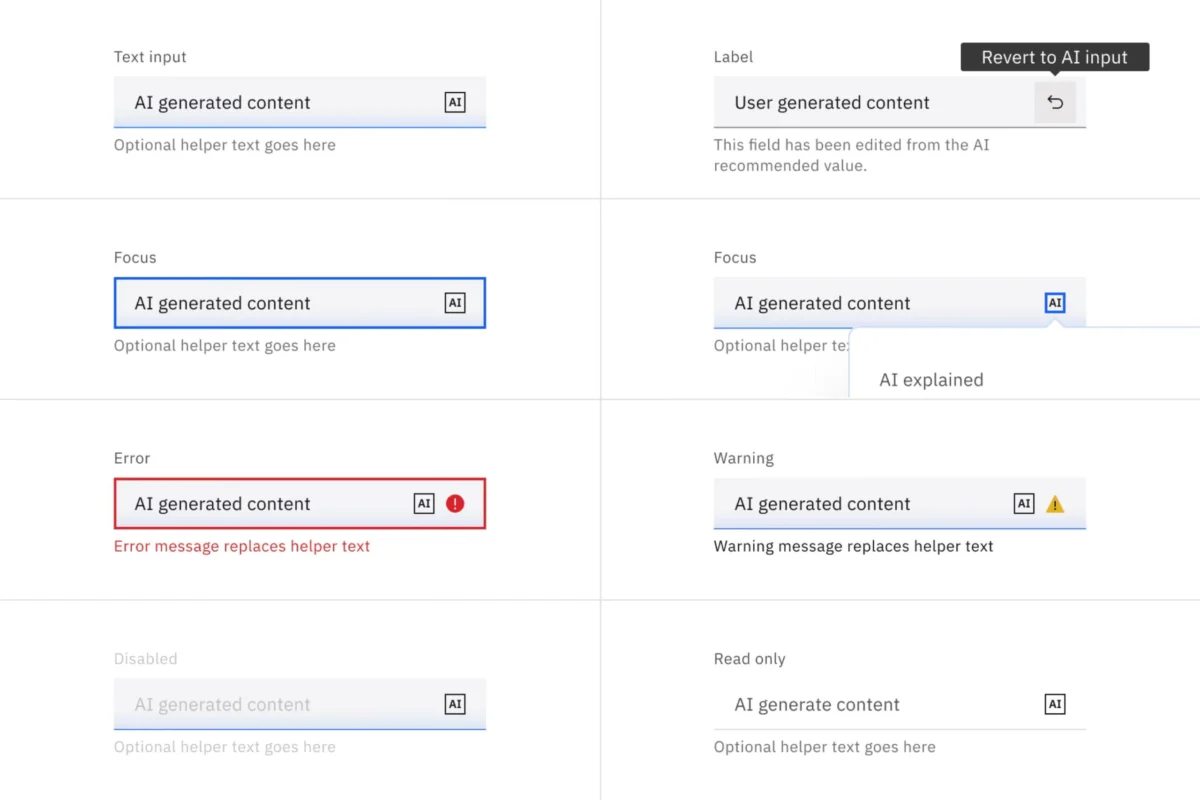
To rectify this, the EU has released a specific set of AI icons designed to be "clear and distinguishable." These icons are intended to be paired with plain-language labels such as "AI-generated" or "Partially AI-modified." The Commission emphasizes that an icon alone—especially one that is buried in a footer or flashes only briefly—will not satisfy the transparency requirement. The disclosure must be:
- Persistent: It must remain visible even when the content is reshared or downloaded.
- Accessible: It must be compatible with assistive technologies, such as screen readers.
- Unambiguous: It must use language that a layperson can easily understand without technical expertise.
Implementation Timeline and Phased Enforcement
The AI Act is being rolled out in stages to allow companies to adjust their technical infrastructures. The timeline for implementation is as follows:

- August 1, 2024: The AI Act officially entered into force.
- February 2, 2025: Prohibitions on "unacceptable risk" AI (such as social scoring or certain biometric systems) take effect.
- August 2, 2025: Rules for General-Purpose AI (GPAI) models, including governance and systemic risk obligations, become mandatory.
- August 2, 2026: The full suite of transparency obligations, including the mandatory labelling of AI-generated content under Article 50, becomes legally binding.
- August 2, 2027: High-risk AI systems (those used in critical infrastructure, education, or employment) must meet full compliance standards.
Failure to comply with these transparency rules can result in significant financial penalties. Under the Act, companies can face fines of up to €35 million or 7% of their total global annual turnover, whichever is higher. These figures are designed to ensure that even the world’s largest technology firms treat AI transparency as a core compliance priority.
A Global Trend Toward Algorithmic Accountability
The EU’s move is part of a broader international movement toward regulating synthetic media. In the United States, several states have already moved forward with their own mandates. California’s SB 942, for instance, requires large AI providers to include "latent disclosures" (such as watermarking) in AI-generated content. On a federal level, Executive Order 14110 on the Safe, Secure, and Trustworthy Development and Use of Artificial Intelligence directs agencies to develop standards for authenticating content and tracking its provenance.

Similarly, China’s Cyberspace Administration (CAC) has implemented "Deep Synthesis" provisions that require clear labels on AI-generated content that could mislead the public. At the United Nations, a consensus resolution led by the U.S. and supported by over 120 countries has called for the development of "reliable mechanisms" to identify AI-generated content to protect human rights and democratic integrity.
These converging regulations suggest that AI labelling is no longer an optional "best practice" for UX designers, but a fundamental legal requirement for the modern digital economy.

Industry Impact and the Path Forward
The transition to mandatory AI labelling will require a significant overhaul of digital interfaces. Designers and developers must move away from "black box" AI implementations and toward "explainable AI" (XAI) frameworks. This involves not only adding labels but also providing users with "explainability panels" that detail why a certain AI output was generated and what data sources were utilized.
For marketers and advertisers, the challenge will be to maintain brand aesthetic while adhering to disclosure rules. Legal experts recommend that realistic AI-generated illustrations or photos in commercial content be labelled as a precaution, even if they do not directly involve a "public interest" topic. This proactive approach helps build consumer trust and protects the brand from potential litigation or regulatory scrutiny.

Ultimately, the EU AI Act’s transparency rules are designed to foster a digital environment where authenticity is protected. By removing the "magic" of the sparkle icon and replacing it with clear, factual disclosures, the regulation aims to empower users to make informed decisions about the media they consume. As 2026 approaches, the focus for global enterprises will shift from whether to label AI content to how to do so in a way that is both legally compliant and user-friendly. In this new era of digital governance, transparency is not just a regulatory hurdle—it is the cornerstone of the future relationship between humans and machines.

