
The rapid proliferation of generative artificial intelligence across the global software landscape has hit a significant point of friction as evidence mounts that a wide gap exists between executive enthusiasm and end-user adoption. While Silicon Valley and enterprise leadership have spent the last 24 months aggressively embedding AI "bolt-ons" into every conceivable digital interface, recent market data and user experience research suggest that the general public is not only fatigued by these additions but actively avoiding them. This phenomenon, often referred to as the "AI Adoption Gap," highlights a fundamental misunderstanding of what constitutes a value proposition in the modern digital economy. For many users, the promise of AI-driven efficiency has translated into increased workloads, fragmented workflows, and a pervasive sense of technological intrusion.
The False Premise of the AI Value Proposition
At the heart of the current industry struggle is the assumption that "AI-powered" is a self-evident benefit. Business model analysts, such as David Bland, have recently argued that AI belongs in the categories of "Key Activities" or "Key Resources" within a business framework, rather than being the "Value Proposition" itself. When a company markets a feature as being powered by AI, they are describing the engine rather than the destination. For the average user, the underlying technology is secondary to whether the tool solves a specific problem reliably and predictably.
The current trend of "bolt-on" AI—where a chat interface or a generative summary tool is added to an existing product without deep integration—often disrupts established workflows. Instead of streamlining a process, these features frequently force users to step out of their primary task to interact with a separate, often unpredictable system. This "context switching" creates a cognitive tax that can outweigh the perceived benefits of the automation. Research from organizations like the Nielsen Norman Group indicates that when AI features are treated as separate entities, they fail to achieve the "invisible utility" required for long-term retention.
A Chronology of the AI Hype Cycle and the Shift to Disillusionment
The trajectory of public sentiment regarding AI has moved through several distinct phases since late 2022. Understanding this timeline is crucial for contextualizing the current resistance to AI features.
Phase 1: The Novelty Surge (November 2022 – Mid-2023)
Following the public launch of ChatGPT, the tech industry entered a period of rapid experimentation. The primary goal for most software companies was speed-to-market. During this phase, user adoption was driven largely by curiosity. Investors rewarded any company that mentioned "AI" in quarterly earnings calls, leading to a rush of "me-too" features that were often thin wrappers around existing Large Language Models (LLMs).
Phase 2: The Integration Mandate (Late 2023 – Early 2024)
As the novelty wore off, enterprise leadership shifted toward mandatory integration. AI was no longer an experimental project but a core directive. This period saw the rise of the "AI Assistant" in workplace tools like Slack, Microsoft Teams, and Google Workspace. However, it was also during this phase that the first signs of the "AI Tax" began to emerge, as employees found themselves spending more time "fact-checking" AI outputs than they would have spent creating the content from scratch.
Phase 3: The Reality Check and Adoption Gap (Mid-2024 – Present)
Currently, the industry is grappling with low retention rates. A study by IBM looking toward 2026 suggests that while many companies have deployed AI, only a fraction of their workforce uses these tools daily. The high cost of delivery—both in terms of computational power and the risk of reputational damage from "hallucinations"—has made the low adoption rates a critical concern for Chief Information Officers (CIOs).

The Productivity Paradox: Supporting Data on Work Intensification
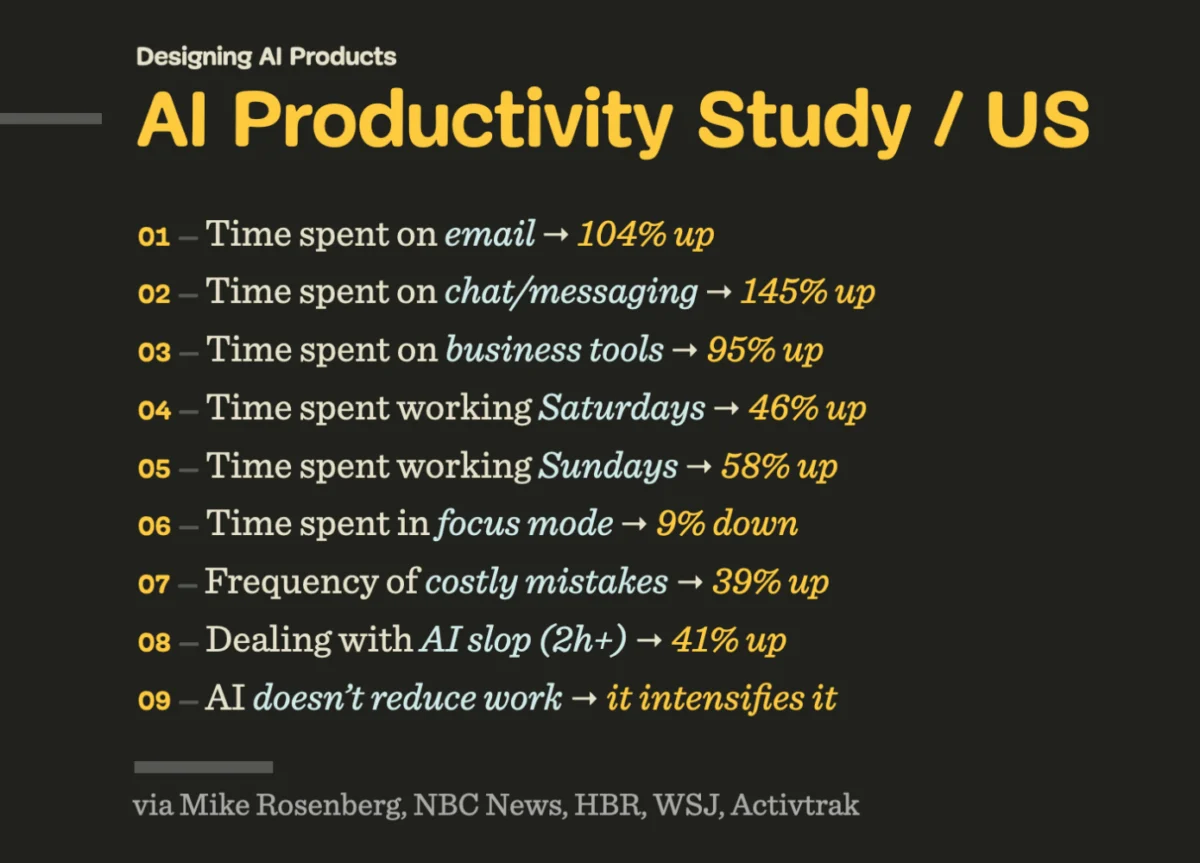
One of the most startling revelations in recent workforce studies is that AI has not necessarily reduced the amount of work for the average employee; in many cases, it has intensified it. Data compiled from sources including NBC News, the Harvard Business Review, and Activtrak reveals a "Productivity Paradox" that contradicts the primary selling point of generative AI.
According to these findings, since the widespread introduction of AI tools in the workplace, time spent on email has increased by 104%, and time spent on chat or messaging platforms has surged by 145%. Usage of general business tools has risen by 95%, while "focus mode"—the uninterrupted time required for deep work—has decreased by 9%. Perhaps most tellingly, the data indicates a sharp rise in weekend work, with Saturday and Sunday activity up by 46% and 58%, respectively.
This intensification is largely attributed to the "cleanup" required for AI-generated content. Users are reporting a 39% increase in costly mistakes and a 41% increase in time spent dealing with "AI slop"—low-quality or irrelevant content generated by automated systems. Instead of replacing labor, AI has created a new category of labor: the AI supervisor. Employees are now tasked with managing a "swarm" of agents that, while fast, lack the nuance and accuracy required for professional-grade output.
The Psychology of Resistance and the Fear of Displacement
Beyond the functional failures of current AI interfaces, there is a deep-seated psychological resistance among users. AI is often perceived as an uninvited guest in the creative and professional process. Unlike traditional software updates that improve a specific tool (such as a better brush in Photoshop or a faster formula in Excel), generative AI often attempts to replace the user’s primary output.

Statements from industry leaders and cultural commentators reflect a growing sentiment that the most human parts of work—thought, intuition, and taste—are being targeted for automation, while the "boring stuff" remains. Bo Young Lee, a prominent voice in the human-centric design movement, summarized this frustration by stating that people do not want AI art galleries or AI-narrated books for their children. Instead, the desire is for AI to handle the mundane, physical, and mentally taxing labor, thereby freeing humans to engage in the very activities that AI is currently attempting to automate.
Furthermore, the lack of predictability in AI behavior makes it a liability in many professional settings. Humans do not compare software to other humans; they compare features to features. If a traditional automation tool works 100% of the time and an AI tool works 85% of the time, the user will invariably view the AI as broken. In a professional environment, an 85% success rate is often worse than a 0% success rate because it necessitates a manual review of every single output, effectively doubling the workload.
The Shift Toward "AI-Second" Design
In response to these challenges, a new philosophy is emerging among UX designers and product strategists. This approach, termed "AI-Second," prioritizes the user’s existing mental models and workflows over the capabilities of the technology. Rather than being "AI-first"—where the interface is built around a prompt box—"AI-second" tools are subtle, ambient, and supportive.
Characteristics of successful "AI-second" integration include:

- Predictability: The tool performs a specific, narrow task consistently.
- Contextual Awareness: The AI works within the existing interface rather than requiring a separate window or tab.
- Low Stakes: The automation focuses on tasks where an error is easily caught or has minimal consequence, such as formatting or data categorization.
- Human-in-the-Loop: The system is designed to augment human decision-making rather than bypass it.
Vitaly Friedman, a leading figure in design patterns for AI interfaces, suggests that the future of the technology lies in its ability to adapt to how people think, rather than forcing people to change their behavior to accommodate the AI. This means moving away from the "magical box" of the chatbot and toward smarter, more responsive versions of the tools users already love.
Broader Implications for the Tech Industry and Labor
The failure to address the AI adoption gap has significant implications for the tech industry’s economic health. If companies continue to invest billions into AI features that users do not want, a market correction is inevitable. We are already seeing a shift in how investors evaluate AI startups, moving away from "cool demos" toward proven utility and retention metrics.
On a societal level, the "AI-first" push risks eroding the sense of achievement and reward that comes from professional mastery. If every task is "vibe-coded" or generated by a prompt, the unique human "point of view" that defines quality in fields like journalism, law, and design may be lost. The data from the Washington Post regarding jobs most exposed to AI automation—such as software developers and public relations specialists—underscores the urgency of creating tools that protect the creative core of these professions while automating the "slop."
Ultimately, the market is sending a clear message: people do not need more AI in their lives; they need more time. If AI can truly automate the mundane, it will be embraced. If it continues to demand more attention, more fact-checking, and more weekend work, the "AI Adoption Gap" will only continue to widen. The path forward for AI leaders is not to build more powerful models, but to build more humble and helpful interfaces that respect the human at the other end of the screen.

