
The global technology sector is currently defined by a singular, pervasive assumption: that every consumer and employee is eager for the integration of artificial intelligence into every facet of their digital lives. From generative text features in email clients to AI-narrated children’s stories and autonomous "agents" managing financial portfolios, the corporate push toward an "AI-first" world is relentless. However, emerging data and user sentiment suggest a significant disconnect between what Silicon Valley is building and what the average user actually requires. Recent market analysis reveals that the rapid deployment of AI features has frequently resulted in low adoption rates, poor retention, and an "intensification" of work rather than the promised liberation from it. This resistance is not merely a byproduct of technophobia but is instead a rational response to tools that often prioritize novelty over utility, adding layers of complexity to already fragmented workflows.
The Adoption Gap and the Value Proposition Fallacy
Despite billions of dollars in capital expenditure toward generative AI infrastructure, the anticipated revolution in user behavior has yet to materialize for many enterprises. According to recent studies, including an IBM 2026 projection on the AI adoption gap, a substantial number of AI features fail to move beyond the initial trial phase. The primary reason, as noted by user experience (UX) researchers at the Nielsen Norman Group, is that "Powered by AI" is not a standalone value proposition. While senior leadership teams often view AI as a magic bullet for efficiency, users view it through the lens of functionality. If a feature is unpredictable, unreliable, or requires significant manual oversight, its status as "AI" becomes a liability rather than an asset.
In many corporate environments, AI features are implemented as "bolt-ons"—supplementary tools that exist outside the primary software environment. This forces employees to "context switch," hopping between their traditional workspace and a separate AI interface. Rather than streamlining a process, these disconnected systems often create a new form of digital labor. Users are finding that while AI can generate a response or a report in seconds, the subsequent need for fact-checking, tone adjustment, and "de-hallucination" consumes more time than writing the content from scratch would have required.
The Productivity Paradox: When Automation Increases Workload
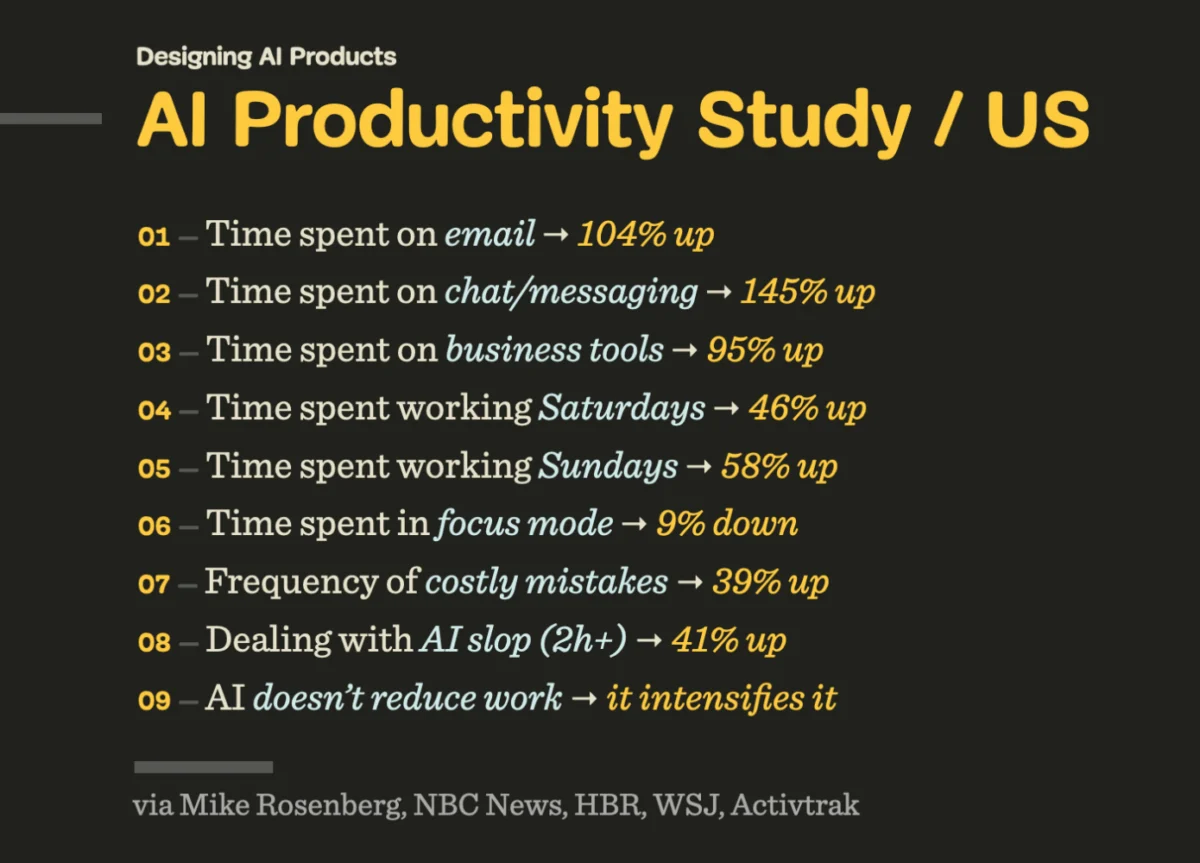
The most significant promise of the AI era was the reduction of mundane tasks to allow for higher-level creative and strategic work. However, data from a cross-section of sources, including NBC News, Harvard Business Review, and Activtrak, suggests the opposite is occurring. An analysis of AI productivity in the United States reveals a series of startling metrics that challenge the narrative of efficiency:
- Communication Overhead: Time spent on email has increased by 104%, and chat/messaging activity has surged by 145% as AI-generated content floods internal channels.
- Extended Work Cycles: The prevalence of AI tools has correlated with a 46% increase in work conducted on Saturdays and a 58% increase on Sundays, as users struggle to manage the volume of output generated by automated systems.
- Accuracy Costs: Costly mistakes attributed to AI reliance have risen by 39%, while the time spent dealing with "AI slop"—low-quality or irrelevant automated content—has increased by 41%.
- Cognitive Drain: Focus mode, the state of deep concentration required for complex problem solving, has decreased by 9% as users are constantly interrupted by AI prompts and the need to monitor automated agents.
These statistics indicate that AI is currently intensifying work rather than reducing it. By lowering the barrier to generating content, AI has increased the total volume of information that must be processed, vetted, and managed by human actors.

Organizational Friction and the Visibility of Technical Debt
For AI to function effectively within an organization, it requires high-quality data and clear, consistent logic. However, many companies suffer from years of accumulated "technical debt," fragmented data silos, and conflicting internal priorities. When AI is layered on top of these broken systems, it does not fix them; instead, it amplifies their shortcomings.
AI systems often expose organizational inconsistencies directly to the end-user. If an AI agent provides conflicting information because it is pulling from two different, outdated databases, the burden of reconciliation falls on the customer or the employee. In this context, AI becomes a mirror reflecting the internal chaos of a business. Leaders who ignore the foundational health of their data and culture while rushing to implement AI are essentially handing their internal "mess" to their users, leading to reputational damage and a loss of trust.
The Psychological Impact: Anxiety and the Loss of Agency
Beyond the functional failures of AI, there is a profound psychological resistance rooted in the way these technologies are introduced. For the majority of the workforce, AI is not a tool they proactively chose to adopt; it is an uninvited guest arriving at a pace dictated by corporate mandates. This lack of agency, combined with a constant media narrative regarding the obsolescence of human labor, has fostered deep-seated anxiety.

The resistance is particularly strong in creative and interpersonal fields. The prospect of AI art museums, AI-narrated books, or AI therapists is often met with a sense of loss rather than excitement. Users have expressed a clear preference for human-to-human interaction in areas involving taste, intuition, and emotional resonance. The sentiment shared by many, including industry leaders like Bo Young Lee, is a desire for AI to handle the "physical and mental labor that taxes" the human spirit, rather than replacing the activities—like reading, creating, and connecting—that make life rewarding.
The Shift Toward "AI-Second" Design
In response to these challenges, a new philosophy is emerging among UX designers and product strategists. Moving away from "AI-first" marketing, some are advocating for an "AI-second" approach. This strategy prioritizes the user’s existing mental models and workflows, treating AI as a subtle, ambient support system rather than a central protagonist.
Characteristics of successful, user-centric AI integration include:

- Predictability: Features that work consistently every time, rather than producing "vibe-coded" or randomized results.
- Integration: AI that exists within the tools people already use, eliminating the need for context switching.
- Augmentation over Replacement: Tools that automate the mundane (e.g., scheduling, data entry, or transcription) while leaving the rewarding, creative parts of a job to the human user.
- Transparency: Clearly defining where AI is helping and providing easy ways for humans to override or correct the system.
Vitaly Friedman and other experts in the field of AI interface design suggest that the goal should be to make AI "calm" and "humble." When technology works well, it often becomes invisible. The most successful implementations of AI in the future likely won’t be branded as "AI" at all; they will simply be seen as "smarter" versions of the tools we already trust.
Chronology of the AI Hype Cycle
To understand the current state of resistance, it is helpful to look at the timeline of the current AI boom:
- Late 2022: The public release of ChatGPT triggers a global arms race in generative AI. Companies rush to integrate LLMs (Large Language Models) into every product.
- Early 2023: "AI-First" becomes the mandatory strategy for tech giants and startups alike. Investment pours into infrastructure, often at the expense of traditional UX research.
- Late 2023: Early signs of "hallucination fatigue" emerge. Users begin to report frustration with the unreliability of AI-generated information.
- Mid-2024: Major studies begin to highlight the "adoption gap." Enterprises realize that while they have the tools, their employees are not using them effectively.
- 2025-2026 (Projected): A market correction toward human-centric design. Companies that fail to integrate AI into meaningful workflows begin to see significant churn, while those focusing on "boring" automation see steady gains.
Implications for the Future of Work and Technology
The pushback against pervasive AI serves as a critical reminder that technology must serve the user, not the other way around. As the industry matures, the focus is expected to shift from the raw power of the underlying models to the quality of the interface and the specificity of the use case.

For businesses, the implication is clear: the path to successful AI implementation is not through more features, but through better integration and a deeper respect for human time and agency. The "productivity paradox" can only be solved if AI reduces the total cognitive load on the user. If a tool requires more management than the task it was designed to replace, it is a failure of design, regardless of how advanced the underlying algorithm may be.
Ultimately, the human desire for connection, storytelling, and creative achievement remains unchanged. People do not want to spend their lives managing a "swarm of AI agents." They want more time to engage with the world and the people around them. The most successful technology of the next decade will be the one that grants users that time, rather than demanding more of it. In the words of many critics of the current trend, the goal of AI should be to automate the boring stuff so humans can do the things they actually love—spending less time with machines and more time with each other.

