
The European Union has finalized its comprehensive framework for the regulation of artificial intelligence, setting a global precedent for how synthetic content must be disclosed to the public. As the EU AI Act transitions from a legislative proposal into an enforceable reality, companies worldwide are grappling with the specific transparency obligations outlined in Article 50, which mandate that AI-generated or manipulated content be clearly labeled by August 2, 2026. While initial industry reactions ranged from confusion to concern over potential "sweeping fines," a closer examination of the guidelines reveals a targeted approach aimed at ensuring users can distinguish between human-led and machine-generated interactions. These rules do not merely apply to companies headquartered within the European bloc; due to the extraterritorial nature of the legislation, any entity serving EU citizens—regardless of its physical location—must comply if its AI output is consumed within the Union’s borders.
The Core Mandate of Article 50
The primary objective of the EU’s AI labeling requirements is to provide users with the right to know when they are interacting with an artificial system or consuming content that has been significantly altered by one. Under Article 50 of the AI Act, transparency obligations are categorized into four distinct areas. First, providers must ensure that AI systems intended to interact with natural persons are designed so that users are informed of the machine-based nature of the interaction. Second, providers of general-purpose AI systems that generate synthetic audio, image, video, or text content must ensure the outputs are marked in a machine-readable format and detectable as artificially generated. Third, "deployers" (those using the AI) of emotion recognition or biometric categorization systems must inform individuals of the system’s operation. Finally, deployers of "deepfakes"—AI-generated content that resembles existing persons, objects, or events and could be falsely perceived as authentic—must explicitly disclose that the content has been artificially created or manipulated.
The legal burden is shared between "providers," who build the technology, and "deployers," who implement it. A company cannot circumvent these obligations by simply licensing a third-party tool; the responsibility to disclose remains with the entity that brings the content into the public sphere. This dual-layered accountability ensures that transparency is maintained throughout the supply chain, from the foundational model to the end-user interface.
Implementation Timeline and Phased Enforcement
The EU AI Act entered into force on August 2, 2024, but its provisions follow a staggered implementation timeline designed to allow the industry sufficient time to adapt. This phased approach is critical for businesses to audit their existing AI features and integrate new disclosure protocols.
- February 2, 2025 (6 Months Post-Entry): Prohibitions on AI systems posing unacceptable risks, such as social scoring and certain types of predictive policing, take full effect.
- August 2, 2025 (12 Months Post-Entry): Rules concerning General-Purpose AI (GPAI) models and the requirements for governance and management become enforceable.
- August 2, 2026 (24 Months Post-Entry): The bulk of the Act, including the transparency and labeling obligations under Article 50, becomes legally binding for all relevant AI systems.
- August 2, 2027 (36 Months Post-Entry): Obligations for high-risk AI systems specifically embedded in products already regulated under EU safety legislation come into force.
By setting the labeling deadline for the summer of 2026, the European Commission has provided a two-year window for designers, engineers, and legal teams to establish standardized UI patterns that meet the "clear and distinguishable" threshold required by the law.

The "Sparkle" Problem: Moving Beyond Ambiguous Icons
In the current digital landscape, the "sparkle" icon (✨) has become the de facto symbol for AI-powered features. From Google’s Gemini to Adobe’s Firefly, the sparkle is used to denote everything from text summarization to image generation. However, the European Commission’s new guidelines suggest that such generic iconography may no longer suffice for legal compliance. The critique of the sparkle icon centers on its ambiguity; it often signals "magic" or "enhancement" rather than providing a factual disclosure of machine generation.
To address this, the European Commission has introduced an official EU AI icon set. These icons are designed to be specific and informative, featuring three distinct variants: one for basic AI interaction, one for fully AI-generated content, and a third for content that has been partially modified. The Commission has emphasized that an icon alone does not establish compliance. For a disclosure to be valid, it must be clearly visible, persist when the content is reshared or downloaded, and be accessible to individuals using assistive technologies.
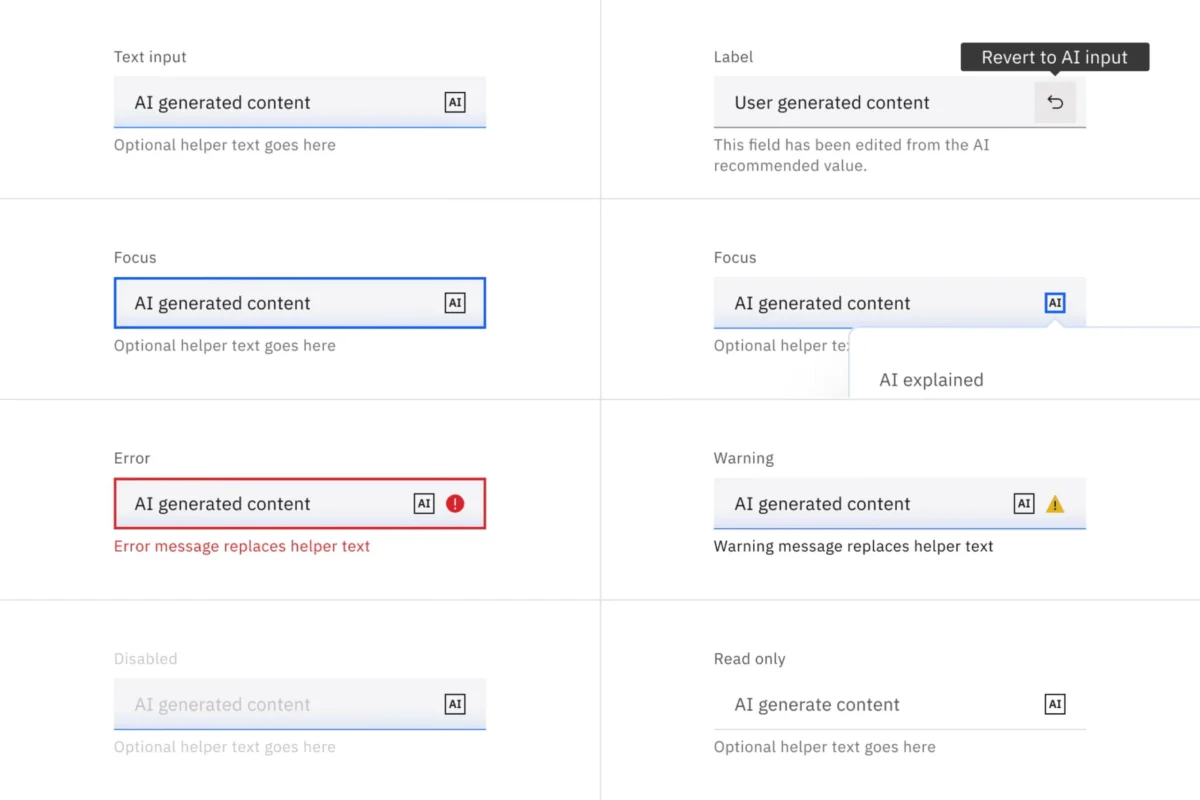
Industry leaders, such as IBM through its Carbon Design System, have already begun developing more robust labeling patterns. These include "explainability panels" that provide users with context on how the AI reached a specific conclusion or what data was used to generate a summary. The transition from "sparkles" to "labels" represents a shift from marketing-driven design to compliance-driven user experience (UX).

Defining the Line: Edited vs. Generated Content
One of the most complex aspects of the new regulation is determining exactly when a piece of content ceases to be "human-led" and becomes "AI-generated." The EU Commission’s guidance differentiates between assistive tools and generative ones. Assistive edits—such as standard spellcheck, grammar correction, basic color grading, or photo cropping—do not trigger the labeling requirement. These are viewed as tools that enhance human output without replacing human editorial responsibility.
In contrast, the following actions are considered "AI generation" and require disclosure:
- Substantive Rewriting: Using AI to transform a bulleted list into a long-form essay.
- Synthetic Imagery: Creating photos or illustrations from text prompts that resemble real-world objects or people.
- Summarization: Automated condensing of documents where the AI selects the most "relevant" points.
- Composite Media: Adding or removing substantive elements from a photograph using generative fill.
A critical nuance in the law is the "human-in-the-loop" exception. If an AI-generated text is reviewed, edited, and verified by a named human editor who takes legal responsibility for the content, the mandatory AI disclosure may be waived. However, the Commission has clarified that a "quick skim" or a cursory glance does not constitute substantive editorial review. There must be an intentional manual intervention that transforms the machine output into a human-sanctioned product.

Financial Risks and the Cost of Non-Compliance
The enforcement mechanism of the EU AI Act is modeled after the General Data Protection Regulation (GDPR), featuring heavy financial penalties designed to deter negligence. For violations of the transparency and labeling rules, companies could face fines up to €15 million or 3% of their total worldwide annual turnover, whichever is higher. For more severe infractions involving prohibited AI practices, fines can reach €35 million or 7% of global turnover.
These penalties are structured to ensure that even the world’s largest technology firms prioritize compliance. Small and medium-sized enterprises (SMEs) and startups are subject to lower caps on administrative fines, but the reputational risk of being labeled "non-compliant" in the EU market remains a significant motivator for all players.
Global Context and the "Brussels Effect"
The EU is not alone in its pursuit of AI transparency. The United States has seen several state-level initiatives, such as Utah’s Artificial Intelligence Policy Act and California’s proposed regulations regarding synthetic media in political campaigns. In Asia, China’s Cyberspace Administration (CAC) has already implemented strict "watermarking" requirements for generative AI services.

The convergence of these global regulations suggests the emergence of a "Brussels Effect," where the EU’s high regulatory standards become the default for global operations. For a multinational corporation, it is often more cost-effective to implement a single, high-standard labeling system across all regions than to maintain a fragmented patchwork of regional interfaces. Consequently, the EU AI Act is expected to dictate the design language of AI globally.
Impact on Industry and Consumer Trust
While some industry groups have expressed concerns that heavy labeling could "stigmatize" AI content and hinder adoption, proponents of the Act argue that transparency is the only way to build long-term consumer trust. In an era of increasing "AI slop"—low-quality, mass-produced synthetic content—clear labeling allows high-quality, human-curated content to stand out.
For designers and product managers, the 2026 deadline necessitates a fundamental rethink of the user interface. Labels must be integrated into dashboards, tables, and form fields in a way that informs the user without creating "notification fatigue." The goal is a digital ecosystem where the provenance of information is clear, reducing the risk of misinformation and deepfake-driven fraud.

Analysis of Broader Implications
The implementation of Article 50 marks the end of the "Wild West" era of generative AI. By mandating disclosure, the EU is forcing a distinction between tool and creator. This will likely lead to a surge in demand for "provenance technology," such as the C2PA (Coalition for Content Provenance and Authenticity) standards, which embed metadata directly into digital files to track their origin.
Furthermore, the requirement for disclosure in "public interest" areas—including health, safety, and politics—will change how pharmaceutical companies, political campaigns, and financial institutions use AI. In these high-stakes sectors, the presence of an "AI-generated" label may serve as a disclaimer, shifting some degree of skepticism back to the consumer and encouraging a more critical evaluation of the information presented.
In conclusion, the EU’s move toward mandatory AI labeling is a pragmatic response to the rapid proliferation of synthetic media. While the transition will require significant technical and design investment, the result will be a more transparent digital environment. As August 2, 2026, approaches, the focus for global companies must shift from the novelty of AI capabilities to the necessity of AI accountability. Those who successfully navigate these rules will not only avoid record-breaking fines but will also position themselves as leaders in the emerging era of ethical and transparent technology.

