
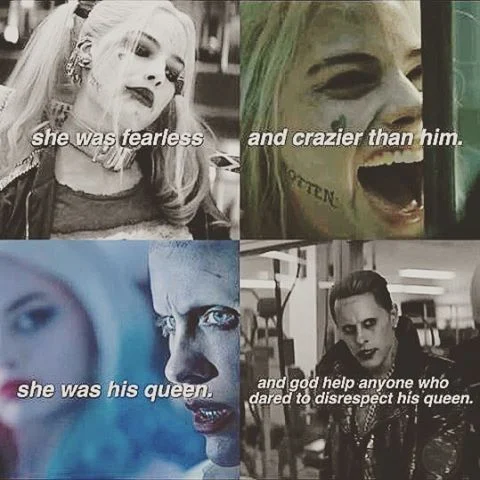
The She Was His Queen internet phenomenon represents a significant case study in how cinematic dialogue, when perceived as overly melodramatic or "edgy," can be repurposed by digital subcultures into a vehicle for satire and social commentary. Originating from the 2016 Warner Bros. Pictures film Suicide Squad, the phrase "She was fearless and crazier than him. She was his queen, and God help anyone who dared to disrespect his queen" has transcended its fictional roots to become a cornerstone of ironic meme culture. What began as an earnest attempt by filmmakers to establish a "ride-or-die" dynamic between the characters of The Joker and Harley Quinn eventually devolved into a widely recognized template for mocking over-sentimentalized or toxic relationship tropes.
Cinematic Origins and the Narrative Context of Suicide Squad
To understand the proliferation of the meme, one must first examine its source material. Suicide Squad, directed by David Ayer and released in August 2016, was a high-profile entry in the DC Extended Universe (DCEU). The film’s marketing campaign leaned heavily into the chaotic, neon-drenched aesthetic of its lead villains, specifically focusing on the relationship between The Joker (played by Jared Leto) and Harley Quinn (played by Margot Robbie).
The specific lines of dialogue are delivered by Amanda Waller, a high-ranking government official portrayed by Viola Davis. During an introductory sequence designed to provide backstory for the various members of Task Force X, Waller narrates the history of Harley Quinn’s descent from a psychiatrist at Arkham Asylum to the Joker’s accomplice. The narration aims to paint their relationship as a dark, epic romance—a "mad love" that exists outside the boundaries of conventional morality.
The full quote—"She was fearless and crazier than him. She was his queen, and God help anyone who dared to disrespect his queen"—was intended to underscore the danger and devotion inherent in their partnership. However, upon the film’s release, critics and audiences alike noted a disconnect between the film’s gritty aspirations and the perceived "cringe-worthy" nature of its dialogue. The hyper-masculine protectionism implied in the phrase "God help anyone who dared to disrespect his queen" struck many as an outdated and melodramatic trope, making it ripe for parody in the burgeoning landscape of social media.

The Chronology of Digital Proliferation
The trajectory of "She Was His Queen" from a movie quote to a viral meme followed a distinct three-stage process: earnest adoption, ironic subversion, and total abstraction.
Phase One: Earnest Adoption (August – September 2016)
Immediately following the film’s premiere, the quote was initially embraced by the "stan" culture on platforms like Instagram, Tumblr, and Pinterest. Fan accounts dedicated to the Joker and Harley Quinn pairing began creating "edits"—images or short video clips featuring the characters overlaid with the text of Waller’s narration. These early iterations were largely sincere, utilizing high-contrast filters and stylized typography to celebrate the characters’ bond. This period established the visual language of the meme: the text was often placed over photos of couples, usually with one partner looking "tough" and the other looking "wild."
Phase Two: The Ironic Pivot (October – December 2016)
By late 2016, the broader internet began to push back against the sincerity of these fan edits. The melodrama of the quote became a target for users who found the "edgy" aesthetic of Suicide Squad to be forced or pretentious. The first wave of parodies involved keeping the original text but replacing the Joker and Harley Quinn with unlikely or humorous pairings.
A pivotal moment in the meme’s history occurred in late August when an Instagram edit featured the text alongside a low-quality, heavily filtered image of a non-celebrity couple. This specific post became a template for what would follow. By December 2016, major digital publications, including New York Magazine’s "Select All" vertical, began documenting the spread of the meme, noting that it had become a shorthand for mocking relationships that try too hard to appear "dangerous" or "unique."
Phase Three: Total Abstraction and Satire (2017 – Present)
In its final form, the meme moved away from human couples entirely. Users began pairing the quote with increasingly absurd subjects, ranging from fictional characters in children’s media to political figures and inanimate objects. The humor derived from the extreme juxtaposition between the "hardcore" sentiment of the text and the mundane or ridiculous nature of the accompanying image.

Analyzing the Visual and Linguistic Mechanics of the Meme
The "She Was His Queen" meme functions through a specific set of linguistic and visual cues. Linguistically, the quote relies on superlative language ("fearless," "crazier") and religious-adjacent threats ("God help anyone"). This type of "tough guy" rhetoric is often associated with adolescent power fantasies, which is why it became such an effective target for irony.
Visually, the memes often mimic the "low-effort" aesthetic of early 2010s social media. Common features include:
- Heavy Compression: Images are often re-saved and re-uploaded so many times that they become pixelated, adding a layer of "deep-fried" irony.
- Watermarks: Multiple overlapping watermarks from various meme pages suggest a history of digital theft and resharing.
- Clashing Fonts: The use of basic fonts like Impact or stylized script fonts that clash with the background image.
One of the most famous examples of this abstraction is the "Jar Jar Binks" version, where the quote is applied to the much-maligned Star Wars character and an equally unlikely partner. Other notable iterations include:
- Political Satire: Using the quote to describe the adversarial relationship between Donald Trump and Hillary Clinton during the 2016 election cycle.
- Animation Mashups: Pairing the text with characters from SpongeBob SquarePants (specifically "Handsome Squidward" and Patrick Star) or Shrek.
- The "Bee Movie" Edit: Applying the text to the relationship between the human protagonist and the bee in the 2007 film Bee Movie, highlighting the absurdity of the "forbidden romance" trope.
Sociological Implications and Audience Reception
The mockery of the "She Was His Queen" line reflects a broader shift in how modern audiences consume media. In the era of the "Post-Ironic" internet, viewers are highly sensitive to "forced" coolness. When a multi-billion dollar franchise attempts to manufacture a "cult" or "edgy" moment, the internet often responds by deconstructing and ridiculing that attempt.
Furthermore, the meme highlights the evolution of the Harley Quinn character herself. In the years following the 2016 Suicide Squad, DC Films shifted the character’s trajectory. The 2020 film Birds of Prey (and the Fantabulous Emancipation of One Harley Quinn) explicitly addressed the toxicity of her relationship with the Joker, effectively "emancipating" her from the very "Queen" status that the 2016 film tried to romanticize. This narrative shift mirrors the public’s own rejection of the "She Was His Queen" sentiment, moving away from the glorification of codependency toward a more nuanced view of the character.

Data and Search Interest Trends
Data from Google Trends indicates that search interest for the phrase "She Was His Queen" peaked in December 2016, coinciding with the peak of the ironic parody phase. While the film was released in August, the "meme-ification" of the dialogue took several months to reach critical mass, suggesting that the internet needed time to process the film’s earnestness before the satirical backlash could fully form.
Geographically, the meme saw its highest engagement in English-speaking territories, particularly the United States, the United Kingdom, and Australia. On platforms like Twitter (now X), the quote continues to resurface periodically as a "caption template," proving the longevity of the joke. Even years after the film’s release, the phrase remains a shorthand for any relationship that appears performatively "crazy" or "intense" on social media.
Broader Impact on Film Marketing
The legacy of the "She Was His Queen" meme has served as a cautionary tale for Hollywood marketing departments. It demonstrates that dialogue intended to be iconic can easily become an object of ridicule if it feels unearned or overly dramatic. Subsequent marketing for DCEU films has notably avoided this brand of hyper-sincere "edginess," opting instead for more self-aware or humor-driven promotion.
The meme also underscores the power of the "bottom-up" cultural critique. In the past, a film’s legacy was largely determined by professional critics and box office returns. Today, a film’s dialogue can be stripped of its context and repurposed by millions of users to create an entirely new cultural meaning. The "She Was His Queen" phenomenon proves that once a line of dialogue is released into the digital wild, the creator loses control over its intent, and the audience—through the medium of the meme—becomes the final arbiter of its significance.
In conclusion, "She Was His Queen" is more than just a joke about a superhero movie; it is a testament to the internet’s ability to identify and satirize the gap between corporate-manufactured "cool" and genuine cultural resonance. By taking a line of dialogue meant to evoke awe and turning it into a punchline, digital communities have created a lasting critique of cinematic melodrama that continues to influence online discourse today.

