
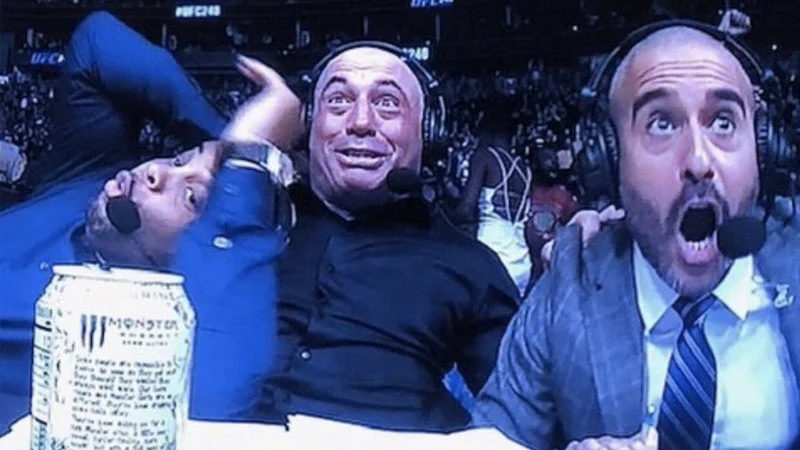
The landscape of digital sports media is frequently punctuated by moments where the intensity of live competition spills over into the broadcast booth, creating cultural artifacts that transcend the sport itself. On March 7, 2020, during the Ultimate Fighting Championship (UFC) 248 event held at the T-Mobile Arena in Las Vegas, Nevada, such a moment occurred. What began as a high-stakes lightweight bout between Beneil Dariush and Drakkar Klose resulted in one of the most recognizable reaction images in contemporary internet culture. The image, featuring commentators Joe Rogan, Daniel Cormier, and Jon Anik in a state of visible, ecstatic shock, has since evolved from a specific sports highlight into a versatile "reaction image macro," utilized by millions to express surprise, excitement, and disbelief across various social media platforms.
The Catalyst: A Technical Knockout at UFC 248
The origins of the meme are rooted in the visceral nature of mixed martial arts (MMA). UFC 248 was a significant event in the promotion’s calendar, headlined by a middleweight title fight between Israel Adesanya and Yoel Romero. However, the preliminary and main card bouts often provide the most explosive highlights. During the lightweight matchup between Beneil Dariush and Drakkar Klose, the momentum shifted violently in the second round.
After a competitive first round, Klose appeared to have Dariush in significant trouble early in the second. However, in a dramatic reversal of fortune, Dariush landed a devastating overhand left that wobbled Klose. Sensing the finish, Dariush pursued Klose across the Octagon, landing a series of heavy shots that culminated in a spectacular knockout at exactly the 1:00 mark of Round 2. The suddenness of the comeback and the sheer power of the finishing blow triggered an immediate and involuntary physical reaction from the three men tasked with narrating the action for the global audience.
The Anatomy of a Viral Reaction
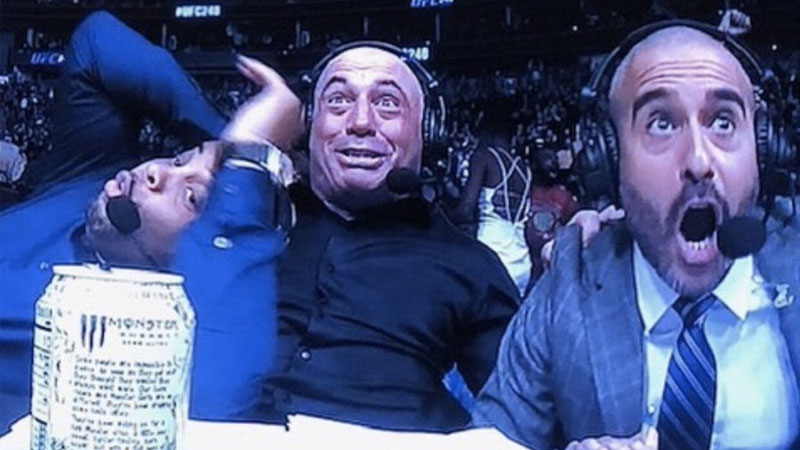
The specific image that became a meme was captured by a dedicated "booth cam," a camera angle the UFC utilizes to show the commentators’ live reactions to significant moments. In the frame, the three men are positioned at their desk. Daniel Cormier, a former two-division UFC champion known for his high-energy personality, is seen nearly falling out of his chair and leaning heavily into Joe Rogan. Rogan, the long-time face of UFC broadcasts, is shown with a wide-mouthed expression of shock, his hands gripping Cormier and Jon Anik to maintain balance. Jon Anik, the lead play-by-play announcer, is captured mid-shout, his face contorted in a mixture of professional duty and fan-like amazement.
The appeal of the image lies in its authenticity. Unlike staged promotional material, the "UFC 248 Reaction" captures a genuine human moment of collective awe. This lack of artifice is a primary driver for viral success in internet meme culture, where users prize relatability and unfiltered emotion.
Chronology of Social Media Proliferation
The transition from a live broadcast moment to a digital meme occurred with remarkable speed, following a clear timeline of distribution across multiple platforms:
Initial Broadcast and Social Media Seeding
Immediately following the knockout on the evening of March 7, 2020, ESPN MMA—the primary broadcast partner for the UFC—shared a video clip of the reaction on its Twitter (now X) account. The post, which highlighted Cormier "falling into Joe Rogan’s lap," served as the initial catalyst, garnering over 800,000 views, 10,000 likes, and 1,800 retweets within the first 72 hours. Simultaneously, YouTuber Thomas MMAvideos uploaded a full-length clip of the reaction, providing a permanent reference point for digital creators.
The Emergence of the Static Image
While the video was popular, the static screenshot provided the necessary "template" for meme creation. Twitter user @iamjohnpollock is credited with sharing one of the earliest high-quality screenshots of the trio at 11:43 PM on the night of the fight. This still image allowed for the addition of text captions, a fundamental requirement for the "image macro" format.
Mainstream Adoption and Influencer Amplification
By the following morning, March 8, 2020, the image had migrated to larger media aggregators. Barstool Sports posted the image on Facebook with a caption comparing the commentators’ shock to watching a "hibachi onion volcano." This post alone generated 29,000 reactions and 20,000 shares, signaling that the image had moved beyond the niche MMA community into the broader public consciousness.
The commentators themselves contributed to the momentum. Jon Anik posted the screenshot to his Instagram account, describing himself and his colleagues as "professional fans." Joe Rogan subsequently shared Anik’s post with his massive following, resulting in over 430,000 likes and further cementing the image’s status as a cultural milestone.
The Evolution of the Image into a Universal Meme
The versatility of the Joe Rogan, Daniel Cormier, and Jon Anik reaction image stems from its ability to represent any scenario involving extreme excitement or a successful outcome against the odds. Over the subsequent years, several distinct categories of the meme have emerged:
- Relatable Everyday Excitement: Memes often use the image to describe mundane but satisfying moments, such as "my dogs when I walk in the house at the same time of day I always do" or the aforementioned "hibachi volcano" reference.
- Niche Cultural References: The image has been adapted for specific subcultures, such as "1700s mfs when sea shanties start playing" or references to Rogan’s well-known interest in psychedelic experiences (e.g., "This DMT ain’t s— / 20 seconds later").
- Sports and Competitive Success: It remains a staple for reacting to other sports highlights, representing the "the boys’ reaction" when a friend or teammate achieves something unexpected.
Commentator Chemistry and the "Reaction Economy" in Sports Media
The success of this meme also highlights a shift in how sports are consumed and marketed. The "reaction economy"—where the viewer’s experience is mediated through the visible emotions of the commentators—has become a central pillar of sports broadcasting. The UFC, in particular, has leaned into the personalities of Rogan, Cormier, and Anik. Their chemistry is built on years of shared experience and a genuine passion for the sport, which translates into the high-octane reactions that the camera seeks to capture.
By publicizing these reactions, the UFC and ESPN create a feedback loop that enhances the perceived "must-see" nature of their events. The UFC 248 reaction serves as a form of organic marketing; even those who did not watch the fight are exposed to the brand through the meme, associating the UFC with peak excitement and unforgettable moments.
Statistical Reach and Digital Footprint
While exact cumulative metrics across all platforms are difficult to calculate due to the decentralized nature of meme sharing, the "UFC 248 Reaction" maintains a significant digital footprint:
- GIPHY Integration: The moment was quickly converted into a GIF by GIPHY Sports, where it remains a top-tier result for search terms like "shock," "excited," and "UFC."
- Instagram Engagement: High-profile meme accounts like @shitheadsteve and @trashcanpaul have utilized the template, with individual posts frequently exceeding 100,000 to 150,000 likes.
- Longevity: Unlike many viral trends that disappear within weeks, this reaction image has remained in active use for years, appearing in "Best of" meme compilations and maintaining steady search interest during major sporting events.
Broader Implications for Sports Broadcasting
The Joe Rogan, Daniel Cormier, and Jon Anik reaction image represents a convergence of professional sports broadcasting and internet-native communication. It illustrates how a single second of "dead air" or "off-camera" action can become more valuable than the actual event it was meant to describe.
From a journalistic and analytical perspective, the meme underscores the importance of human element in sports. In an era of increasing automation and data-driven analysis, the raw, unscripted joy of three experts losing their professional composure reminds the audience why they watch: for the thrill of the unexpected. The image has become a permanent part of the UFC’s legacy, serving as a visual shorthand for the "Dariush vs. Klose" fight and a testament to the enduring power of a perfectly timed reaction.
As digital culture continues to evolve, the UFC 248 reaction stands as a premier example of how sports moments are no longer confined to the arena or the highlight reel; they are woven into the very fabric of how people communicate emotion in the 21st century.

