
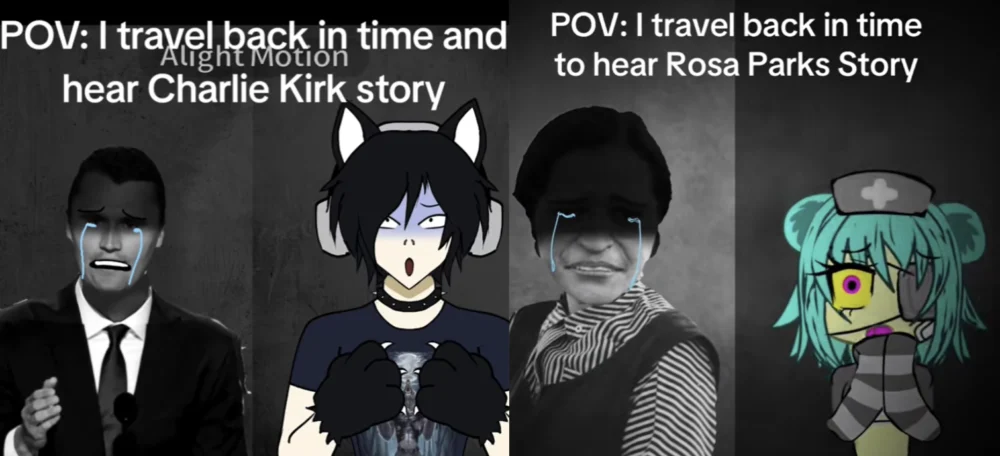
The digital landscape of early 2026 has been significantly shaped by a burgeoning subgenre of short-form video content known as the POV: I Travel Back In Time To Hear X Story animation trend. This phenomenon, which emerged primarily on the social media platform TikTok, represents a complex intersection of original character (OC) fan culture, historical dramatization, and absurdist internet humor. Characterized by its use of mobile-based motion design software and a distinct auditory signature, the trend has evolved from a sincere, albeit controversial, form of digital storytelling into a vehicle for high-velocity satire and "brain rot" aesthetic commentary.
At its core, the meme utilizes a recurring phrasal template where a user’s original character—a personalized avatar often reflecting the creator’s artistic style or persona—is depicted traveling through time to witness or console a historical figure, celebrity, or fictional character during a moment of profound emotional distress. These videos are typically produced using Alight Motion, a motion design application popular among younger creators for its accessible "tweening" and visual effects capabilities. The resulting aesthetic is often defined by smooth, digital movements, heavy use of "crying" filters or hand-drawn tears, and a somber, cinematic atmosphere that borders on the melodramatic.
The Rosa Parks Catalyst and the Origin of the Format
The genesis of the trend can be traced back to February 21, 2026, when TikTok user @knoxxsnipes uploaded an animated sequence featuring their original character standing alongside a weeping depiction of civil rights icon Rosa Parks. The video was captioned with the text, "POV: I travel back in time to hear Rosa Parks Story," and featured a slowed-down, ethereal version of the song "Parade" by Japanese composer Susumu Hirasawa. The track, originally composed for Satoshi Kon’s 2006 surrealist anime film Paprika, provided a haunting, march-like backdrop that intensified the video’s emotional register.
The original post by @knoxxsnipes garnered significant traction, accumulating over 936,900 views and 58,500 likes within a two-week window. While the creator intended the video as a tribute—evident in the caption "Happy birthday month Rosa Parks… Gone but never forgotten"—it inadvertently sparked a massive wave of secondary content. The juxtaposition of a stylized, modern "OC" with a figure of monumental historical trauma struck many viewers as jarring, leading to a divide between those who appreciated the artistic effort and those who viewed the format as inherently "cringe-worthy" or performative.
Musical Significance and Technical Execution
The choice of Susumu Hirasawa’s "Parade" is a critical component of the trend’s identity. In the context of the film Paprika, the song accompanies a literal parade of inanimate objects and delusions that signify the collapse of reality and the subconscious. By slowing the track and applying a reverb effect, TikTok creators transformed a frantic, maximalist anthem into a melancholic ballad. This auditory shift is a hallmark of "Slowed + Reverb" culture, which often seeks to extract nostalgia or sadness from otherwise upbeat compositions.
Technically, the "POV: I Travel Back In Time" videos rely heavily on the Alight Motion ecosystem. This app allows creators to manipulate vector graphics and bitmaps with keyframe animation, enabling a specific style of "tweening" where character limbs and facial features move with a fluid, elastic quality. This specific visual language is synonymous with the "Gacha" and "Animation Meme" communities, which have long used such tools to express complex internal narratives. The adoption of this style for historical or political subjects marked a significant shift in how these tools were utilized by the broader TikTok user base.
Chronology of Proliferation and Subcultural Diversification
Following the initial Rosa Parks video, the trend underwent a rapid transformation between late February and early March 2026. This period can be categorized into three distinct phases of evolution:
-
The Sincere Expansion (February 22–24, 2026): Other animators began adopting the format to depict interactions with various historical figures or personal inspirations. During this phase, the videos remained largely earnest, focusing on themes of empathy and time-traveling companionship.
-
The "Brain Rot" Subversion (February 25–26, 2026): The trend was quickly intercepted by creators who specialize in "brain rot" content—a term used to describe hyper-edited, chaotic, and nonsensical videos designed to overwhelm the viewer’s senses. Users such as @yourlocalguardreal began posting "bait-and-switch" edits. These videos would begin with the somber Rosa Parks animation only to be violently interrupted by loud, distorted music and memes such as "Tung Tung Tung Sahur" or "Evan Burger." This subversion served as a critique of the original format’s perceived sentimentality.
-
The Satirical and Political Pivot (February 27 – March 5, 2026): As the format became a recognized "exploitable," creators began using it to make pointed political or social statements. On February 27, user @alexanemic posted a version featuring Israeli Prime Minister Benjamin Netanyahu with the caption "POV: You travel back in time to hear Israel’s story." This video, which received over 535,000 views, signaled the transition of the meme into a tool for geopolitical commentary and dark humor.
Analytical Perspective: The Psychology of the OC Interaction
Sociologists and digital culture analysts have noted that the "POV: I Travel Back In Time" trend reflects a modern phenomenon known as the "Savior Complex" in digital storytelling. By placing a personalized original character into a scene of historical suffering, the creator is positioning themselves (or their digital proxy) as a witness to trauma. This can be interpreted as a form of parasocial empathy, where the user attempts to bridge the gap between the present and the past through artistic intervention.
However, the backlash and subsequent parodies highlight a growing exhaustion with "main character syndrome" on social media. The satirical versions of the meme—featuring figures like Charlie Kirk or YouTube personality IdkSterling—mock the idea that an animated avatar could provide meaningful comfort to complex figures. This tension between sincerity and irony is a defining characteristic of Gen Z and Gen Alpha internet culture, where the "Great Meme Reset" often involves the aggressive deconstruction of any trend that appears too earnest or "niche."
Broader Impact and Industry Implications
The trend has also had a measurable impact on the visibility of mobile animation software. Alight Motion and similar apps have seen a spike in search interest as users attempt to replicate the specific "tweening" style seen in the viral clips. This democratization of animation tools allows for a rapid turnover of visual trends, where a single creator’s aesthetic choice can become a global standard within forty-eight hours.
Furthermore, the trend has revitalized interest in the works of Susumu Hirasawa and the film Paprika. While the director Satoshi Kon passed away in 2010, his visual and auditory legacy continues to be reinterpreted by a generation that was not yet born when his films were released. This "digital haunting," where older media is repurposed for new, often unrelated contexts, is a recurring theme in the lifecycle of TikTok trends.
Summary of Cultural Reception
The reception of the "POV: I Travel Back In Time To Hear X Story" trend remains polarized. Within the animation community, it is viewed as a testament to the power of accessible creative tools. In the broader meme landscape, it is frequently cited as an example of the "cringe" inherent in OC culture. Despite these conflicting views, the trend’s reach is undeniable. By combining historical themes with modern animation techniques and a surrealist soundtrack, it has created a unique, if controversial, digital artifact.
As of March 2026, the trend continues to mutate. Newer iterations have moved away from historical figures entirely, focusing instead on "meta-commentary" where characters travel back in time to witness the creation of the meme itself. This recursive loop suggests that while the specific subjects of the "stories" may change, the underlying desire to insert oneself into a narrative—whether through sincerity or satire—remains a powerful driving force in contemporary social media.
Timeline of Key Events
- February 21, 2026: @knoxxsnipes posts the original Rosa Parks animation, establishing the visual and musical template.
- February 25, 2026: The "Brain Rot" transition begins with @yourlocalguardreal’s high-intensity edit, signaling a shift toward irony.
- February 27, 2026: Satirical political versions emerge, most notably the Benjamin Netanyahu parody by @alexanemic.
- March 1, 2026: The trend reaches peak saturation with variations featuring political commentators and internet celebrities, such as the Charlie Kirk animation by @bootybandit495.
- March 5, 2026: The format is widely recognized as an "exploitable" template, with "redrawn" parodies becoming the dominant form of the meme.
This trajectory illustrates the lifecycle of a modern viral phenomenon: from a sincere creative spark to a widely mocked trope, and finally to a versatile tool for social and political expression. The "POV: I Travel Back In Time" trend stands as a significant case study in how animation, music, and historical memory intersect in the age of the algorithm.

