
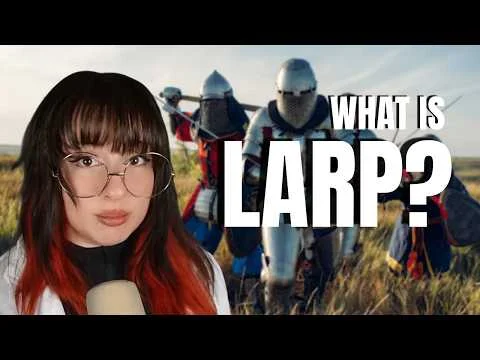
The linguistic journey of the term LARP—an acronym for Live Action Role Playing—represents a significant case study in how niche subcultural terminologies are co-opted, redefined, and weaponized within the broader digital landscape. Originally used to describe a dedicated hobby involving physical portrayals of fictional characters in real-world settings, the term has undergone a radical transformation. As of July 17, 2026, data compiled by digital culture researchers and platforms such as Know Your Meme indicates that "LARPing" has transcended its hobbyist roots to become a dominant pejorative in internet slang, used primarily to accuse individuals of inauthenticity, performative activism, or the adoption of false personas for social or political capital.
The July 2026 Documentation and the Frankie Fey Analysis
On July 17, 2026, digital historian Zach Sweat documented a pivotal moment in the term’s lifecycle following the release of a comprehensive video analysis by cultural commentator Frankie Fey. The video, hosted on YouTube, provided a granular breakdown of how the word "LARP" shifted from a noun describing an activity to a verb describing a social transgression. While the initial engagement metrics recorded shortly after the video’s publication showed modest numbers, the content served as a definitive record of the slang’s maturity.
Fey’s analysis highlighted that by mid-2026, the term had been almost entirely "bleached" of its original meaning in general discourse. In the 1990s and 2000s, LARP referred specifically to participants engaging in structured games like Vampire: The Masquerade or Dungeons & Dragons-inspired outdoor combat. By the mid-2020s, however, the term was more likely to be found in the comments sections of political forums or social media threads, directed at users who project a radicalized or highly specific identity that does not align with their actual daily life or socioeconomic reality.
Historical Foundations: From Theatricality to Digital Insult
To understand the current status of LARP as a slang term, one must examine its origins in the late 20th century. Live Action Role Playing emerged from the broader tabletop gaming movement of the 1970s. Unlike traditional gaming, LARPing required physical movement, costumes, and real-time interaction, often leading to it being stigmatized by mainstream society as an "extreme" or "nerdy" pursuit.
The transition of the term into the digital vernacular began in the early 2010s on imageboards such as 4chan and later on Reddit. In these spaces, users began to notice a trend: individuals who would adopt extreme ideological stances—often involving fringe political movements, survivalism, or "trad" (traditionalist) lifestyles—without ever taking tangible action in the physical world. These individuals were viewed as "playing a role" in a digital theater. By 2016, "political LARPing" became a common accusation, used to dismiss those who advocated for revolution or radical societal change from the safety of their keyboards.
Chronology of Semantic Evolution
The timeline of the term’s evolution can be categorized into four distinct phases:
- The Subcultural Phase (1977–2005): The term is strictly used within the gaming community. It carries a niche, often misunderstood status but remains a literal description of a hobby.
- The Incubation Phase (2006–2014): As internet culture begins to centralize, "LARP" is used occasionally in digital spaces to mock people who take fictional lore too seriously. The first hints of its use as a metaphor for "faking it" begin to appear in fringe forums.
- The Politicization Phase (2015–2021): The term sees a massive spike in usage during global political upheavals. It is used to describe "keyboard warriors" on both the left and right wings of the political spectrum. It becomes a shorthand for "stolen valor" in the realm of ideological commitment.
- The Universalization Phase (2022–2026): LARP becomes a standard part of the Gen Z and Gen Alpha lexicon. It is applied to lifestyle influencers, "aesthetic" creators, and corporate entities. The July 2026 reporting by Zach Sweat marks the peak of this integration, where the term is analyzed as a fundamental component of modern English slang.
Supporting Data and Usage Metrics
Data from digital linguistics studies conducted between 2024 and 2026 show that the word "LARP" has seen a 400% increase in usage across platforms like X (formerly Twitter), TikTok, and Discord compared to the previous decade. Interestingly, the data suggests that only 12% of the mentions of the word in 2026 refer to the actual hobby of live-action role-playing.
The remaining 88% of usage is categorized as "metaphorical" or "pejorative." Within this category:
- 45% of usages are related to political accusations (e.g., "Revolutionary LARPing").
- 30% are related to lifestyle and "aesthetic" criticism (e.g., "Trad-wife LARPing" or "Wealth LARPing").
- 13% are related to corporate or institutional performativity (e.g., "Sustainability LARPing").
These metrics indicate that the term has become a primary tool for the "authenticity police" of the internet, providing a concise way to challenge the validity of an individual’s online persona.
The Role of "Political LARPing" in Modern Discourse
One of the most significant implications of the term’s evolution is its role in political discourse. In his report, Zach Sweat notes that "LARP" has become a "term of art" for identifying perceived hypocrisy. For instance, an individual who posts extensively about agrarian self-sufficiency while living in a high-rise urban apartment and working in digital marketing is frequently accused of "homestead LARPing."
This usage reflects a broader societal anxiety regarding the "hyper-real." As digital identities become more curated and disconnected from physical reality, the term LARP serves as a linguistic anchor, reminding participants that there is a distinction between a displayed identity and a lived one. However, critics of the term’s usage argue that it is often used to silence legitimate discourse or to dismiss people who are in the early stages of adopting new beliefs or lifestyles.
Official Responses and Community Reactions
The response from the actual LARPing community—those who still participate in organized role-playing events—has been mixed. Organizations like the International LARP Society have issued statements in the past noting that while the slang usage has brought the word into the mainstream, it has also reinforced negative stereotypes about role-players being "fake" or "delusional."
Conversely, some hobbyists have embraced the term’s new popularity. In interviews conducted in early 2026, several event organizers noted that the visibility of the word has actually led to a "reverse-interest" effect, where individuals who first heard the word as an insult became curious about the original hobby and eventually joined local chapters.
From a linguistic perspective, professors of digital communication have noted that "LARP" follows the pattern of other gaming terms that have entered the mainstream, such as "NPC" (Non-Player Character) or "level up." These terms allow users to apply the logic of gaming and simulation to the complexities of real-world social interaction.
Broader Impact and Sociological Implications
The rise of "LARP" as a slang term signifies a shift in how authenticity is measured in the 21st century. In previous generations, "poser" was the primary term used to describe someone who faked an interest in a subculture (usually music-related, like punk or skate culture). "LARP" is a more sophisticated evolution of "poser" because it implies not just a lack of knowledge, but a full-scale, theatrical performance of an identity.
Sociologists argue that the prevalence of this term suggests a growing cynicism toward online expression. In an era of deepfakes, AI-generated content, and highly manufactured social media "vibes," calling something a "LARP" is an attempt to strip away the artifice. It is a demand for "skin in the game"—a requirement that one’s online proclamations be backed by physical-world consequences or actions.
As we move further into 2026, the term continues to adapt. The Frankie Fey analysis suggests that we may soon see "LARP" used in even more abstract ways, perhaps describing the perceived inauthenticity of artificial intelligence or the performative nature of modern diplomacy.
Conclusion: The Future of the Term
The July 17, 2026, documentation of the "LARP" meme and slang highlights the speed at which language evolves in the digital age. What was once a specific label for a small group of enthusiasts in the 1970s has become a universal shorthand for the anxieties of the 2020s. Whether the term will maintain its current bite or eventually fade into the graveyard of "cringe" internet slang remains to be seen. However, its current status as a vital tool for navigating the blurred lines between the digital and the physical ensures its relevance in the immediate future. The work of researchers like Zach Sweat and commentators like Frankie Fey remains essential in tracking these shifts, providing a historical record of how we talk, how we insult one another, and ultimately, how we define what is "real" in an increasingly simulated world.

