
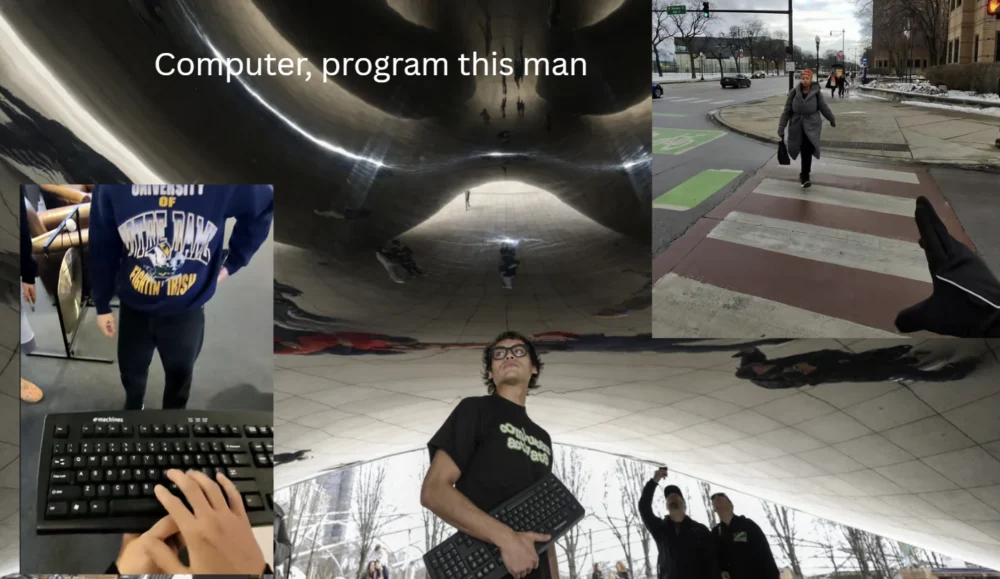
The digital landscape of early 2026 has been significantly reshaped by a singular, surrealist comedic trend originating on the streets of Chicago. Known colloquially as the "Computer Guy" or "Computa Guy" phenomenon, the series of viral videos features TikTok creator Julius Mondragon, operating under the handle @okjuskiii, utilizing wearable technology to superimpose a "command-line" logic onto real-world social interactions. By delivering deadpan, pseudo-programming instructions to unsuspecting strangers—often prefaced with the iconic vocalization "Computa"—Mondragon has successfully bridged the gap between niche internet subcultures and mainstream social media fame.
The trend is defined by its unique first-person perspective, captured via Ray-Ban Camera Glasses. This technological choice is central to the meme’s efficacy; the point-of-view (POV) footage creates an immersive experience for the viewer, effectively placing them behind the eyes of a "programmer" who treats the physical world as a manipulatable software environment. As of March 2026, the "Computer, Turn X into Y" format has evolved from a series of experimental pranks into a globally recognized meme template, influencing dozens of imitators and sparking discussions regarding the ethics and aesthetics of modern street performance.
The Chronology of a Digital Phenomenon
The "Computer Guy" saga began in relative obscurity. On January 10, 2026, Julius Mondragon posted his inaugural video in this specific format. In the clip, Mondragon approached a stranger in downtown Chicago and announced, "Computer, activate CBT," a reference to a long-standing and provocative internet subculture meme. This initial foray into the format did not immediately achieve viral status, garnering approximately 19,000 views and fewer than 1,000 likes within its first two months. Despite the low engagement, the foundational elements were present: the first-person perspective, the "Computer" invocation, and the deadpan delivery of a technical command to a non-technical subject.
The turning point occurred on January 19, 2026, when Mondragon shifted his focus to a supermarket setting. In this video, he directed his "computer" to "turn various customers gay," a provocative and surreal command that leveraged shock humor and the absurdity of treating human orientation as a toggleable software setting. This video acted as a catalyst, amassing over 621,900 views and 118,200 likes in rapid succession. It established the "Computa" catchphrase as a linguistic hallmark of his content and signaled the beginning of a meteoric rise in his follower count.
Following this success, Mondragon’s output became more frequent and diverse in its "programming" objectives. On January 20, 2026, he moved his operations to a local cafe. This installment saw a notable shift in tone; rather than purely provocative commands, Mondragon employed more whimsical instructions such as "activate rapid-fire typing" and "computer, activate intense focus session" while observing patrons working on laptops. The video resonated deeply with the platform’s algorithm, generating 2.9 million views and 430,000 likes.
By late January, the "Computer Guy" had become a fixture of the Chicago urban landscape. On January 22, he posted a video involving a more aggressive form of surrealist humor, asking his computer to "dematerialize this man’s balls." This video exceeded 3.5 million views, proving that the audience’s appetite for his specific brand of "admin-mode" comedy was not yet satiated. The climax of this initial viral wave arrived on January 26, 2026, when Mondragon filmed a segment on a Chicago commuter train. Directing his commands toward a bald rider and other passengers, he called for "infinite joy programming" and "hair follicle reactivation." This video achieved 4.4 million views, cementing his status as a premiere content creator for 2026.
Technological Integration and Aesthetic Appeal
A critical component of the "Computer Guy" trend is the hardware utilized. The Ray-Ban Meta Camera Glasses allow Mondragon to maintain a naturalistic presence while filming. Unlike traditional pranks that involve a visible camera person or a handheld smartphone—both of which signal to the target that they are being recorded—the wearable glasses allow for a "stealth" approach. This heightens the authenticity of the strangers’ reactions, which range from genuine confusion and mild irritation to occasional amusement.
From a stylistic perspective, the videos mimic the interface of a head-up display (HUD) without the need for post-production graphics. The "programming" is done entirely through Mondragon’s voice, turning his speech into the primary user interface. This reflects a broader cultural fascination with augmented reality (AR) and the "gamification" of daily life. By speaking as if he has administrative privileges over reality, Mondragon taps into a collective digital fantasy: the ability to edit the world around us as easily as a line of code.
Statistical Analysis and Audience Engagement
The growth of @okjuskiii is a case study in exponential engagement. In the span of less than sixty days, his primary videos moved from five-figure view counts to multi-million-view sensations. Data suggests that the "wholesome" or "positive" commands—such as those wishing joy or success upon strangers—often outperform the more aggressive "trolling" videos in terms of shareability and long-term engagement.
According to internal TikTok metrics and third-party social analytics, the "Computer Guy" videos possess an unusually high "completion rate," meaning viewers are likely to watch the entire clip rather than scrolling past. This is attributed to the suspense inherent in the format: the viewer waits to see how the stranger will react to being "programmed." Furthermore, the comment sections of these videos have become a breeding ground for community-driven lore, with users suggesting new "commands" for Mondragon to execute in future installments.
Local Recognition and the Chicago Tribune Profile
As Mondragon’s digital footprint expanded, his physical presence in Chicago began to elicit a unique social response. He transitioned from an anonymous prankster to what journalist Christopher Borrelli of the Chicago Tribune described as a modern "urban legend." In a profile piece published in early 2026, Borrelli noted that Chicagoans had begun to recognize the "Computer Guy" on sight, with some residents actively avoiding him to escape being the subject of his next viral "script."
In his interview with the Tribune, Mondragon offered insight into the psychological evolution of his content. He acknowledged that while his earlier videos relied on "rage-baiting" and "trolling" (standard tactics in the prank genre), he discovered that "joy-based" content had a more profound impact. "The joy-based [videos] do better," Mondragon stated. "People like them more, I think, as corny as that sounds." This pivot toward a more benevolent "Programmer" persona helped insulate him from the backlash typically directed at street pranksters who harass the public for views.
Broad Social Impact and Imitation
The success of the "Computer, Turn X into Y" format has inevitably led to a wave of "copycat" content. By March 2026, the trend had transcended Mondragon’s original account. Other creators began adopting the "Computa" vocal fry and the HUD-style filming technique. One notable example is TikTok user @urmomsajoe69, who posted a video on March 8, 2026, utilizing the format in a college setting. His video, which commanded the computer to "turn random straight guys super gay for each other," garnered over 255,000 views in 24 hours, demonstrating the format’s durability and its appeal to diverse demographics.
The trend has also influenced the lexicon of Gen Z and Gen Alpha. The word "Computa," delivered with Mondragon’s specific inflection, has become a shorthand for any situation where a person wishes they could exert control over an inconvenient reality. Whether used ironically in a classroom or as a genuine command to an AI assistant, the phrase has entered the digital zeitgeist.
Ethical Considerations and Future Outlook
The rise of the "Computer Guy" is not without its critics. As with any street-based content, questions regarding consent and privacy are frequently raised. While Mondragon’s "commands" are verbal and do not involve physical contact, the act of filming strangers in public spaces for commercial or social gain remains a point of contention. Some legal experts suggest that the use of wearable cameras like Ray-Ban Metas may lead to stricter regulations regarding "surveillance-style" content creation in the future.
However, as of the first quarter of 2026, the trend shows no signs of decelerating. Julius Mondragon has successfully carved out a niche that blends high-tech aesthetics with low-brow humor, creating a format that is as addictive as it is absurd. The "Computer Guy" phenomenon serves as a precursor to a future where the lines between our digital identities and our physical presence are increasingly blurred. Whether he is "activating infinite joy" or "dematerializing" metaphorical obstacles, Mondragon has proven that in the age of the algorithm, the person who holds the "command line" holds the attention of the world.
As the "Computer Guy" continues to iterate on his "programming," the tech community and social media analysts alike are watching closely. The trend represents more than just a series of pranks; it is a reflection of a society increasingly comfortable with—and perhaps even expectant of—the integration of computing logic into the fabric of everyday human life. For now, the streets of Chicago remain the primary server for this ongoing experiment in viral sociology.

