
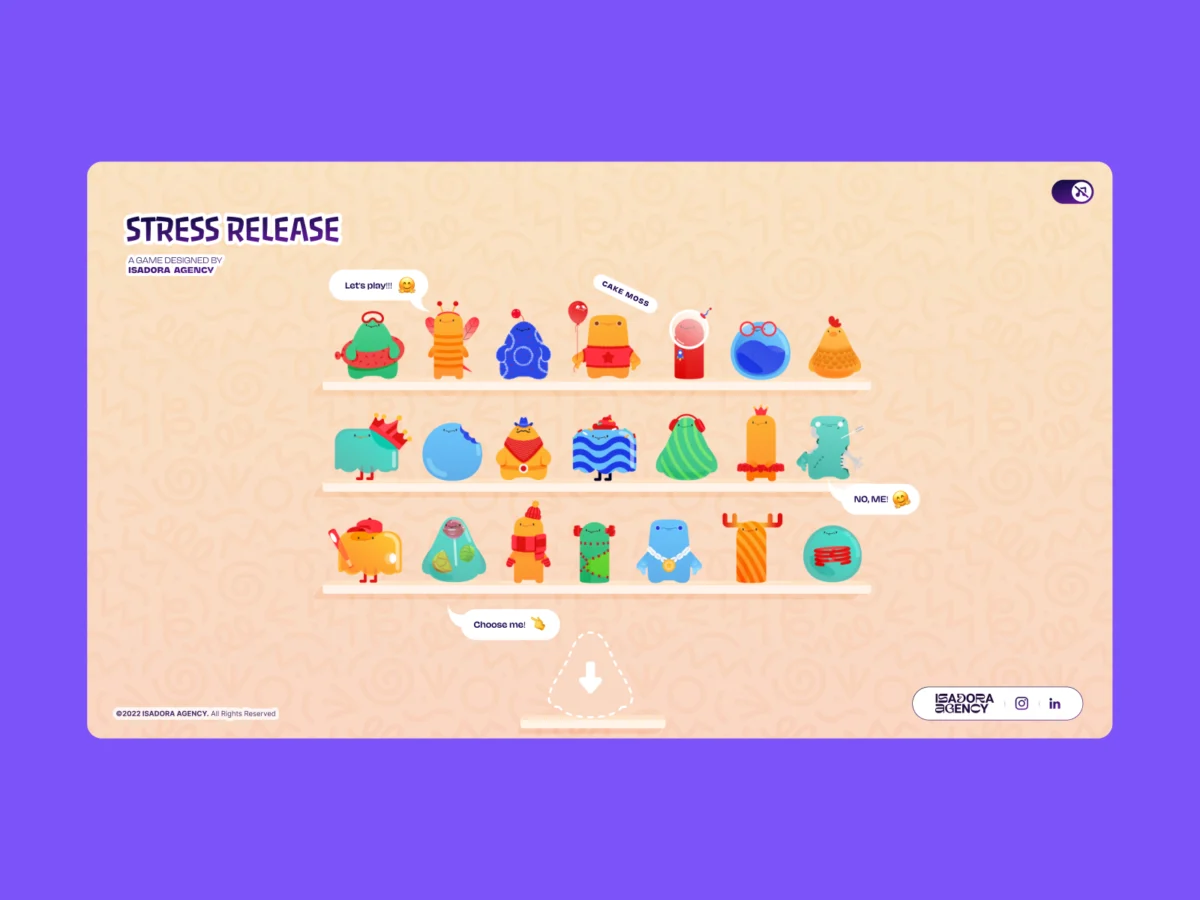
Building Tactile Web Experiences by Prioritizing Intentional Motion Over Physics Engines represents a significant shift in how front-end developers approach interactive web design, moving away from the unpredictability of physics simulations toward the absolute control of frame-based animation. When the development team at Isadora Agency was commissioned to create "Stress Release," a digital stress-relief game, they faced a fundamental architectural choice: utilize industry-standard physics engines or develop a custom framework that honored the specific, frame-by-frame intentions of their design team. Led by developer Alexey Kopytin, the team ultimately rejected traditional tools like Matter.js and Cannon.js, opting instead for a system built on Lottie animations, DOM events, and distance-based mathematics. This approach allowed the agency to maintain "intentional motion"—a philosophy where every bounce, squish, and explosion is meticulously crafted by an artist rather than approximated by an algorithm.
The Shift from Physics-Based Simulation to Deterministic Animation
In the contemporary web development landscape, creating a "tactile" feel usually necessitates the use of a physics engine. These engines, such as Matter.js for 2D or Cannon.js for 3D, simulate real-world forces like gravity, friction, and elasticity. While effective for creating plausible environments where objects interact randomly, they often struggle to replicate the highly stylized, exaggerated "squash and stretch" techniques used in traditional animation.
For "Stress Release," the primary objective was to provide a satisfying, responsive experience for users—primarily burnt-out creatives—looking to "smash" and "distort" digital characters. During the initial prototyping phase, the Isadora Agency team discovered that physics engines produced motion that was realistic but lacked the personality and specific timing required by the art direction. The animators had designed complex sequences, such as a "mega squeeze" that required exactly 181 frames of build-up before a specific release. A physics engine would have recalculated these movements on the fly, potentially leading to visual glitches or a "mushy" feel that deviated from the original creative vision.
By pivoting to a deterministic model, the team ensured that every interaction triggered a specific segment of a Lottie JSON file. This transition highlights a growing trend in high-end UX engineering: the prioritization of "absolute deterministic control" over emergent behavior. In this model, the code serves as a trigger mechanism for the art, rather than the primary driver of the motion itself.
Technical Implementation: The Mechanics of Radial Input Mapping
To achieve a tactile sensation without a physics engine, the team implemented a system of radial input mapping. This process involves converting a user’s click or tap into a coordinate space relative to the interactive character. By using the Pythagorean theorem, the system calculates the distance from the center of the character to the point of impact.
The mathematical foundation of this system is remarkably lean. The character’s center point is established within its own coordinate space, and the click position is calculated relative to the character’s top-left corner. The distance is then derived using the formula Math.hypot(a, b), where ‘a’ and ‘b’ represent the vectors from the center to the click point. This single numerical value—the distance—becomes the primary data point for the entire interaction.
This distance-based logic drives several simultaneous reactions:

- Scoring Accuracy: The system uses a concentric zone model, similar to a dartboard. A click within 10 pixels of the center yields maximum points, while increasing distances result in lower point rewards.
- Feedback Intensity: The distance determines which animation segment is triggered, allowing for "light," "medium," or "heavy" reactions based on where the character was hit.
- Visual Alignment: To maintain the illusion of physical impact, the "explosion" animation—a separate Lottie file—is programmatically repositioned to the exact coordinates of the click.
This method bypasses the need for complex hitboxes or collision detection libraries. Because the Lottie animations are rendered as SVGs within the DOM, the team could manipulate them using standard CSS and JavaScript, keeping the technical overhead low while maintaining high visual fidelity.
Chronology of Development: From Concept to Optimization
The development of "Stress Release" followed a non-linear path that reflects the challenges of modern web-based gamification.
Phase 1: Conceptualization and Art Direction. The project began with the creation of 21 unique characters, each with its own personality and movement profile. Animators utilized Adobe After Effects to create high-fidelity vector animations, which were then exported as JSON files via the Bodymovin plugin.
Phase 2: The Physics Engine Prototype. Early in development, the team attempted to integrate these animations with a physics engine to handle character movement and collisions. However, the "plausible motion" generated by the engine conflicted with the "intentional motion" of the animations. The team found that the engine often "fought" the animation keyframes, leading to a loss of the tactile "snap" they desired.

Phase 3: The Architectural Pivot. Realizing the limitations of the physics engine, the team scrapped the initial build and moved toward a DOM-centric architecture. They developed a state-management system that mapped specific frame ranges within the Lottie files to user actions. For example, an "idle" state might loop frames 0 through 40, while a "squeeze" reaction would trigger frames 41 through 80.
Phase 4: Mobile Optimization and Performance Tuning. As the project neared completion, the team faced the challenge of loading 21 heavy JSON files simultaneously. This led to the implementation of "aggressive optimization," where quality and frame rates were dynamically adjusted based on the user’s current view.
Supporting Data: Performance and Optimization Metrics
The decision to use Lottie and the DOM rather than WebGL or a dedicated game engine like Phaser.js introduced specific performance considerations. Lottie JSON files, while more efficient than traditional video formats, can still be substantial in size.
To maintain a fluid 60 frames-per-second (FPS) experience, the team implemented two primary performance tiers:

- The Shelf View: On the character selection screen, 21 animations play simultaneously. To prevent CPU spikes, particularly on mobile devices, the team lowered the Lottie quality setting to 0.5 (50%) and reduced the playback speed to 0.6 (60%). This reduced the number of interpolation calculations the browser had to perform per second.
- The Play View: When a user selects a single character, the system shifts resources. The selected character is rendered at 1.0 (100%) quality, ensuring the highest possible visual clarity during the primary interaction phase.
Furthermore, the team leveraged CSS custom properties (variables) to handle responsive resizing. By recalculating --doc-height and --doc-width on every window resize event, the SVG-based characters could scale fluidly without losing their animation state or requiring a re-render of the coordinate system. This approach significantly reduced the complexity of building a cross-platform experience, as the "hit detection" math remained consistent regardless of screen size.
Official Responses and Strategic Rationale
Alexey Kopytin, the lead developer on the project, emphasized that the choice of technology must always serve the art direction. "Physics engines produce plausible motion, but in our case, the animators produced intentional motion," Kopytin stated. This distinction is vital for agencies like Isadora, where the brand experience is tied to the specific "feel" of the UI.
The agency’s rationale was rooted in the need for "absolute deterministic control." In a game designed for stress relief, the feedback loop (click-squish-score) must be instantaneous and perfectly aligned. By using Lottie’s native API to jump to specific frame segments, the team eliminated the "latency of calculation" that can sometimes occur when a physics engine is processing complex collisions.
Industry analysts have noted that this "low-code, high-math" approach is becoming more attractive as browsers become more capable of handling complex SVG manipulations. By avoiding the "black box" of a physics engine, developers can more easily debug interactions and ensure a consistent experience across the fragmented landscape of mobile and desktop browsers.

Broader Impact and Implications for Web Development
The success of "Stress Release" serves as a case study for the "less is more" philosophy in web architecture. While the industry often gravitates toward the most powerful tools available—such as WebGL or advanced physics libraries—this project demonstrates that traditional DOM manipulation combined with clever mathematics can often yield superior results for specific use cases.
The implications for the broader web development community are three-fold:
- The Rise of the "Anim-Engineer": There is an increasing demand for developers who understand both the technical constraints of the browser and the principles of classical animation. The ability to programmatically control timelines (as seen with Lottie) is becoming as important as the ability to write efficient CSS.
- Performance as a Design Constraint: The project highlights that performance optimization is not just a post-production task but a core part of the architectural decision-making process. Choosing Lottie necessitated a specific strategy for resource management that influenced the final UI.
- The Value of Determinism: As web interfaces become more "game-like," the need for predictable, repeatable interactions grows. Deterministic systems allow for better synchronization between visual effects, sound design, and scoring logic.
In conclusion, the development of "Stress Release" by Isadora Agency underscores a vital lesson for modern UX design: the most advanced technology is not always the best technology. By honoring the "intentional motion" of their designers and relying on the fundamental strengths of the DOM and basic geometry, the team created a tactile, satisfying experience that remains lightweight and responsive. This approach paves the way for a new generation of interactive web experiences that prioritize art direction and user feedback over raw simulation.

