
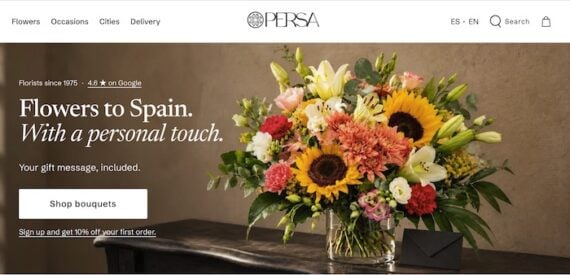
A family-owned florist in Spain, Persa Flores, has experienced a significant surge in online revenue, directly attributing a substantial portion of its sales to customers discovered through ChatGPT. This unexpected growth, detailed in a recent company report, highlights a burgeoning trend in e-commerce and raises critical questions about how businesses track and understand traffic originating from artificial intelligence platforms. The findings offer a stark contrast to earlier reports that presented mixed results on AI’s impact on e-commerce traffic, suggesting that precise attribution methods are key to unlocking its true potential.
The revelation comes from José Pérez Sánchez, who manages online operations for Persa Flores. Prompted by articles published in October and April concerning AI shopping metrics and e-commerce traffic, Sánchez began meticulously analyzing his company’s sales data. His investigation revealed a compelling statistic: since September 2026, one in every five online orders placed with Persa Flores originated from a customer who first found the business via ChatGPT. This level of direct referral was previously undetectable through conventional analytics, underscoring the challenge many businesses face in accurately measuring the impact of AI-driven discovery.
The Elusive Referrer: Unmasking AI Traffic
The primary hurdle in identifying AI-generated sales lies in the nature of how these interactions are logged by e-commerce platforms. Sánchez explained that while platforms like Shopify meticulously record a customer’s journey, including their first and last visits before a purchase, the source of these visits is not always straightforward. Key data points typically include the referring site, the landing page URL, and the date of interaction. However, AI platforms often do not pass this information in a way that traditional analytics tools can easily interpret.
"For every order, Shopify records the customer’s first and last visit before buying: where they came from, the referring site, the landing page with its full URL, and the date," Sánchez elaborated in an email. "We count an order as ChatGPT when either [the first or last] visit came from ChatGPT or OpenAI."
Crucially, Sánchez discovered that these AI-referred customers often arrive via a direct link tagged with utm_source=chatgpt.com. This tag, added by ChatGPT itself, is a vital clue. However, he noted that only about one in eight of these orders also listed ChatGPT as the explicit referrer in the HTTP header data. This discrepancy means that businesses relying solely on referrer data would significantly underestimate or completely miss the true volume of traffic and sales originating from AI.
The term "referrer" itself can be a source of confusion. Technically, it refers to the URL of the previous webpage a user visited before landing on the current site. Web browsers transmit this information in HTTP headers, which are then read by analytics software. However, several factors can prevent this data from being captured. These include browser privacy settings, website security policies, or even a protocol downgrade from HTTPS to HTTP. When referrers are not passed or are blocked, analytics tools often classify such traffic as "direct" or "unknown," effectively obscuring its origin. In Persa Flores’ case, this meant that a substantial portion of their ChatGPT-driven traffic was previously being miscategorized.
A Flourishing New Channel: Quantifying AI’s Impact
Once Persa Flores developed a more robust method for attribution, the significance of ChatGPT as a sales channel became undeniably clear. The data revealed a consistent and rapid upward trajectory in both order volume and revenue originating from the AI platform.

In July 2026, ChatGPT accounted for just 4% of the florist’s online orders and 2% of its online revenue. By August, these figures had climbed to 12% of orders and 11% of revenue. The growth accelerated dramatically in September, with ChatGPT contributing 21% of online orders and 18% of revenue. By the end of October 2026, through the 27th, this share had further increased to 23% of orders and an impressive 26% of revenue.
The cumulative data for the period from July to October 2026 paints an even more compelling picture. Across these four months, ChatGPT was responsible for an average of 16% of all online orders and 15% of online revenue. A focused look at the September-October period shows a strong convergence, with ChatGPT contributing 22% of both orders and revenue, indicating a stabilizing yet highly significant presence.
While Sánchez did not disclose the absolute number of orders, he confirmed that the overall e-commerce business at Persa Flores was also expanding during this period. This means that ChatGPT was not merely cannibalizing existing sales but was actively driving incremental growth within an already growing market.
The findings were publicly shared by Persa Flores on their company website in late October 2026, providing a transparent look at their AI-driven success. Notably, the majority of this growth occurred before the company began implementing specific optimization strategies for its presence on ChatGPT. Sánchez revealed that deliberate efforts to improve their visibility on the platform were only initiated in mid-October, after the substantial increase in AI-referred sales had already been observed. This suggests that organic discovery through ChatGPT can be a powerful, albeit initially opaque, driver of business.
Deeper Dive: The Customer Journey Through AI
Beyond simply identifying the source of traffic, Persa Flores also conducted an in-depth analysis of the behavior of these AI-generated customers. The findings offered valuable insights into the purchasing patterns and demographics of this new customer segment.
A striking observation was that every single customer whose order was attributed to ChatGPT was a first-time buyer. According to Shopify’s data, there were no previous orders associated with the email addresses or accounts of these individuals. This indicates that ChatGPT is effectively acting as a powerful customer acquisition tool, bringing entirely new patrons to the business.
Furthermore, the purchasing timeline was remarkably swift. Most of these new customers placed an order within 24 hours of their initial recorded visit via ChatGPT. This suggests a high level of intent and immediate satisfaction with the offerings discovered through the AI.
Interestingly, approximately half of these customers made their purchases from outside of Spain, with the primary intention of sending flowers to recipients within the country. This highlights ChatGPT’s global reach and its utility as a tool for cross-border gift-giving.
While the average order value for ChatGPT-referred customers was comparable to that of other online orders, Sánchez noted a limitation in their current analytics. The company does not yet track conversion rates by source with sufficient precision to directly compare ChatGPT against established channels like Google Search. However, the qualitative data—that these are new customers and that they are purchasing with high intent—provides a clear picture of ChatGPT’s value. This order-level data offers a more concrete understanding of ChatGPT’s impact than traffic reports alone, revealing not just who is visiting, but who is converting and why.
The Power of Targeted Landing Pages
A particularly insightful discovery from Persa Flores’ analysis was the landing page behavior of ChatGPT-referred customers. Sánchez reported that a significant 84% of these customers first arrived on a "city page," a stark contrast to the approximately one-third of customers from Google who land on similar pages.
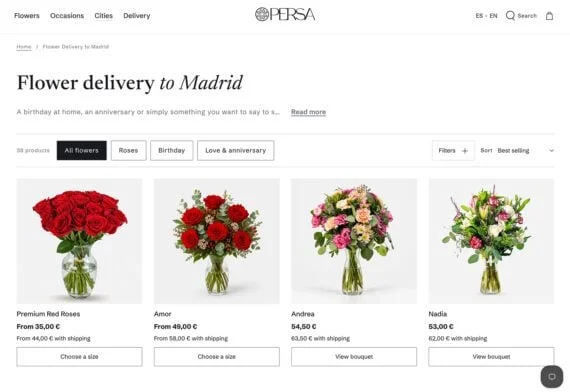
Persa Flores has long utilized a strategy of creating dedicated city-specific pages on their website. These pages, available in both Spanish and English, are designed to provide localized information about sending flowers to specific Spanish cities, such as Marbella, Madrid, Alicante, A Coruña, Gijón, and Segovia. Each page details who Persa Flores is, showcases available bouquets, and clearly displays delivery prices for that particular location.
Sánchez theorizes that this targeted approach is highly effective when interacting with ChatGPT. "When someone asks ChatGPT how to send flowers to a particular town, a page dedicated to exactly that is an easy answer to give," he explained. This suggests that ChatGPT’s algorithms are adept at matching user queries with highly specific and relevant content.
This strategy is not novel in the realm of search engine optimization (SEO). For years, digital marketers have leveraged location- or intent-specific landing pages to more closely align with user search queries than broader category or homepage links. The innovation here lies in the intermediary: ChatGPT appears to be exceptionally good at connecting a user’s granular request to the precise landing page that fulfills it.
Crucially, Persa Flores did not create these city pages with ChatGPT in mind. They were already part of the company’s established SEO strategy, implemented well before the recent surge in AI-driven traffic. This observation strongly implies that foundational SEO practices, such as creating well-structured, informative, and keyword-optimized landing pages, can significantly boost a business’s visibility and performance within AI-powered discovery engines. The implication is that traditional SEO principles are not becoming obsolete but are evolving to encompass new digital landscapes.
The Future of AI Attribution
The experience of Persa Flores underscores a critical challenge for businesses navigating the evolving digital marketing landscape: the need for sophisticated attribution models to accurately measure the impact of AI. For many, AI-driven product discovery and sales can easily be missed if they are solely reliant on traditional traffic reporting methods.
The ability of platforms like ChatGPT to generate direct customer acquisition, as demonstrated by Persa Flores, necessitates a deeper dive into customer journeys. This involves looking beyond simple referrer data to understand the complete path to purchase, from initial AI interaction to final sale. As AI continues to integrate into consumer search and discovery habits, businesses will need to invest in analytics tools and methodologies that can capture and interpret these new data streams. The success of Persa Flores suggests that a proactive approach to understanding and leveraging AI, coupled with a commitment to robust data analysis, can lead to significant and unexpected business growth in the burgeoning era of artificial intelligence commerce. The florist’s blooming revenue serves as a potent case study for merchants worldwide, highlighting the immense, and often hidden, potential of AI as a direct sales channel.

