
Early indicators from Adobe’s comprehensive "AI Traffic Trends Report" for August 2026 suggest a significant potential for artificial intelligence to tackle one of e-commerce’s most persistent and costly challenges: product returns. While the finding is embedded within a broader analysis of digital retail trends, the implications for profitability and customer satisfaction are substantial, pointing towards a future where AI-driven shopping experiences lead to fewer unwanted purchases and a more efficient online marketplace.
The report, a deep dive into over a trillion visits to U.S. retail websites and encompassing 100 million stock-keeping units (SKUs), also incorporated survey data from 5,000 U.S. consumers conducted in July 2026. This dual approach, combining quantitative website analytics with qualitative consumer sentiment, provides a robust foundation for understanding the evolving landscape of online retail. The specific insight regarding returns, though occupying a relatively concise section of the 59-page document, highlights a pivotal shift in consumer behavior and merchant opportunity.
The Data: Reduced Returns and Increased Confidence
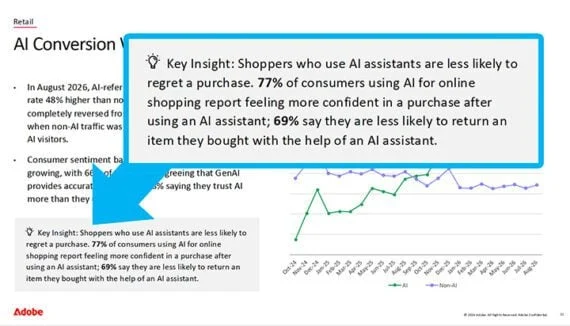
The core of Adobe’s finding rests on the reported experiences of consumers who have engaged with AI for their online shopping endeavors. According to the survey, a compelling 69% of these AI-assisted shoppers indicated they were less likely to return an item purchased with AI’s guidance. This statistic directly addresses the financial drain of product returns, which encompasses shipping costs, restocking fees, and lost sales opportunities.
Complementing this, a significant 77% of respondents who utilized AI assistants expressed increased confidence in their purchasing decisions. This heightened assurance suggests that AI is effectively bridging the information gap that often leads to buyer’s remorse and subsequent returns. When consumers feel more certain about a product’s suitability for their needs, the likelihood of keeping that product naturally rises.
How AI Transforms the Shopping Journey
The transformative power of AI in this context stems from its ability to streamline and enhance the pre-purchase research phase. Historically, consumers would dedicate considerable time to comparing products across multiple e-commerce platforms. This involved scrutinizing features, dimensions, compatibility with existing items, reading through a deluge of reviews, and meticulously comparing prices. This iterative process, while thorough, was often time-consuming and could still leave room for error or unmet expectations.
In the current e-commerce environment of 2026, AI assistants are increasingly capable of performing this extensive research autonomously. By leveraging virtual web browsers and sophisticated data analysis, these AI tools can visit numerous e-commerce sites, gather pertinent information, and synthesize it into concise recommendations. This pre-filtering process means that when a consumer is directed to a specific merchant’s website, they often arrive with a clearer understanding of the product and a higher degree of certainty about its fit for their requirements.
A pertinent example of this evolving AI capability is Meta’s Muse. This AI-powered assistant can independently navigate dozens of e-commerce sites, effectively acting as a digital personal shopper. By the time Muse recommends a product, the consumer, through the AI’s preliminary research, has already narrowed down their options and potentially resolved any initial uncertainties. This sophisticated level of pre-qualification is a direct contributor to the observed reduction in return intentions.
The Impact on Conversion and Revenue
The implications of AI-driven pre-qualification extend beyond just reducing returns; they also translate into tangible improvements in merchant performance. Adobe’s data reveals that in July 2026, retail website visitors referred by AI platforms demonstrated a 60% higher conversion rate compared to non-AI-referred traffic. Furthermore, these AI-referred consumers generated 53% more revenue per visit.
This surge in both conversion and revenue per visit can be attributed to several factors. Firstly, AI-referred shoppers are more qualified, meaning they are more likely to make a purchase once they arrive at the site. Secondly, their increased confidence, fostered by AI-driven research, reduces hesitation and encourages them to complete the transaction. Finally, the AI’s ability to match specific consumer needs with suitable products can lead to higher-value purchases, contributing to the increased revenue per visit.
The Crucial Role of Product Information
For e-commerce merchants, the insights from Adobe’s report underscore a critical imperative: the quality and comprehensiveness of product information are paramount. The effectiveness of AI shopping assistants is directly proportional to the accuracy and detail of the data they can access. To enable AI to accurately assess a product’s suitability for a shopper, merchants must provide extensive and well-organized information.

This includes detailed specifications, precise dimensions, clear compatibility details (e.g., with other devices or systems), information on available variants (color, size, material), accurate delivery estimates, customer reviews, frequently asked questions (FAQs), and comparative data against similar products. When this information is readily available and accurately presented, AI assistants can perform their diagnostic and recommendation functions with a much higher degree of precision.
The potential benefit for merchants is twofold: not only can they secure a sale through a more informed recommendation, but they can also significantly reduce the likelihood of that sale resulting in a return. This creates a virtuous cycle where better product data fuels more effective AI, leading to more satisfied customers and a more profitable e-commerce operation.
A Look at the Timeline and Evolution
The integration of AI into e-commerce is not a sudden phenomenon but rather an accelerating trend. While sophisticated AI assistants capable of complex research are becoming more prevalent in 2026, their development has been building for years. Early iterations focused on chatbots for customer service and basic recommendation engines. However, advancements in natural language processing, machine learning, and web scraping technologies have enabled the current generation of AI to perform much more nuanced and comprehensive tasks.
The "AI Traffic Trends Report" itself represents a snapshot of this evolving landscape. Released in August 2026, it reflects data collected throughout the preceding months, providing a contemporary view of AI’s impact. The survey data, gathered in July 2026, offers direct consumer feedback on their experiences with AI-assisted shopping. This timely release allows industry stakeholders to gauge the immediate effects of AI adoption and to plan for future strategies.
Expert Reactions and Industry Implications
While specific direct quotes from Adobe representatives or industry leaders regarding this particular finding are not detailed in the initial report, the implications are clear and resonate across the e-commerce sector. Industry analysts and retail technology providers have long anticipated AI’s potential to optimize the online shopping experience. The Adobe report provides concrete data to support these predictions.
The ability of AI to reduce returns has significant financial ramifications. According to various industry studies, the cost of product returns in e-commerce can range from 20% to 40% of the original sale price, encompassing shipping, handling, and potential markdown of returned goods. A substantial reduction in this figure could translate into millions, if not billions, of dollars in increased profitability for online retailers.
Furthermore, a decrease in returns contributes to greater sustainability in e-commerce. Fewer returned items mean less transportation-related carbon emissions and reduced waste from damaged or unsellable goods. This aligns with growing consumer demand for environmentally responsible business practices.
Broader Impact on Consumer Trust and Merchant Strategy
The shift towards AI-assisted shopping and its corollary of reduced returns is likely to reshape consumer trust and merchant strategies. As consumers experience the benefits of more confident purchasing decisions and fewer hassles with returns, their reliance on AI tools is expected to grow. This, in turn, will incentivize more merchants to invest in AI integration and to prioritize the quality of their product data.
Merchants who fail to adapt may find themselves at a competitive disadvantage. Retailers who can effectively leverage AI to guide consumers towards the right purchases will likely see improved customer satisfaction, increased loyalty, and a healthier bottom line. Conversely, those with inadequate product information or a reluctance to embrace AI-driven tools may struggle to retain customers and manage the escalating costs associated with high return rates.
The Adobe report serves as a critical signal, indicating that the future of e-commerce is intrinsically linked to the intelligent application of AI. The promise of fewer returns is not merely a cost-saving measure; it is a fundamental step towards a more efficient, customer-centric, and sustainable online retail ecosystem. The data suggests that the era of AI-powered, confident purchasing is not just on the horizon; it is actively shaping the present landscape of online commerce.

