
The burgeoning field of Artificial Intelligence (AI) search visibility is presenting marketers with a new frontier, yet current tracking tools are falling short, offering metrics that are easily manipulated and fail to reflect genuine consumer search behavior. Tools like Profound and Peec AI, designed to monitor how frequently businesses appear in AI responses to specific prompts, are highlighting a critical disconnect between what these tools measure and what truly drives consumer engagement. The fundamental flaw lies in the methodology: visibility scores are heavily reliant on pre-defined prompts, which can be intentionally crafted to include a business’s name, thereby artificially inflating its appearance rate and skewing the perceived success.
The Illusion of AI Visibility: Prompt Dependency and Manipulation
At the core of the issue is the inherent dependency of AI visibility metrics on the prompts used for tracking. Tools such as Profound and Peec AI operate by analyzing AI-generated responses to a set of queries. Businesses are then assigned visibility scores based on their presence within these responses. However, a significant vulnerability has emerged: agencies and businesses are reportedly manipulating these scores by designing prompts that explicitly mention their brand. For instance, if a prompt is phrased as "What are the best SEO tools, including Semrush?", Semrush is guaranteed to appear in the response. This artificial inclusion can lead to a perceived 100% visibility for that specific prompt, drastically elevating the overall average score without reflecting organic consumer interest.
This approach mirrors early SEO strategies that focused on keyword stuffing and on-page optimization without a deep understanding of user intent. In the context of AI, it suggests a superficial engagement with the technology, prioritizing a high score over genuine connection with potential customers. Experts argue that more meaningful metrics are required, ones that genuinely reflect the search queries that real consumers would enter when seeking information, products, or services. The current system, therefore, risks leading businesses down a path of misguided optimization, investing resources in strategies that create an illusion of prominence rather than fostering authentic discoverability.
Shifting the Focus: From Citations to Consumer Intent

The prevailing marketing focus on achieving high citation rates within AI responses is being called into question. While appearing in numerous AI-generated answers might seem like a victory, the dynamic and often unpredictable nature of these citations presents a challenge. The same prompt, even from the same user, can yield different results across various AI platforms and even from one instance to the next. This variability makes strategies solely built on maximizing citation frequency a precarious endeavor.
A more robust and actionable approach, as suggested by industry analysis, involves analyzing domains that are consistently cited across a diverse range of generative AI platforms. This broader perspective allows for a more strategic focus on:
- Most Cited Domains: Instead of chasing every possible citation, marketers can identify the domains that consistently emerge as authoritative sources across multiple AI systems. This helps in understanding which content and platforms are gaining traction within the AI ecosystem.
- Competitor Citations and Content Gaps: AI tracking tools can offer insights into competitor strategies and identify content gaps that businesses are failing to address. By examining which competitors are frequently cited for relevant queries and analyzing their on-site content, businesses can identify areas where they can improve their own offerings to better meet consumer needs. For example, if a competitor’s "how-to" guide on a specific topic is consistently retrieved by AI, it signals an opportunity for a business to create a similar or superior resource.
- Understanding "Invisible" vs. "Visible" Citations: A crucial distinction is emerging between citations that merely link to a page without naming the source ("invisible citations") and those that explicitly mention the brand ("visible citations"). Data suggests that invisible citations generate significantly less traffic, indicating that consumers are less likely to engage with them. Visible citations, on the other hand, appear to have a greater influence on purchasing decisions, making them the primary target for AI optimization efforts.
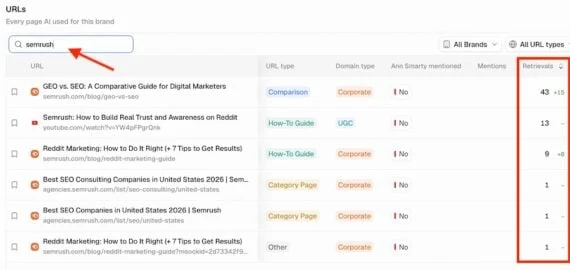
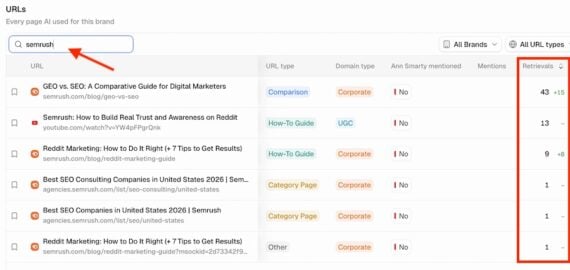
The Peec AI screenshot provided illustrates this point effectively. It displays a report filtering citations for "semrush," revealing a table of retrieved pages. Columns detail the URL, its type (e.g., Comparison, How-To Guide), domain type, whether a specific AI expert mentioned it, the number of mentions, and retrievals. The highlighted "Retrievals" column shows that a "GEO vs. SEO comparison guide" had 43 retrievals, an increase of 15. This granular data allows marketers to understand not just if they are being cited, but how and in what context, and critically, how often their content is being accessed by AI.
The Strategic Imperative of Branded Prompts
The ultimate goal of AI visibility optimization should be to ensure that a business’s unique value proposition and offerings are effectively communicated to consumers through AI. This necessitates a strategic approach centered on "branded prompts." These are queries specifically designed to elicit information about a particular business. By analyzing how AI platforms respond to branded prompts, businesses can gain a critical understanding of their own AI discoverability and the clarity of their messaging.
When crafting and analyzing responses to branded prompts, marketers should look for several key indicators:
- Detailed and Up-to-Date Information: Do the AI responses provide comprehensive and current details about the business, its products, services, and unique selling points?
- Accuracy of Information: Is the information presented factually correct and aligned with the business’s actual offerings?
- Relevance to Consumer Needs: Does the AI articulate how the business can solve potential customer problems or fulfill their needs?
- Clarity of Brand Messaging: Is the business’s core message and identity conveyed effectively through the AI’s output?
By systematically testing branded prompts and evaluating the AI’s responses, businesses can identify areas where their information might be outdated, incomplete, or unclear. This proactive approach allows for the refinement of website content, knowledge bases, and other data sources that AI platforms rely on to generate their answers. The aim is to equip AI with the most accurate and persuasive information about the business, thereby enabling it to serve as an effective digital ambassador.
Implications for the Future of Digital Marketing
The current landscape of AI visibility tracking signals a critical juncture for digital marketers. The initial enthusiasm for readily available AI tracking tools is being tempered by the realization that superficial metrics can be misleading. As AI continues to evolve and integrate further into consumer search habits, the demand for more sophisticated and user-centric measurement will only grow.
Businesses that prioritize genuine consumer intent, focus on creating valuable and informative content, and strategically leverage branded prompts will be best positioned to succeed in this new era. The implications extend beyond mere search rankings; they touch upon brand reputation, customer acquisition, and the very way businesses will be discovered and engaged with in the digital realm.
Furthermore, the distinction between "invisible" and "visible" citations highlights the importance of direct brand recognition. While AI may aggregate information from various sources, consumers often seek clear attribution and direct engagement with brands they trust. Therefore, optimizing for mention-based visibility, where the brand is explicitly named and associated with its offerings, is likely to yield more tangible results in terms of driving purchasing decisions.
The evolution of AI visibility tracking is not just a technical challenge; it’s a strategic imperative. It demands a shift in mindset from simply appearing in AI responses to ensuring that businesses appear in AI responses in a way that is meaningful, accurate, and ultimately, beneficial to both the consumer and the business. The ongoing development and refinement of these tracking methodologies will be crucial in guiding marketers toward truly effective AI-driven strategies. As AI becomes more ingrained in our daily information-gathering processes, the ability to accurately measure and optimize a business’s presence within these intelligent systems will become an indispensable component of any successful digital marketing strategy.

