
The global technology industry has entered a period of what design experts call conversational tunnel vision, a phenomenon where the rapid advancement of Large Language Models (LLMs) has led to the default adoption of chat-based interfaces for nearly every artificial intelligence capability. While LLMs are inherently trained on dialogue data, making the chat bubble a familiar home for AI, industry leaders are beginning to warn that this reliance on text-based interaction often ignores the fundamental principles of user experience (UX) design. Great UX is defined by matching interaction modalities to a user’s specific context, intent, and cognitive load, ensuring the interface adapts to the human rather than forcing the human to accommodate the machine.
As generative AI integrates into everything from enterprise resource planning to consumer travel apps, the limitations of the "do-it-all chatbot" are becoming increasingly apparent. Professional UX and product teams are now being urged to move beyond the chat box and adopt a more intentional approach to modalities—the sensory ways a person interacts with a system, including seeing, hearing, touching, speaking, and typing. The shift represents a move toward "ambient" and "contextual" AI, where the system understands the physical and psychological state of the user to provide the most efficient path to a goal.
The Problem of Conversational Tunnel Vision
The allure of the chatbot from a product development standpoint is its status as a "blank slate." It suggests a system capable of handling any query. However, experts argue that a text-heavy interface often imposes a high "adaptation load" on the user. This load represents the psychological tax paid when a person must alter their natural thought processes to suit the limitations of a computer.
When an interface relies solely on conversation, it creates a dual burden: a linguistic challenge for input and a cognitive challenge for output. For input, a blank text box often leads to choice paralysis. Unlike traditional graphical user interfaces (GUIs), which use buttons and menus to signal available actions, a chat box requires the user to remember specific phrasing or technical terms to achieve a desired result. For output, text is a serial medium, meaning the human brain must process it word by word to extract meaning. In high-stakes environments, such as medical diagnostics or financial trading, this sequential reading is significantly slower and more error-prone than parallel processing—the ability to spot patterns in a visual chart or dashboard in a fraction of a second.
Historical Chronology: From Command Lines to Ambient AI
The evolution of human-computer interaction provides a necessary context for the current AI design crisis. Understanding how we arrived at the "chat-first" era explains why the industry must now pivot toward multi-modality.
- 1970s–1980s: Command Line Interfaces (CLI). Users interacted with computers via text commands. This required high technical literacy and total recall of syntax, similar to the "prompt engineering" required by today’s LLMs.
- 1980s–1990s: The Rise of the GUI. The introduction of the mouse, windows, icons, and menus allowed users to recognize actions rather than recall them. This lowered the barrier to entry for computing globally.
- 2000s–2010s: Touch and Mobile. Interaction moved from peripherals to direct manipulation on screens. Modality became tied to physical gestures, allowing for "eyes-busy" interactions on the go.
- 2020–Present: The LLM Boom. The success of ChatGPT and similar models brought conversation back to the forefront. However, the industry reflexively applied the "chat" format to all use cases, even those better suited for visual or haptic feedback.
- The Future: Adaptive Multi-Modality. The emerging standard involves AI systems that switch between voice, text, and visual dashboards based on the user’s environment and the complexity of the task.
The Cognitive Spectrum of Modality
To better understand why chat is often the wrong tool, designers use the "Cognitive Spectrum," which maps mental effort against interaction methods. On the low-effort, "ambient" end of the spectrum are push notifications and audio alerts—information that can be processed at a glance or while the user is performing another task. On the high-effort end are multi-modal creative tasks and complex data analysis, which require deep focus and high-density visual displays.
In a real-world scenario, a traveler rushing through a loud airport terminal exemplifies the failure of conversational tunnel vision. If a gate change occurs, a traveler carrying luggage and coffee needs "glanceable" information—a large, high-contrast gate number. If the AI assistant instead provides a dense paragraph explaining weather patterns and places the gate number at the bottom of a chat response, the interface has failed the user’s cognitive and physical load. The input required physical dexterity the traveler lacked (typing while walking), and the output demanded a level of reading focus they could not spare.

The Task Audit: A Framework for Evidence-Based Design
To combat the default to chatbots, UX practitioners are adopting a rigorous "Task Audit" framework. This process moves design teams away from assumptions and toward evidence-based decisions by gathering data on the physical, social, and cognitive context of a task. The audit typically focuses on four key areas:
- Physical Constraints: Is the user’s movement restricted? Are their hands busy (e.g., a technician on a ladder)? Are their eyes occupied (e.g., a driver)?
- Environmental Factors: Is the setting loud? Is there significant screen glare? Is the environment sterile, requiring gesture-based interaction?
- Cognitive Load: Is the user under high stress? Is the task a routine check or a complex analysis requiring high fidelity?
- Social Context: Is the user in a public space where voice input would be inappropriate? Is the information sensitive?
Research methods such as contextual inquiry—observing users in their natural workspace—have become essential. Observation often reveals "hidden work," such as workarounds users have created to deal with poor interfaces, which they might forget to mention in a standard interview.
Case Study: High-Voltage Grid Maintenance
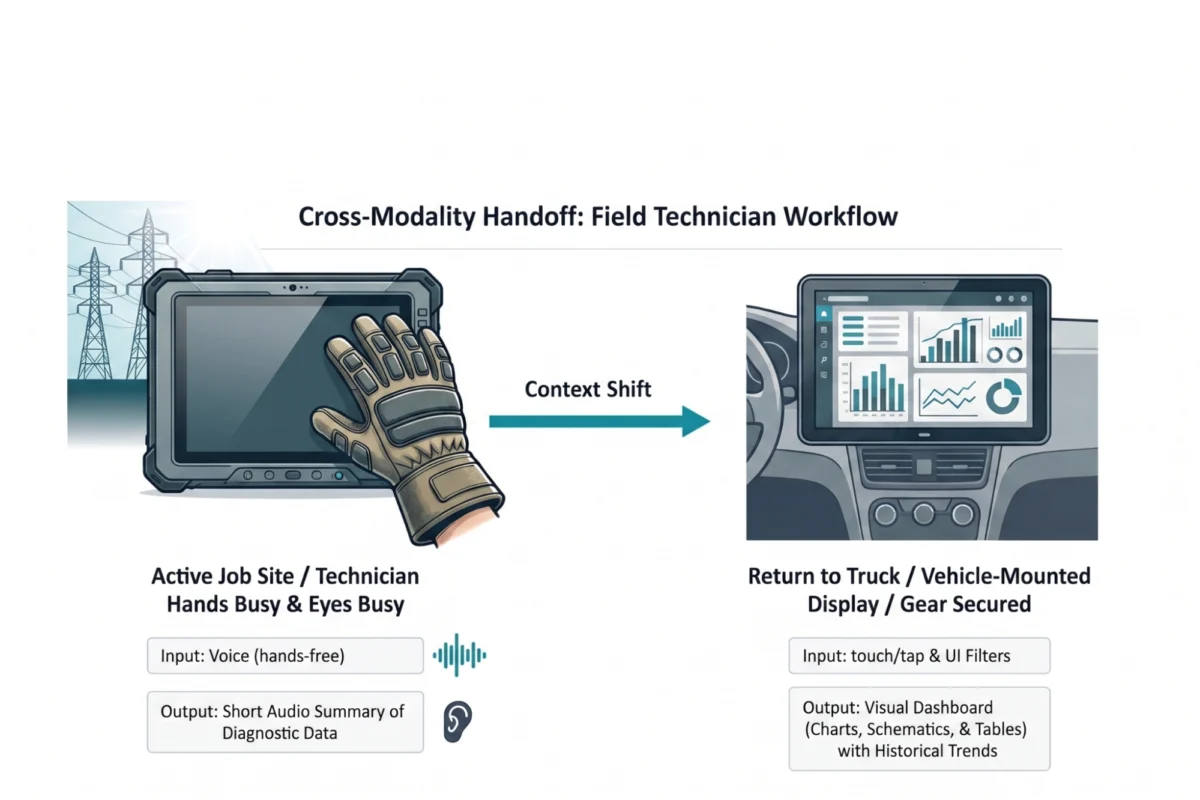
The practical application of multi-modal design is best seen in high-risk industrial environments. Field technicians servicing high-voltage electrical grids face extreme physical and cognitive constraints. Traditionally, these workers relied on ruggedized tablets for diagnostic reports. However, wearing thick protective gloves and working at heights in bucket trucks makes touchscreens nearly impossible to use. Furthermore, screen glare from direct sunlight often washes out text-heavy reports.
A Task Audit conducted for a national utility provider led to a radical redesign of the AI interface. Instead of a tablet-based form, the system was moved to a "voice-first" modality while the technician is on the job site. The AI provides short audio summaries of voltage readings and temperature trends, allowing the technician to maintain situational awareness of the live wires.

Once the technician returns to the safety of their truck, the system performs a "modality handoff." The workflow automatically transitions to a 15-inch visual dashboard mounted inside the vehicle. This allows for the parallel processing of historical trend data and complex schematics that are too dense for audio. By fitting the modality to the person and the place, the utility reported a 20% reduction in diagnostic time and a significant increase in safety compliance.
The Input/Output Alignment Matrix
To standardize these design choices, product teams are utilizing an Input/Output Alignment Matrix. This tool maps specific user intents to the optimal modality combination:
- Quick Status Check: Best served by voice/single-tap input and audio/push notification output. Ideal for hands-busy contexts.
- Specific Detail Query: Best served by natural language chat and short text summaries. Ideal for focused, low-density data needs.
- Complex Analysis: Best served by GUI elements like filters and sliders, outputting to visual dashboards. Ideal for desk-based environments.
- Creative Generation: Best served by multi-modal input (image + text) and interactive canvases for output.
- Guided Task Completion: Best served by structured forms or step-by-step wizards, providing inline confirmation and progress indicators.
Broader Impact and Industry Implications
The shift toward multi-modal AI has profound implications for accessibility and global productivity. For users with visual disabilities, the move away from text-only interfaces toward audio summaries and haptic feedback is not just a convenience—it is a requirement for inclusion. Modality choices must multiply the pathways to information, ensuring that a visual dashboard for one user has a screen-reader-optimized audio alternative for another.
Furthermore, as AI becomes a "co-pilot" in professional settings, the goal is to reduce the "friction of thought." Every second a professional spends deciphering a chat response or trying to phrase a prompt correctly is a second of lost productivity. Industry analysts suggest that the next generation of successful AI products will be those that "disappear" into the user’s workflow, providing information through the most natural sense available at that moment.

Conclusion: Designing for the Environment
The future of AI user experience is not found in a more clever chatbot, but in a diverse ecosystem of visual, vocal, haptic, and ambient interfaces. While building a chatbot is fast and familiar, building an interface that feels like a natural extension of human work is the more significant challenge facing today’s designers.
The design brief for the next decade of AI development must start outside the screen. It must begin in the field sites, the operating rooms, and the warehouses where work actually happens. By grounding modality decisions in the physical and social realities of the user’s environment, the tech industry can move past the era of conversational tunnel vision and toward a future where technology truly understands the human context. As the industry evolves, the most powerful AI models will be those that do not demand our undivided attention but instead respect our physical and cognitive limits.

