
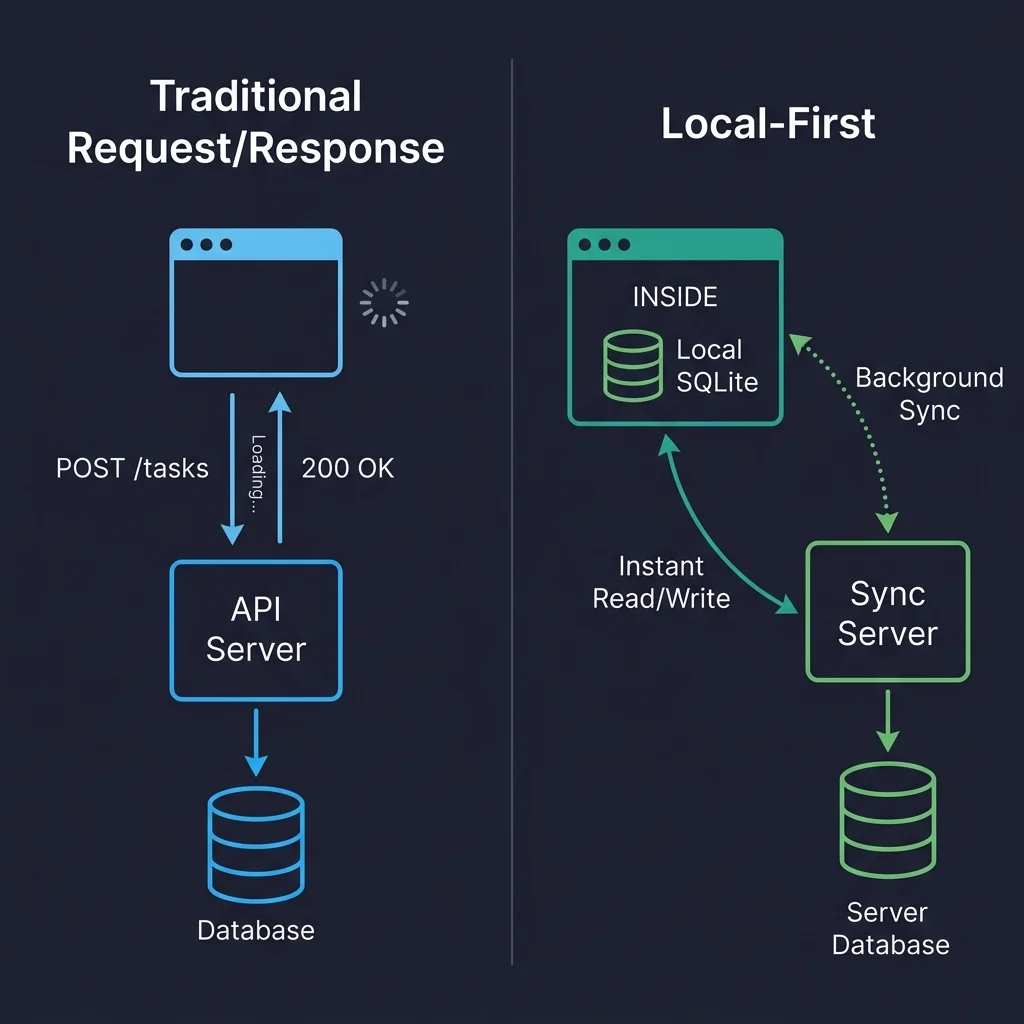
The landscape of web development has undergone a fundamental shift as of mid-2026, moving away from the traditional request-response model toward a data architecture known as local-first. This paradigm, which prioritizes the client device as the primary source of truth rather than a centralized server, has transitioned from a niche academic pursuit into a mainstream engineering requirement for high-performance collaborative applications. Unlike previous iterations of "offline-first" development, local-first architecture in 2026 leverages mature tooling, including WebAssembly-based databases and sophisticated conflict-resolution algorithms, to provide users with instantaneous interaction regardless of network stability.
The Evolution of Data Architecture: 2019 to 2026
The conceptual foundation for local-first software was solidified in 2019 with the publication of the "Local-First Software" research paper by the Ink & Switch industrial research lab. The paper identified seven key ideals for software: fast performance, multi-device synchronization, offline capability, collaboration, longevity, privacy, and user ownership. At the time, the engineering community largely viewed these goals as aspirational due to the immaturity of browser-based storage and the complexity of distributed systems.
Between 2021 and 2024, the development of the Origin Private File System (OPFS) and the stabilization of SQLite compiled to WebAssembly (WASM) provided the necessary infrastructure for browsers to handle complex relational data at high speeds. By 2026, the "spectrum of local-first" has become a recognized implementation strategy, where developers apply local-first patterns to specific high-interaction features—such as document editors or project management boards—while maintaining traditional REST or GraphQL APIs for server-generated content like analytics and global search.
Technical Fundamentals: Replicas over Requests
In a traditional web architecture, the client acts as a "thin view" that must request permission from a server to read or modify data. This dependency introduces latency, often measured in hundreds of milliseconds, and results in "loading spinners" whenever the network is congested.
Local-first architecture replaces this model with a distributed systems approach. Every client device maintains a local replica of the database. When a user performs an action, such as creating a task or editing a document, the application writes directly to the local database. This operation typically completes in under 10 milliseconds, providing a perceived "instant" user interface. A background synchronization engine then handles the propagation of these changes to other peers or a central server.
The Role of SQLite and WASM
The primary engine for local-first web apps in 2026 is SQLite running in the browser via WASM. This allows developers to use standard SQL queries, transactions, and indexes directly on the client.
Data persistence has moved beyond the limitations of localStorage (which is synchronous and limited to 10MB) and IndexedDB (which has a cumbersome API). Instead, the Origin Private File System (OPFS) provides a sandboxed file system that allows WASM-based databases to perform high-speed, synchronous I/O operations within Web Workers. Engineering benchmarks in 2026 show that a local SQLite database can handle thousands of records with query times consistently below 5 milliseconds, even on mid-range mobile devices.
The Sync Engine Landscape
The most significant engineering hurdle in local-first development remains the synchronization of data across multiple devices while resolving conflicting edits. By 2026, the market has bifurcated into several dominant approaches:
Conflict-Free Replicated Data Types (CRDTs)
Libraries such as Yjs and Automerge have become the industry standard for real-time collaborative text editing. CRDTs use mathematical proofs to ensure that concurrent edits can always be merged without conflicts. If two users edit the same paragraph simultaneously, the CRDT logic ensures their characters are interleaved correctly across all replicas without requiring a central coordinator.
Database Replication Engines
For structured application data, such as task lists or inventory systems, database replication engines like PowerSync and ElectricSQL have gained significant traction. These tools manage the plumbing between a server-side Postgres database and a client-side SQLite database. PowerSync, for instance, utilizes a one-way replication path for data fetching and a defined mutation path for writes, allowing teams to integrate local-first capabilities into existing Postgres-backed infrastructures.
Full-Stack Integrated Databases
Newer entries like Triplit offer a unified database experience where the distinction between client and server databases is abstracted away. These systems provide a single API that handles both local storage and global synchronization, though they often require developers to adopt a proprietary stack.
Conflict Resolution and Semantic Consistency
While structural conflicts (e.g., two users editing the same database row) are handled by synchronization engines, semantic conflicts remain a complex challenge for developers. A semantic conflict occurs when two changes are structurally valid but logically incompatible, such as two users booking the same meeting room at the same time while offline.
Industry best practices in 2026 have moved toward a "validate and flag" model. In this scenario, the server accepts all structural merges to prevent data divergence between the client and the server. However, a server-side validation layer checks for domain-invariant violations. If a conflict is detected, the server syncs a "violation record" back to the clients. The application then prompts the user to resolve the conflict manually, such as by choosing a different meeting time. This approach avoids the "ghost record" problem, where a client believes a write was successful while the server has rejected it.
Operational Realities: Security, Migrations, and Performance
The transition to local-first architecture introduces new operational requirements that differ from traditional cloud-native development.
Authorization at the Sync Boundary
In a local-first world, the client is no longer a trust boundary. Developers cannot sync the entire database to a user’s device and rely on front-end code to hide unauthorized data. Instead, authorization must be enforced at the sync layer. Modern sync engines utilize "sync rules" or "shapes" to define exactly which rows and columns a specific user is authorized to replicate to their local device.

Schema Migrations
One of the most significant challenges identified by engineering teams is managing schema migrations across thousands of independent client databases. Unlike a server-side migration where the developer controls the environment, a client-side migration must be executed the next time a user opens their app. This requires additive schema design—adding new columns with defaults rather than renaming or dropping existing ones—to ensure compatibility with older versions of the application that may still be syncing data.
The Complexity Budget and Performance Costs
While local-first architecture eliminates network latency for most operations, it introduces a "bundle size tax." Compiling SQLite to WASM adds approximately 400KB (gzipped) to an application’s initial JavaScript bundle. Furthermore, initial synchronization of a large dataset can take several seconds on a slow connection. To mitigate this, 2026-era applications frequently use partial synchronization, only downloading data relevant to the user’s current workspace, and utilize lazy-loading for the database modules to ensure the initial page render is not delayed.
Market Impact and Future Outlook
The adoption of local-first patterns is driven by both user experience demands and the rising importance of data privacy. By keeping the primary copy of data on the user’s device, companies can offer end-to-end encryption (E2EE) more easily, as the server acts only as a relay for encrypted blobs it cannot read. This has become a significant competitive advantage for productivity and healthcare applications.
However, industry analysts warn that local-first is not a "silver bullet." For systems requiring strong transactional consistency—such as high-frequency trading, banking, or inventory management for limited-stock items—the eventual consistency model of local-first sync is often inappropriate.
Looking toward 2027 and beyond, the emergence of PGlite (Postgres compiled to WASM) suggests a future where the SQL dialect used on the client and server is identical, further reducing the friction of local-first development. Additionally, the integration of local AI models with local-first data stores promises a new class of "private-by-design" intelligent agents that can process a user’s entire history without sensitive data ever leaving the device.
The engineering consensus in 2026 is clear: while the architectural complexity of local-first is higher than traditional models, the resulting improvements in reliability, speed, and user satisfaction make it the preferred choice for the next generation of collaborative web software. Developers are encouraged to evaluate their "complexity budget" and consider a feature-by-feature adoption of local-first patterns to stay competitive in an increasingly "instant-access" digital economy.

