
The rapid proliferation of generative artificial intelligence across the global technology sector has created a significant disconnect between corporate strategy and user requirements. While major software vendors and enterprise leaders have pivoted toward an "AI-first" philosophy, emerging data and user experience (UX) research suggest that the general consumer and professional workforce are experiencing a profound fatigue. The assumption that users crave a constant influx of new AI features has met the reality of low adoption rates, high delivery costs, and a growing skepticism regarding the actual utility of these tools. Industry analysts observe that many AI features are being treated as "bolt-on" additions rather than fundamental improvements to existing workflows, leading to fragmented digital environments that increase rather than decrease cognitive load.
The Emerging Disconnect in Value Proposition
The current landscape of software development is dominated by the integration of large language models (LLMs) and generative agents into almost every conceivable interface. However, a fundamental tenet of business strategy—the value proposition—is frequently being overlooked in the rush to market. Research from the Nielsen Norman Group emphasizes that "Powered by AI" is not, in itself, a value proposition. For a feature to provide value, it must solve a specific problem more efficiently, reliably, or cheaply than existing methods.
In many organizational settings, AI is currently functioning as a spotlight on existing inefficiencies. Rather than resolving years of accumulated technical debt, poor data quality, or broken internal cultures, AI often amplifies these shortcomings. When an AI tool is layered on top of inconsistent data, the resulting output is often a "hallucination" or a conflicting priority that the user must then manually verify and correct. This creates a paradox where the "automated" solution requires more human oversight than the manual process it was intended to replace.
Chronology of the AI Integration Wave: From Hype to Fatigue
To understand the current state of AI resistance, it is necessary to examine the timeline of its implementation.
- Late 2022 – Early 2023: The Breakthrough Phase. The public release of ChatGPT and subsequent generative models sparked a gold rush. Companies felt immense pressure from stakeholders and boards to demonstrate an "AI strategy," leading to the rapid deployment of chatbots and summary tools.
- Mid-2023: The Integration Phase. Major platforms (such as Microsoft 365, Google Workspace, and Adobe Creative Cloud) began embedding AI directly into their core products. The narrative centered on "unprecedented productivity gains."
- Early 2024: The Implementation Gap. Organizations began to notice that while AI tools were available, active usage remained concentrated among a small percentage of "power users." General employees reported feeling overwhelmed by the number of new interfaces they were expected to master.
- Late 2024 – Present: The Critical Re-evaluation. Current market sentiment has shifted toward scrutinizing the return on investment (ROI). High operational costs for running LLMs, combined with user reports of "AI slop"—low-quality, AI-generated content—have led to a more cautious approach.
Supporting Data: The Productivity Paradox
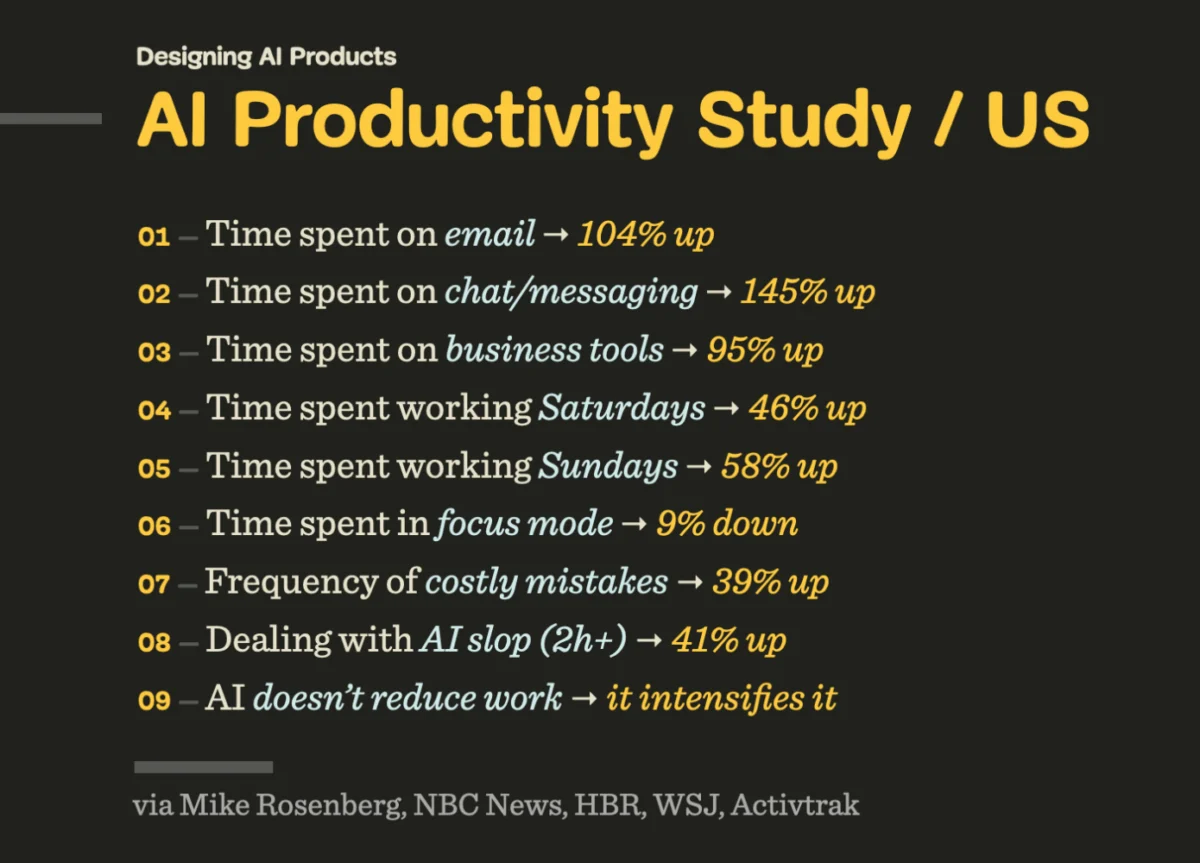
Contrary to the promise of reduced workloads, recent studies indicate that AI integration may be intensifying the professional environment. Data compiled from sources including NBC News, Harvard Business Review, and the Wall Street Journal highlight a troubling trend in digital productivity. According to recent findings:

- Communication Overhead: Time spent on email has increased by 104%, while chat and messaging activity has risen by 145%.
- System Fragmentation: The use of business tools has increased by 95% as users hop between traditional software and new AI interfaces.
- The "Always-On" Culture: Work on Saturdays and Sundays has increased by 46% and 58%, respectively, suggesting that AI is not shortening the workweek but extending it.
- Quality Control Issues: Costly mistakes attributed to over-reliance on AI have risen by 39%, and the time spent "cleaning up" AI-generated content (often referred to as AI slop) has increased by 41%.
These statistics suggest that AI, in its current implementation, often acts as a catalyst for "busy work." The time saved in the initial generation of a draft is frequently lost in the subsequent phases of fact-checking, tone adjustment, and system navigation.
The Psychological Impact and Professional Anxiety
The resistance to AI is not merely a technical or functional issue; it is deeply rooted in human psychology and the fear of obsolescence. Many employees view AI not as a helpful assistant, but as an uninvited intruder that threatens their livelihood. This anxiety is supported by data from the Brookings Institution and the Washington Post, which indicates varying levels of job exposure to automation.
Software developers and public relations specialists are among the most "exposed" to AI automation, as their roles involve high volumes of digital content creation and logic-based tasks. Conversely, roles requiring physical presence and manual dexterity, such as firefighters or healthcare providers, remain relatively insulated. This disparity creates a culture of "vibe-coded" change, where employees feel their unique contributions—taste, intuition, and personal point of view—are being devalued in favor of algorithmic efficiency.

Furthermore, the "black box" nature of AI creates a lack of predictability. Users generally prefer tools that are reliable and consistent. When a software feature works flawlessly in one instance but fails or hallucinates in another, it loses the user’s trust. In the professional world, where a single error can have significant financial or reputational consequences, the unreliability of AI becomes a major liability.
Shifting Toward an "AI-Second" Design Philosophy
The failure of "AI-first" initiatives has led UX experts and product designers to advocate for an "AI-second" approach. This philosophy prioritizes the user’s existing mental models and workflows over the capabilities of the technology itself.
An "AI-second" tool is characterized by its subtlety. Instead of forcing the user into a chat interface (the "magical box" that requires constant prompting), the AI operates in the background. It identifies mundane, repetitive, and low-value tasks—such as data entry, file organization, or scheduling—and automates them without disrupting the user’s focus.

The goal of this approach is augmentation rather than replacement. By automating the "boring" parts of a job, the technology frees up the user to engage in high-value, creative, and rewarding work. This aligns with the human desire for achievement and the "flow state," which is often interrupted by the need to manage a swarm of disconnected AI agents.
Industry Responses and Expert Perspectives
The shift in user sentiment has prompted reactions from various stakeholders in the tech ecosystem. Vitaly Friedman, a prominent UX design expert and founder of Smashing Magazine, argues that the industry must move away from the assumption that people want "more AI." He suggests that the focus should be on making tools that are fast, accessible, and predictable.
Corporate leaders are also beginning to voice similar sentiments. Bo Young Lee, a noted executive, recently highlighted the human element of this transition, stating that while AI can handle physical and mental labor, it cannot replace the emotional connection found in human-created art, literature, and therapy. The consensus among these thought leaders is that the most successful AI implementations will be those that "give back time" to humans to spend with other humans, rather than forcing them to spend more time interacting with machines.

Broader Implications and the Future of Digital Work
The current "AI adoption gap" serves as a critical lesson for the future of technology. It demonstrates that technological capability does not automatically equate to user demand. For AI to reach its full potential, it must undergo a transition from a "spectacle" to a "utility."
In the coming years, we can expect a consolidation of AI features. The "bolt-on" chatbots that currently clutter interfaces will likely be replaced by ambient intelligence that is deeply integrated into the operating system or the core functionality of the software. The focus will likely shift from "generative" AI (which creates new content) to "interpretive" and "assistive" AI (which helps navigate existing complexity).
The ultimate success of artificial intelligence will not be measured by how many people use a "chat" feature, but by how invisible the technology becomes. When AI works well, it should disappear into the background, allowing the human user to remain the protagonist of their own professional and personal lives. The companies that recognize this—favoring reliability and human-centric design over hype—are the ones most likely to bridge the adoption gap and define the next era of the digital age.

