
The evolution of modern web development has reached a juncture where the boundary between traditional user interfaces and immersive gaming experiences is increasingly blurred. As digital agencies strive to capture user attention in a crowded attention economy, the demand for "tactile" web experiences—interfaces that respond with the weight, elasticity, and personality of physical objects—has surged. Traditionally, developers have met this demand by integrating complex physics engines such as Matter.js or Cannon.js, or by leveraging the high-performance rendering capabilities of WebGL. However, a new architectural philosophy championed by Alexey Kopytin and the team at Isadora Agency suggests that for projects where art direction is paramount, the unpredictability of physics simulations can often hinder rather than help the creative vision.
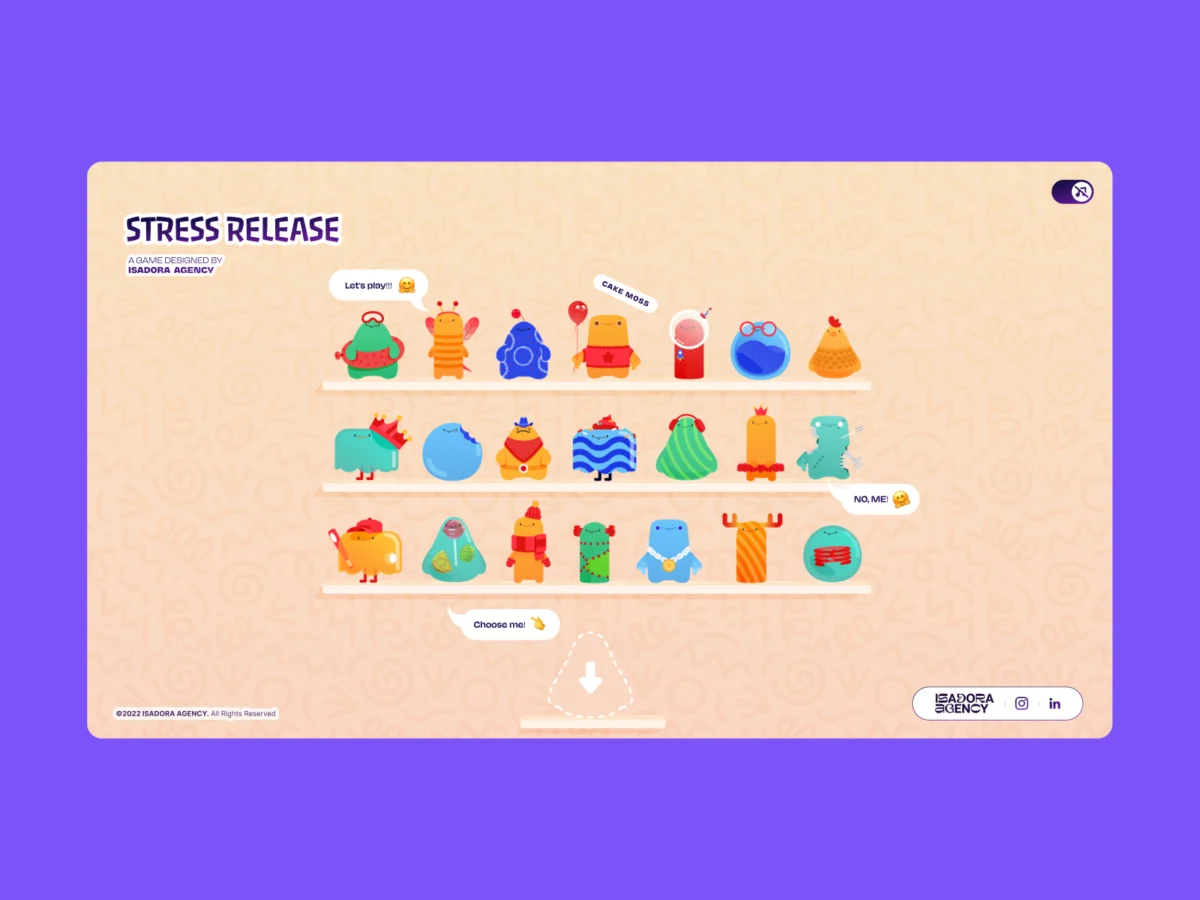
When Isadora Agency embarked on the development of "Stress Release," a digital stress-relief squeeze toy game, they faced a fundamental architectural dilemma. The project required a high degree of interactivity, allowing users to smash, stretch, and distort a cast of animated characters. While the industry instinct was to reach for a physics engine to handle these deformations, the team discovered that "plausible motion"—the hallmark of algorithmic physics—was insufficient for the "intentional motion" crafted by their animators. This realization led to the development of a bespoke system built entirely on programmatic Lottie state controls, DOM manipulation, and distance-based mathematics, bypassing the need for a single line of WebGL or heavy physics libraries.
The Shift from Simulation to Deterministic Control
In the realm of front-end engineering, physics engines are celebrated for their ability to create emergent behavior. By defining the mass, friction, and restitution of an object, a developer can let the engine calculate how that object should react to a collision. This is ideal for simulations where the outcome does not need to be frame-perfect. However, for "Stress Release," the characters were not merely shapes; they were personalities. Each "mega squeeze" or "squish" was a choreographed sequence of 181 frames, meticulously timed to provide a specific emotional response.
The core requirement of the project was absolute deterministic control. If a user clicked the center of a character, the response needed to be a specific, high-intensity animation that honored the animator’s original keyframes. A physics engine, by nature, approximates motion based on real-time calculations, which can lead to "floaty" or "glitchy" interactions if the browser’s main thread is under heavy load. By choosing a programmatic state-control model using the Lottie native API, the developers ensured that the interaction layer acted as a flawless trigger for the animation layer, maintaining the integrity of the art direction across all devices.
Chronology of Development: From Physics Prototyping to Lottie Integration
The development of "Stress Release" followed a rigorous timeline that mirrored the evolving needs of the project’s UX requirements.

- Conceptualization and Art Direction: The creative team at Isadora Agency designed 21 unique characters, each with distinct visual identities and "personalities." The goal was to create a digital version of a foam stress ball that felt satisfying to manipulate.
- Initial Physics Prototyping: The technical team initially explored Matter.js to handle hit detection and object deformation. While functional, the "squish" felt generic. The physics engine treated every character like a generic rubber body, ignoring the specific, expressive distortions the animators had envisioned.
- The Pivot to Lottie: Recognizing that the animators had already solved the problem of "how it should look" through After Effects, the team transitioned to Lottie. Lottie, an open-source animation file format developed by Airbnb, allows developers to export After Effects animations as JSON files and render them natively on the web as SVGs or Canvas elements.
- Implementing Radial Input Mapping: To bridge the gap between a static animation and a tactile game, the team developed a mathematical model to handle user input. Instead of complex collision boxes, they used the Pythagorean theorem to calculate the distance between the click coordinate and the character’s center.
- Optimization for Mobile: The final phase involved scaling the experience for mobile browsers, where the overhead of playing 21 simultaneous Lottie animations threatened performance. This led to a tiered quality system where background animations were throttled to 50% quality and lower speeds, while the active character received 100% resources.
Technical Deep Dive: The Mathematics of the "Squish"
The tactile sensation of the game is driven by a concentric zone system, similar to a dartboard. When a user clicks, the system converts the page coordinates into the character’s local coordinate space. By calculating the straight-line distance from the center (using Math.hypot(a, b)), the engine determines the "score" and the "intensity" of the reaction.
This distance-based math serves as a proxy for a physics engine’s collision detection. If the distance is less than 10 pixels, it is a "bullseye," triggering a high-score event and a specific "heavy" reaction animation. As the distance increases, the points decrease and the animations shift to "light" or "medium" reactions. Crucially, the explosion Lottie animation—the visual feedback of the impact—is repositioned to the exact (X, Y) coordinates of the click. This spatial accuracy is what creates the "I hit that" sensation, convincing the user’s brain that they are physically interacting with the vector graphic.
Managing State and Performance in the DOM
Unlike a canvas-based game where everything is rendered in a single black box, "Stress Release" utilizes the standard Document Object Model (DOM). This choice offered significant advantages for responsive design. By using CSS custom properties (variables), the agency was able to recalculate the app’s height and width on every resize event, ensuring the Lottie SVGs scaled naturally without losing their current animation state.

However, the cost of this fidelity is file size. Lottie JSON files, while more efficient than traditional video or GIF formats, can become heavy when 21 different characters are involved. To maintain a fluid 60 frames per second (FPS), the team implemented aggressive optimization:
- The Shelf Screen: For the character selection screen, where all characters are visible, animations were set to 50% quality (
lottie.setQuality(0.5)) and slowed to 60% speed to reduce the number of interpolation calculations per second. - The Play Screen: Once a character is selected, the engine focuses all resources on a single animation at 100% quality, ensuring the "intentional motion" is rendered with crisp, vector precision.
Analysis of Implications for the Digital Industry
The architectural choices made by Isadora Agency signal a broader shift in how high-end digital experiences are constructed. For years, the industry has pushed toward "emergent" systems where code dictates behavior. This project suggests that for luxury brands, creative agencies, and art-driven games, "deterministic" systems may be superior.
By mapping Lottie’s native timeline capabilities directly to DOM events, developers can bypass the "uncanny valley" of web physics—where things look almost right but feel slightly off. This method allows for a tighter collaboration between designers and developers. Designers can work in familiar tools like After Effects, knowing that their exact easing curves and frame sequences will be preserved, while developers can focus on the logic of state management and interaction math.

Furthermore, this approach has significant implications for accessibility and cross-platform compatibility. Because the interaction relies on standard DOM events and CSS, it is inherently more compatible with screen readers and mobile touch interfaces than a closed WebGL environment.
Industry Response and Future Outlook
Industry reactions to this "no-physics" approach have been largely positive, particularly among UX engineers who have struggled with the performance overhead of libraries like Three.js in mobile environments. "The goal of UX is often to reduce friction," says one independent front-end consultant. "By using math instead of a simulation, Isadora Agency reduced the technical friction of the site while increasing the emotional friction—the ‘bounciness’—of the interface."
As web browsers continue to improve their handling of SVG rendering and JSON parsing, the use of Lottie as a primary interaction engine is expected to grow. The "Stress Release" project serves as a case study in why the most advanced technology is not always the best tool for the job. Instead, the "right" technology is the one that serves the art direction and the user’s emotional experience.

In conclusion, the success of "Stress Release" demonstrates that tactile, satisfying, and responsive web interfaces do not require the complexity of real-world physics simulation. Through the clever application of basic geometry and the programmatic control of frame-based animations, developers can create digital worlds that feel as "squishy" and "destructive" as their physical counterparts, all while maintaining the absolute precision required by high-level design. For the next generation of web experiences, the mantra may well be: let the physics be plausible, but let the motion be intentional.

